
One of the major challenges in integrating women into the ranks of the Armed Forces of Ukraine (AFU) has been ensuring servicewomen are properly equipped with uniforms, footwear and personal protective equipment. During the first two years of the full-scale invasion, this problem became considerably more acute. Over this period, the number of servicewomen in the AFU rose sharply — up 40% on 2021 levels, reaching around 43,000 by autumn 2023. By September 2025, this figure had climbed to 54,000. Meanwhile, 8,156 women serve in the State Border Guard Service of Ukraine, 6,656 in the National Guard of Ukraine, and 922 in the State Special Transport Service.
For more detail on how well servicewomen are supplied with other items — such as summer field uniforms, helmets, winter jackets and trousers, footwear, underwear, thermal underwear and hygiene products — see the full analytical report.
Historically, the system for supplying combat kit to Ukraine’s Defence Forces has been geared predominantly towards men. As a result, most items of clothing and personal equipment — and, by extension, their technical specifications — were designed around men’s needs. The separate uniform for women previously approved by the Ministry of Defence and other agencies was intended solely for everyday and ceremonial, non-combat duties.
It was not until 2016 that the AFU expanded the list of military specialisms open to women, allowing them to serve in such roles as rifleman, sniper, machine gunner, grenade launcher operator and others. In 2018, the Verkhovna Rada passed a law granting women the right to hold any position in any military formation on an equal footing with men. In 2018, the Verkhovna Rada passed a law granting women the right to hold any position in any military formation on an equal footing with men.
Right up until the end of 2023, both women and men in the Defence Forces were issued the same standard-issue combat kit, which had been designed for men and did not take into account the anatomical features of the female body. Despite the wide size range specified in the uniform specifications, women were forced to buy clothing at their own expense, turn to volunteers, or have their issued kit altered to fit. As of November 2025, servicewomen are still being issued male-pattern items — including body armour, winter field uniforms and thermal underwear — which affects their effectiveness in the field, both physically and psychologically.
That said, significant steps were taken in 2023–2025 to address these imbalances — both under the Action Plan for implementing the National Strategy for Creating a Barrier-Free Environment in Ukraine through to 2030, and with support from civil society, notably the ArmWomenNow initiative run by the NGO Smiliva Ukraina (“Brave Ukraine”). The Ministry of Defence developed technical specifications (TS) and launched centralised procurement of women’s summer field uniforms and women’s underwear, and certified the first samples of body armour adapted to female anatomy. However, by the end of 2025 not a single piece of women’s body armour had actually been procured.
From 2024, the National Guard of Ukraine (NGU), the State Border Guard Service of Ukraine (SBGSU) and the State Special Transport Service (SSTS) also began procuring women’s summer field uniforms compliant with the MoD’s TS. Since the vast majority of servicewomen across the Defence Forces serve in the AFU, StateWatch analysts focused their detailed analysis of provisioning specifically on this branch.
In addition to summer uniforms and underwear, by spring 2025 the Ministry of Defence had approved TS and reference samples for women’s thermal underwear (both mid-season and cold-weather versions), and over the summer it approved specifications and samples for a women’s winter uniform. The AFU’s annual requirement for 2025 called for 52,000 units each of trousers and jackets, plus 52,000 sets of cold-weather thermal underwear and 104,000 sets of mid-season thermal underwear — even though development of the winter uniform was still ongoing as of the end of August. However, as of mid-October none of the above items had actually been procured. By contrast, for 2026 the Logistics Forces Command has planned specific — albeit modest — volumes of centralised supply:
- winter windproof and water-resistant jackets — at least 10,000 units;
- winter windproof and water-resistant trousers — at least 10,000 units;
- modular body armour (configurations 1–5) with the “Zh” (women’s) component — at least 2,000 sets.
This means that, for the first time, the state has included female-pattern body armour in its annual procurement plan.
Among the positive developments worth noting are amendments to Scale of Issue No. 1 under MoD Order No. 2326, which reduce the list of inventory items that personnel are required to return upon transfer to another unit or discharge. Since the end of 2024, personnel have been permitted to keep all issued items of kit — with the exception of body armour, helmets and their covers — when changing unit or leaving service. This has a direct bearing on the consistency of equipment provision across different units.
Despite these positive changes, some servicewomen continue to be issued uniforms and equipment that do not match their anatomical features — not only because of a lack of women’s models, but also due to an imperfect system for collecting sizing data and distributing incoming stock from warehouses. Ill-fitting clothing or personal protective equipment, along with low-quality or excessively heavy body armour, can affect mobility, endurance and health, as well as a sense of inclusion and equality within the military system.
Methodology
This study is based on an analysis of technical specifications and Prozorro procurement records for key elements of the standard-issue combat kit, as well as selected hygiene products, procured by the Ministry of Defence from July to December 2023 and by the State Enterprise State Logistics Operator (DOT) from January 2024 to September 2025. The study does not, however, cover the provision of everyday uniforms or other items of clothing and kit designated for women.
StateWatch analysts examined technical specifications and procurement outcomes, focusing on the volumes of goods procured relative to the requirement set by the AFU Logistics Forces Command, as well as the sizes and delivery timeframes for these items. The figures presented in the tables do not include terminated contracts.
Only procurements for which data is publicly available on Prozorro were analysed. The information is current as of 3 October 2025. Volumes were calculated by summing the contracts and the quantities of goods specified in them that were scheduled for delivery within the calendar year. Where goods were contracted at the end of one year but delivered in the following year, the data were attributed to the following year.
When analysing procurement of unisex items, it is not possible to establish the breakdown of volumes by sizes intended specifically for women, as contracts only specify general sizing data without indicating gender. For this reason, in certain cases the analysts were only able to draw conclusions about the quantities of the smallest sizes and compare these with the number of servicewomen.
It should be noted that information on the quantities and sizes of items procured by the MoD’s Department of State Procurement in 2023 is largely withheld from public disclosure. Consequently, where such data is missing for individual item descriptions, this analysis is not provided.
To examine experiences of using the combat kit, a survey of 97 AFU servicewomen was conducted together with the ArmWomenNow initiative (89% of respondents have combat experience, and 50% serve in the Ground Forces). In addition, six in-depth interviews were carried out with serving women from various branches of the AFU. Although the sample was drawn on a convenience basis and is not statistically representative, the qualitative approach — combining semi-structured in-depth interviews with open-ended questionnaires — made it possible to achieve data saturation.
Modular and Lightweight Body Armour with the “Zh” (Women’s) Element
Of all the items in the combat kit, body armour is the most critical element of protection, while also being the heaviest and most expensive to procure. These factors give rise to systemic shortcomings in supplying women with unisex models. At the same time, women’s models have not been supplied to date.
As early as the beginning of 2024, the Ministry of Defence approved two models of modular body armour for servicewomen in the 1–5 configuration, developed in accordance with the 2023 TS (the Korsar M3mp-6W and Kharakternytsia models). The Ministry is currently working on approving a reference sample for a lightweight model.
There is no separate TS for women’s body armour; however, the current specifications for the modular and lightweight models include an additional component coded “Zh”, comprising damping — that is, cushioning — inserts on the inner walls of the chest plate pocket, or other solutions that adapt the body armour to female anatomy.
The first approved sample featuring the “Zh” component is the Kharakternytsia model, developed by Ukrainska Bronia LLC. It features an outward-curved armour plate, narrowed shoulder straps and a flared lower section, designed to accommodate women’s anatomical features.
The second sample, developed by Research and Production Enterprise Temp 3000 LLC, is fitted with damping pads that allow the body armour to be individually adjusted to fit the female body. The set includes three pads of different sizes, as well as an additional protective pouch containing a soft ballistic insert for groin protection.
According to the technical specification, the size range for modular body armour runs from S to XL. The total weight of body armour in the basic 1–5 configuration (the most common) is 10.5 kg for size S, 12 kg for M, 13.5 kg for L and 15.5 kg for XL. Lightweight models, procurement of which began in 2025, weigh between 7.5 and 12 kg depending on size. Under the specifications, women’s samples have the same ballistic performance as men’s body armour.
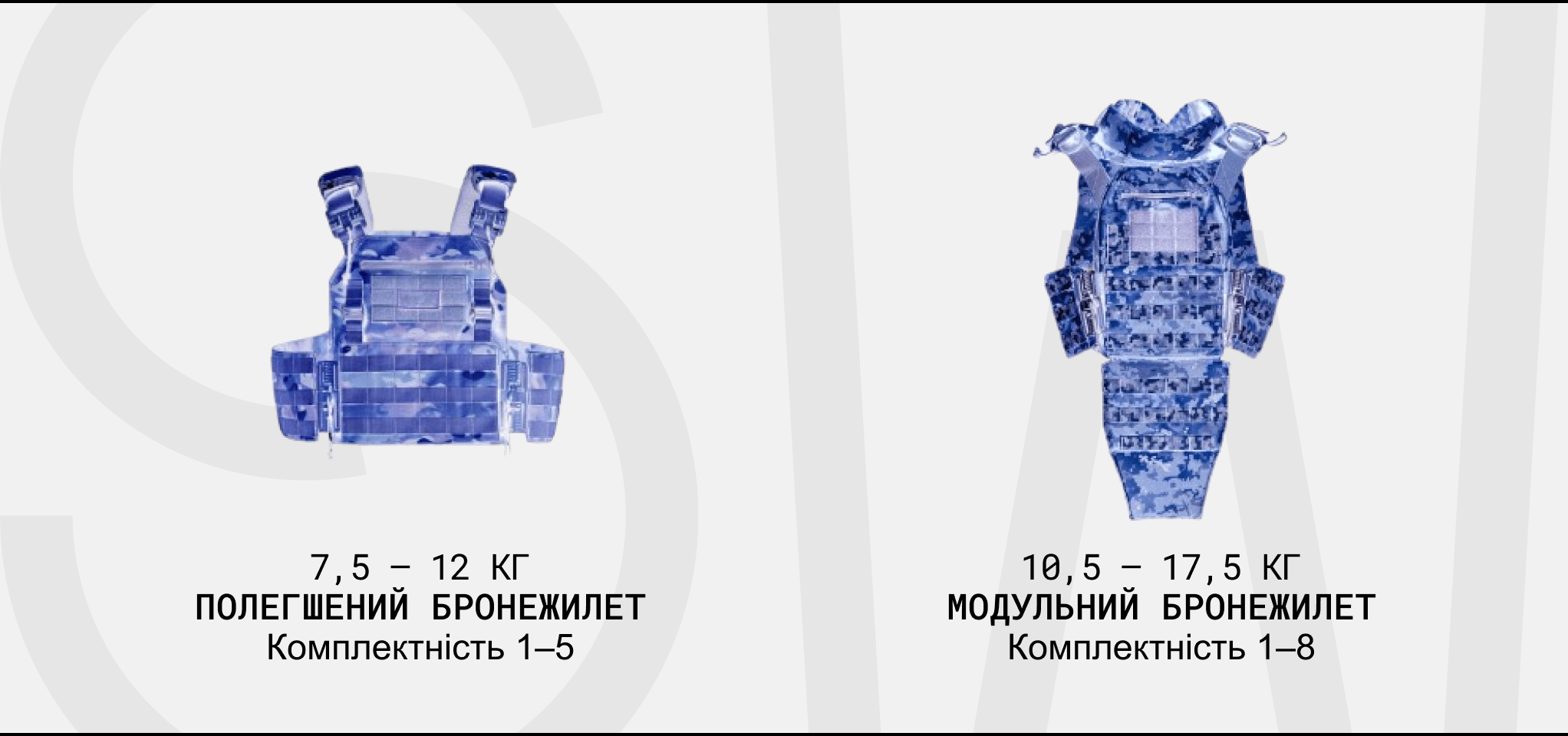
Among the most significant shortcomings of modular body armour identified by service personnel during interviews and the survey was excessive weight, which causes health problems, including excessive pressure on the chest.
"We're issued standard-issue armour... the best the Armed Forces have — it's modern, good quality, but very heavy"says a servicewoman from the Air Force
"The body armour can't be properly secured, the fasteners are poor... it constantly slips to one side and causes pain in the shoulder blade. It presses on the chest"quote from an anonymous survey response
Although by the beginning of 2024 the Ministry of Defence had already certified two reference samples of body armour incorporating design features for women, neither was procured centrally in either 2024 or 2025. The Logistics Forces Command attributed the exclusion of women’s body armour from the Requirement to a lack of funding. For 2026, however, the Requirement includes at least 2,000 sets of women’s modular body armour in the 1–5 configuration.
At the same time, throughout 2024–2025 the DOT procured identical models for personnel of both sexes. In 2024, the agency procured 140,860 sets of modular body armour (excluding terminated contracts). As shown in the table, 16,845 sets of the smallest size, S, were procured, along with 35,130 of size M. Notably, reflecting the increased requirement for 2025, 194,000 sets had been contracted within just nine months, with sizes S and M accounting for 20,990 and 58,510 respectively.
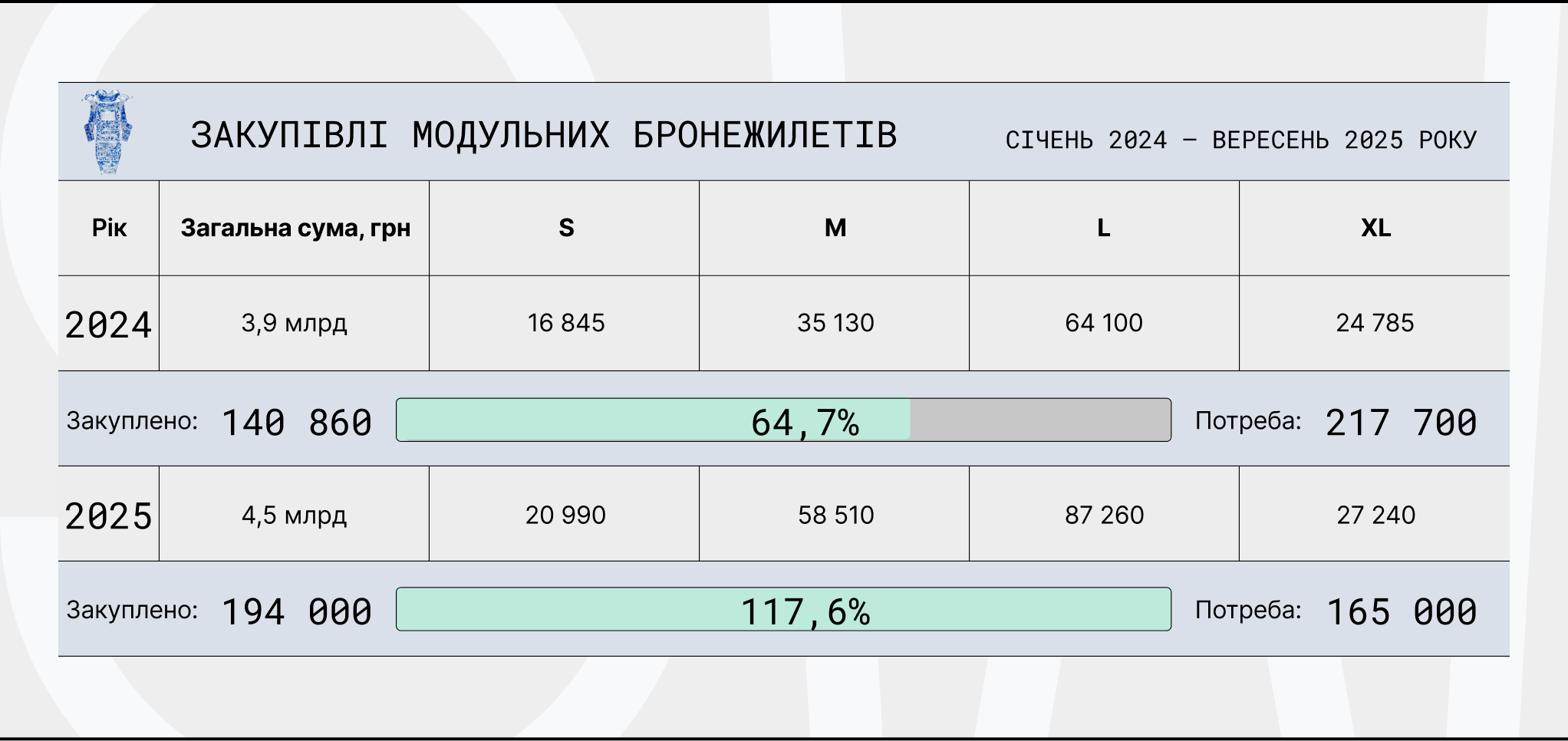
As for lightweight models, 10,000 sets were procured, of which 460 were size S and 1,050 were size M.
The women surveyed described their experience of using the body armour issued by the Ministry as predominantly unsatisfactory. 23% of respondents stated that they had not been issued body armour, while among those who had received a set, 73% did not consider its weight and size acceptable. This indicates that, in recent years, the Logistics Forces Command has not only failed to prioritise the procurement of women’s models, but has also failed to take into account the sizes women need when formulating the Requirement.
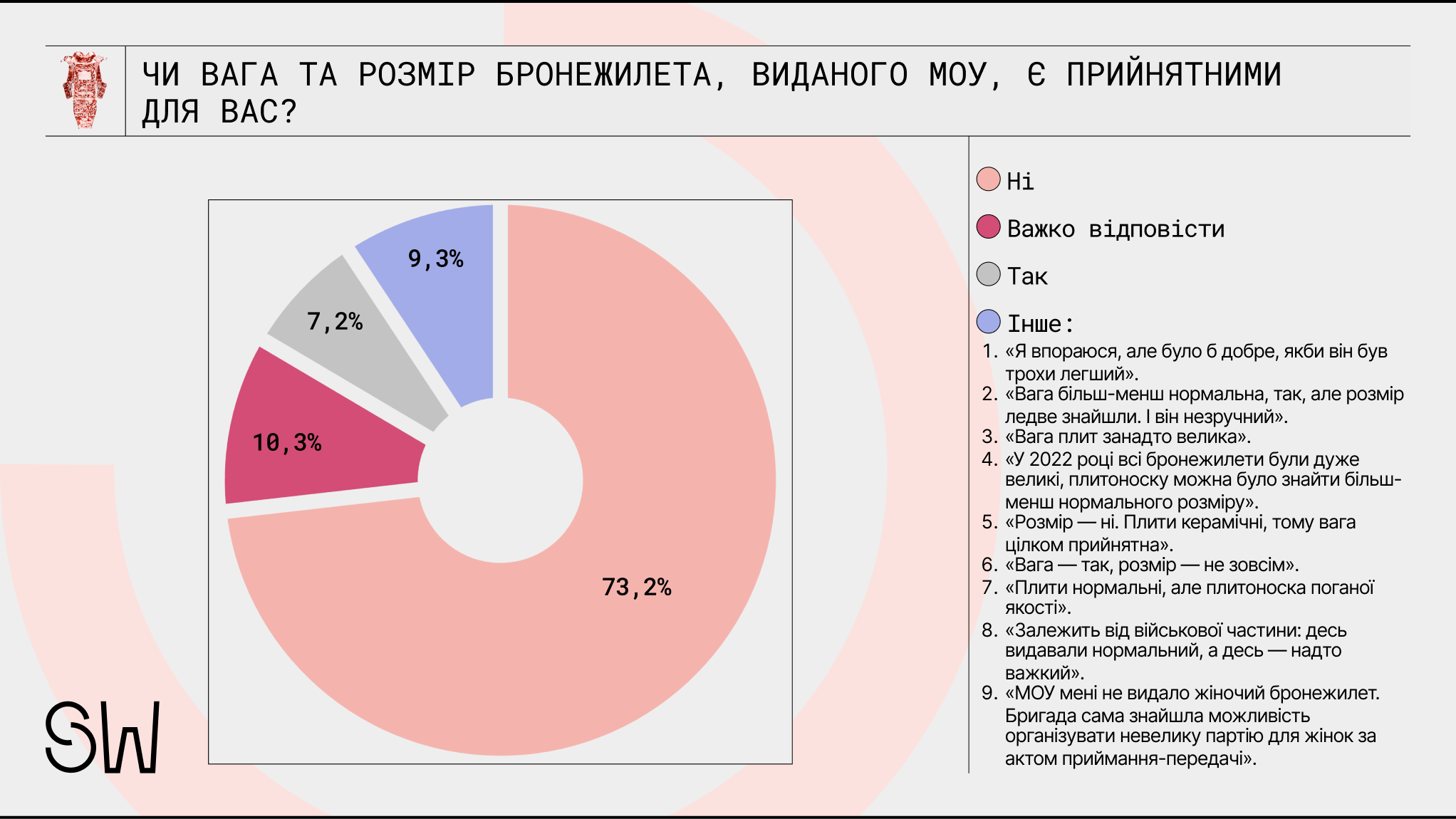
"My back suffered terribly from it (ed.: the body armour)... it weighed 17 kilos, 550 to 600 grams. It pressed really tightly on my chest, and it often hurt. Then I had to deal with a problem and see a mammologist — I had inflammation right through my chest muscles and mammary glands. I just handed that body armour back, and I figure, whatever it costs, I need to buy one that's, firstly, lighter, so there's no strain on the back, and secondly, at least a little bit shaped to fit a woman's body…"a servicewoman from the Ground Forces
Recommendations
To the Ministry of Defence:
- Split the summer field uniform (types 1 and 2) into separate technical specifications (TS) for jackets and trousers, so that requirements and procurement can be formulated taking into account the separate sizing of the two items. Make corresponding amendments to Scale of Issue No. 1 under MoD Order No. 232;
- Expand the size range by adding smaller sizes to the TS for combat kit items such as winter gloves, and larger sizes to the TS for women’s underwear (top and briefs);
- Approve reference samples of lightweight body armour for women;
- Introduce ongoing monitoring of whether service personnel actually receive procured items, through on-site inspections, surveys and similar methods;
- At the legislative level, introduce mechanisms for reimbursing servicewomen for hygiene products and underwear purchased at their own expense, and simplify the reimbursement mechanism for other purchased items of kit;
- Make the provisions of MoD Order No. 232 more specific by adding terms such as “women’s summer field uniform (type 2)”, “women’s winter windproof and water-resistant trousers and jackets (type 3)”, and “women’s mid-season underwear (type 2) and cold-weather underwear (type 2)”. At present, the Order only uses the term “summer field uniform”, which does not cover the women’s model;
- Implement a feedback system for ongoing monitoring of how well the uniform meets the needs of servicewomen.
To the Logistics Forces Command:
- Align the 2026 Requirement with the current number of servicewomen, in particular for the following women’s items: modular body armour, windproof and water-resistant trousers and jackets, and mid-season and winter underwear;
- Digitise the collection of data on the actual sizes of personnel, for further analysis and improvement of the supply system, and introduce systematic updating of this data;
- Systematically record stock balances of items delivered to Joint Logistics Support Centre (JLSC) warehouses, in particular for sizes intended for women;
- Review procurement planning to ensure the timely delivery of season-appropriate items.
This study was prepared by the StateWatch Think Tank in cooperation with the NGO Smiliva Ukraina ("Brave Ukraine"), which runs the ArmWomenNow social initiative, as part of the support programme led by the UK Special Defence Advisor Team (SDA) and implemented by the EDGE Foundation and StateWatch.Disclaimer