One of the most significant challenges in integrating women into the Armed Forces of Ukraine (AFU) has been providing servicewomen with appropriate military uniforms, footwear, and personal protective equipment. Historically, the AFU supply system has been predominantly oriented towards men. Consequently, the majority of military equipment items and their technical specifications were designed for male personnel.
Following Russia’s full-scale invasion, this issue became substantially more pressing as the number of women in the military increased dramatically: by 40% in the first two years of the war. As of January 2024, the AFU comprised 66,900 women, including 47,200 servicewomen. Of these, 6,500 held leadership positions, while over 5,000 were deployed on the front line.
In 2023, one of the key achievements was the introduction of centralised procurement of specialised women’s summer field uniforms and women’s underwear. Furthermore, in November 2024, the MoD announced the commencement of testing new samples of women’s mid-season and winter uniforms, as well as thermal underwear. However, as of September 2024, neither the body armour nor winter uniforms designed for women had been procured through centralised channels.
Following Russia’s full-scale invasion in 2022, both women and men were issued the same Unified Combat Kit (SCK), which was designed for men and did not account for the anatomical features of female physiology. There are also significant shortcomings in the data collection system regarding sizes and uniform distribution. Most servicewomen do not undergo proper measurement before being issued with equipment, and the submitted size data is often disregarded during uniform distribution. Even when female-specific uniform items are fully stocked, women do not always receive items in the appropriate size, indicating issues within the planning and supply logistics systems.
The issue of providing personal hygiene products, particularly in field conditions, requires additional attention. Most necessary items have to be purchased by servicewomen at their own expense or obtained through volunteer organisations.
To analyse the combat kit user experience, 64 surveys and 6 in-depth interviews were conducted with active servicewomen from various branches of the AFU, as well as representatives of NGOs, particularly “Brave Ukraine” which is implementing the social initiative Arm Women Now. The short version provides an analysis of the provision of uniforms, personal protective equipment, footwear, and underwear.
Supply Conditions for Servicewomen
Women’s Summer Field Uniform
The technical specification (TS) of the uniform provides for a design and fit that differ from the male model, and includes key parameters to ensure comfort and functionality, including a wide size range. The specification includes two hip-chest ratio (fullness) groups (2 and 3) and a broad size range: bust circumference from size 40 to 64 (80-128 cm) and hip circumference (88-140 cm).
Additionally, it accounts for servicewomen’s different heights – from 146 cm to 188 cm, allowing for the needs of women with various anthropometric characteristics. From January to October 2024, the State Logistics Operator (DOT) fully met the 2024 requirement for women’s summer field uniforms by procuring 65,000 sets.
In 2023, the MoD delivered 50,000 sets, though their size distribution cannot be analysed due to classified data in Prozorro. The total quantity of summer uniforms procured over two years amounts to 115,000 sets. Since each servicewoman is entitled to two sets with a two-year service life, the procured quantity fully covers the needs of servicewomen (47,200).
Whilst 90.6% of female respondents received summer uniforms (including both women-specific and universal designs procured throughout 2022), nearly two-thirds faced size compatibility issues. This is particularly critical, given that the summer uniform is a fundamental equipment element required for daily service.
“The uniform was obviously designed for men, sizes were inadequate, and I had to either alter it or purchase my own. For instance, I’ve never heard of women’s uniforms being available in our brigade… Combat effectiveness should be the top priority, but our current uniforms offer nothing of the sort”, — reported a respondent currently serving in the Ground Forces.
Winter Uniform (Winter Jackets and Trousers)
The absence of adapted women’s winter uniforms in the AFU remains a significant obstacle to servicewomen’s comfortable and effective performance of their duties. The winter clothing elements currently supplied by the Ministry of Defence have been designed based on male body structure. Specifically, wind and water-resistant jackets and trousers are procured according to universal technical specifications for all personnel, regardless of gender. Moreover, all specifications consider only 1 out of 5 parameter types for determining chest-to-hip ratio differences (third fullness group), which fails to reflect the diversity of female anatomy.
Furthermore, the smallest waist circumference in the technical specifications for windproof and waterproof trousers is 72 cm, indicating certain limitations in the size range for women. The absence of detailed hip circumference parameters has resulted in trousers that may fit well at the waist but are too narrow in the hip area for some women.
The procurement analysis has shown that winter trousers and jackets in smaller sizes are being procured in critically low quantities. Although the DOT managed to contract 100% of the requirement within three quarters, the size distribution indicates ineffective consideration of women’s needs in the military.
For example, only 141 pairs of trousers in the minimum size were procured for personnel of various heights, while sizes 44-46 totalled 7,036 units. The situation with jackets is similarly concerning: only 212 units were purchased in the smallest cut (size 42), compared to 11,340 in sizes 44-46. Notably, only 77 pairs of trousers and 131 jackets were procured for all military personnel shorter than 158 cm, while individuals with smaller measurements were not considered at all.
“They (ed. in 2022) were giving out winter jackets and trousers to everyone. I used to joke that they didn’t give me a jacket, they gave me a coat. It was so large, down to my knees, and if you needed to climb into something bulkier, like armour, you had to hike up all this outerwear…”, — one of the interviewed servicewomen said.
Women’s Top and Briefs
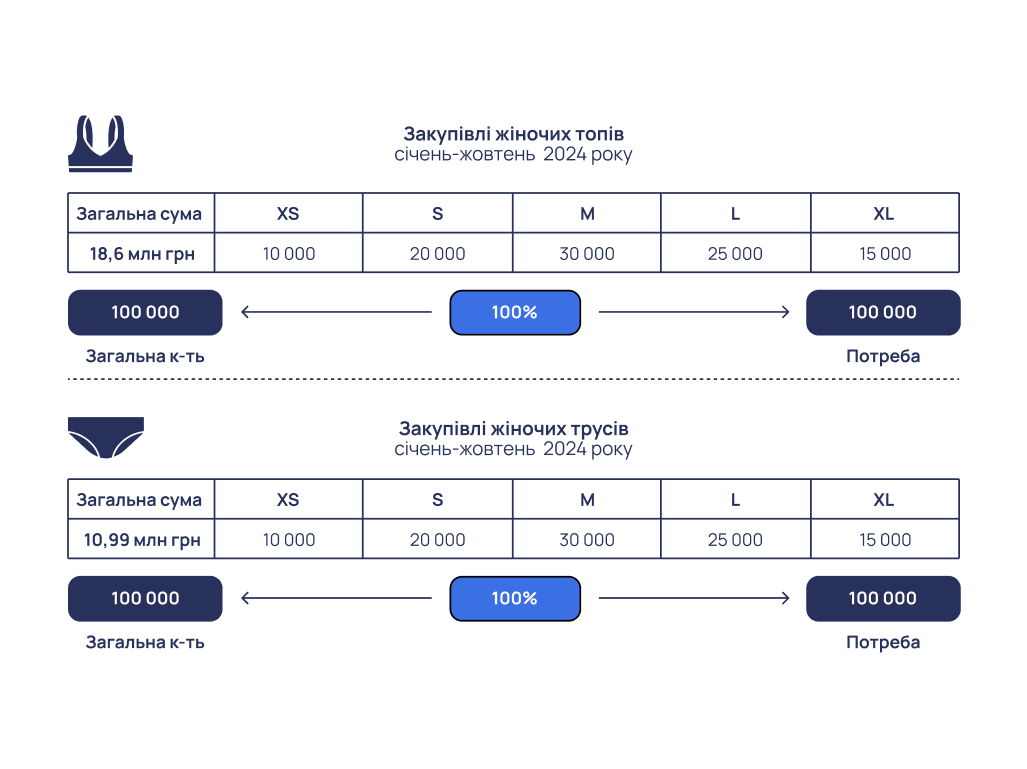
In 2023, women’s underwear (tops and briefs) was approved for provision, with the requirements regulated by the relevant technical specifications from June 2023. Underwear sizes range from XS to XL, with bust circumferences varying from 84 to 104 cm and hip circumferences from 88 to 108 cm. It should be noted that these TS for underwear do not accommodate women with larger hip and chest measurements, which are quite common among Ukrainian women, as evidenced by the size range in the TS for women’s field uniforms.
In 2024, the DOT procured 100,000 units each of women’s tops and briefs, which covers 100% of the MoD requirements for 2024 (the requirement being two sets per year for each servicewoman). In 2023, the procurement of women’s underwear was conducted under defence procurement procedures, therefore information about quantities and sizes remained classified.
However, many servicewomen’s actual measurements often exceed the largest available size XL, of which only 15,000 units were procured. Thus, the size range, which is limited to hip measurements up to 108 cm and bust measurements up to 104 cm, effectively excludes a significant proportion of women from being provided with appropriate underwear.
According to the MoD’s response to an information request from Iryna Nykorak, MP and head of the Arm Women Now initiative, as of 18 October 2024, the distribution level of underwear is approximately 10% of what was procured: 11,484 tops and 10,716 pairs of briefs.
Footwear
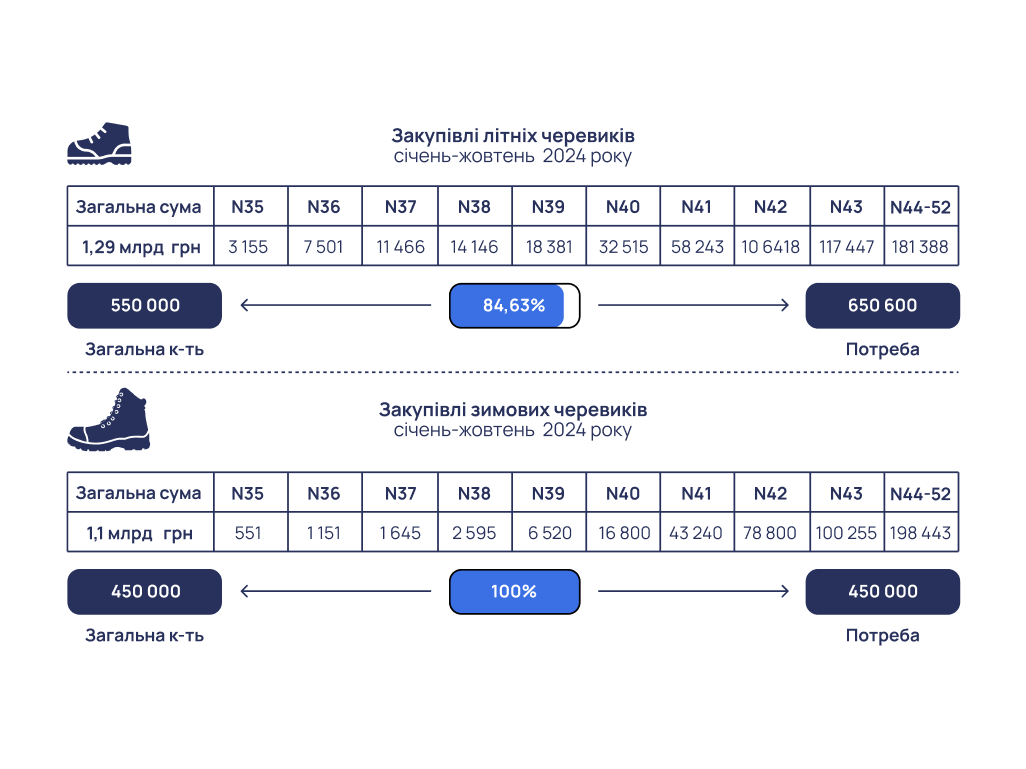
As of late October 2024, the DOT has procured 84.63% of the required summer boots and met 100% of the requirement for winter high-ankle boots – 550,000 and 450,000 pairs respectively. Notably, the final 100,000 pairs of winter boots were only contracted in October. Considering the number of service personnel and the most common women’s sizes (EU 36-40) for winter boots, too few pairs suitable for most female personnel were purchased during the analysis period.
The situation is markedly better with summer boots, where procurement of smaller sizes (EU 35-37) was six times higher than winter boots over the same period. However, by the end of September, just over half of the required summer boots had been purchased (340,000 out of 650,000), suggesting possible procurement planning issues. In 2023, the MoD purchased over 101,800 pairs of summer boots and 25,000 winter boots. While some contracts and the full size range details remain classified, this indicates a clear disparity between summer and winter footwear procurement.
Winter boot procurement for Q4 2024 requires a review to adjust quantities per size, specifically to increase the proportion of smaller boots.
It’s worth noting that while the technical specifications for summer and winter combat boots list size ranges starting at EU 36 and EU 35 respectively, both ending at EU 47/48, in practice both models are being purchased in sizes EU 35 through EU 52. This discrepancy calls for an update to the technical specifications.
Women surveyed by StateWatch also frequently face difficulties in obtaining properly sized footwear. Survey results show that 23.4% of respondents did not receive summer combat boots in their size, whilst 10.9% were not provided with this type of footwear at all. The figures for winter combat boots are even lower: 40.6% and 12.5% respectively.
“Footwear in my size 37 wasn’t available (ed. in 2022), so I had to buy everything myself. They said I could take size 40 and exchange it later… Winter boots were size 39, I exchanged them for 37, and managed to find an exchange through acquaintances…”, — one of the respondents commented.
Body Armour
The first modular body armour sample was developed by “Ukrainian Armour” LLC. It features an outward-curved armour plate, narrowed shoulders, and a widened bottom, considering women’s anatomical features. The second sample, developed by “Research and Production Enterprise ‘Temp 3000’” LLC, is equipped with damping pads that allow individual adjustment of the body armour to the female body. The set includes three pads of different sizes, as well as an additional protective pouch with a soft ballistic package for groin area protection.
The weight of modular body armour starts from 10.5 kg, and lightweight body armour from 7.5 kg, depending on the configuration. Women’s samples have the same ballistic characteristics as men’s body armour, according to specifications.
The procurement of women’s body armour models was not planned in the List by the end of 2024. Thus, DOT procured identical models of modular body armour for service personnel of both sexes, which not only caused discomfort but also reduced the combat effectiveness of servicewomen and increased the risk of injury during combat missions. At the same time, procurement of the lighter model was not included in the 2024 procurement list.
According to the technical specifications, the modular body armour size range varies from S to XL. The total weight of the body armour in the basic configuration 1-5 (most common) is 10.5 kg for size S, 12 kg for size M, 13.5 kg for size L, and 15.5 kg for size XL.
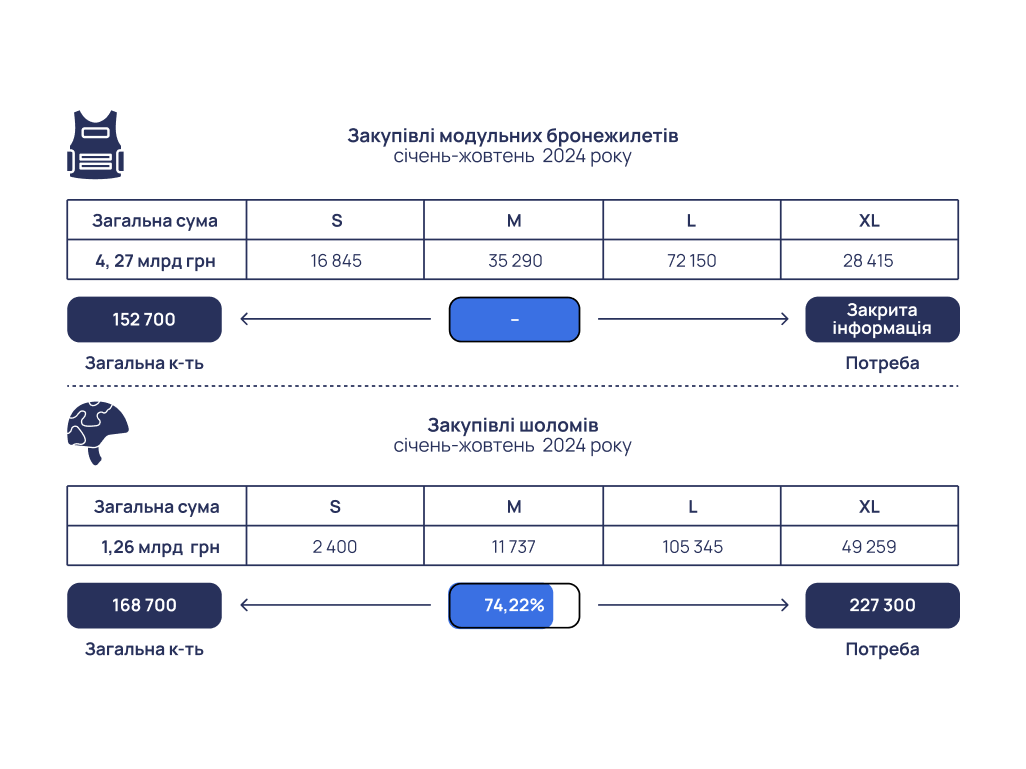
Over the first 10 months of 2024, the DOT awarded 12 contracts for the supply of 152,700 modular body armour units. As shown in the table, 16,845 sets were purchased in the smallest size S, and 35,290 in size M, which is insufficient considering the number of women and male personnel of smaller build in the AFU.
Most data regarding body armour procurement in 2023 remains classified for security reasons, with tender winners listed only as defence suppliers. The only publicly available information concerns contracts for 21,000 body armour units, with no disclosure of the size distribution of the purchased items.
The research revealed critical issues with body armour for women in the Armed Forces, related to size, poor fit, and excessive equipment weight. 70.3% of respondents indicated that their body armour did not match their size, while 6.3% were not provided with armour at all. Furthermore, 56.2% rated the quality of the issued body armour as “low” or “very low”.
The combat helmet is also part of personal protective equipment, issued at a rate of one unit per person every two years. According to technical specifications, the DOT procures two types of ballistic combat helmets: full-cut and high-cut versions. The size range runs from the smallest size S (head circumference 51-53 cm) to XL (head circumference 60-62 cm). Helmet weight varies by model: the full-cut helmet weighs from 1.45 kg in size S to 1.75 kg in size XL, while the high-cut version is lighter, ranging from 1.35 kg (S) to 1.65 kg (XL).
By the end of October 2024, the DOT had contracted for 168,741 helmets. Notably, no size S helmets were procured before August 2024, and by October, only 2,400 units had been contracted in this size. Meanwhile, 11,737 units were purchased in medium size M (head circumference 54-56 cm), with the majority scheduled for delivery in the second half of 2024.
Overall, while this procurement approach demonstrates efforts to supply various categories of service personnel, the absence of smaller helmet sizes in the first half of the year indicates a need for more precise planning.
The 2023 procurement was conducted under classified contracts for security reasons, therefore no analysis of contracted quantities and sizes was undertaken.
The research has revealed significant deficiencies in providing servicewomen with personal protective equipment for head protection. According to the survey, 67.8% of female respondents who received helmets reported size incompatibility. This issue significantly impacts protection effectiveness and may lead to increased risk of injury during combat operations. Half of the servicewomen rated the quality of issued helmets as “low” and “very low”.
Data Collection, Planning, and Logistics in Practice
The proper formation of material support requirements, which takes into account individual service members’ parameters, follows a specific algorithm. Military unit commanders submit their requirements to the Joint Supply Centre (JSC) of the AFU Logistics Forces Command. The Chief of Material Support is responsible for collecting information about sizes and inventory of personal requirements. Their duties also include receiving the necessary items of material support from the JSC warehouse and ensuring their timely distribution to personnel.
However, the research revealed significant discrepancies between the established procedure and actual practice. The vast majority of surveyed female service members (86%) reported that they did not receive body, head, and foot measurements before being issued equipment. A considerable proportion of respondents (40%) either lack information about or cannot recall the size data collection procedure in their military unit. 5% indicated a complete absence of size-related enquiries, whilst the remainder communicated this information through various channels – either directly to staff members or to the unit commander.
Among the barriers to proper material support, respondents cited limited availability of required sizes in warehouses, as well as insufficient motivation from chiefs of material support to provide women with properly sized SCK items.
“They have indeed started collecting sizes, asking us to measure and submit them. But they collect this information every year, and every year we end up with the same situation. They keep collecting and collecting, but nothing ever reaches us,” noted a combat medic from the Territorial Defence Forces.
The research also revealed a disruption in the logical sequence of size information collection. According to one respondent, enquiries about sizes often come only after items have already arrived at the warehouses.
“Here’s how it happens. The person responsible for material supplies calls from the unit: ‘Send over your sizes for head, uniform, boots, and everything else’. So we send them through some messenger, Signal, for example. But this happens not before the deliveries, but after they’ve already arrived”.
Analysis of the collected data indicates significant shortcomings in the logistics support system for female service members. StateWatch suggests there is a communication gap in the chain between military formations, the Joint Supply Centre and AFU Logistics Forces Command. The paper-based data accounting system creates additional opportunities for errors when processing size information.
The research showed that despite female service members providing accurate information about their sizes, they often do not receive appropriate items. It is telling that the majority of respondents did not receive the correct size, even of those items (women’s field uniforms and underwear) which were procured in full quantities. This indicates that the problem extends beyond the simple absence of small sizes in procurement.
Additional evidence of the system’s inefficiency is the practice of trying on items directly at the warehouse before receiving them, without prior collection of size data. StateWatch analysts propose that uniforms may be held up at various stages of the logistics chain: either at Joint Supply Centre warehouses, where chiefs of material support may not collect women’s items, or at military units where they are not issued to female personnel.