What Is the problem with the current policy?
When planning logistics procurement under martial law, the UMOD Logistics Planning Department (UMOD LPD) sets the indicative prices for defence goods based on prices for similar contracts concluded in the previous year. At present, this approach does not take into account fluctuations in the average market price of goods throughout the year and leads to a number of problems. In particular, this practice limits competition in the supplier market and increases the risk that the AFU will not receive the required amount of goods in the expected time frame.
Currently, there is no regulatory act of the Cabinet of Ministers of Ukraine or the Ministry of Defence that defines the methodology for setting and revising the indicative price of goods. Consequently, this approach is inefficient and may result in missed deadlines for meeting the needs of the Armed Forces of Ukraine.
Procurement cancellation due to lack of bids
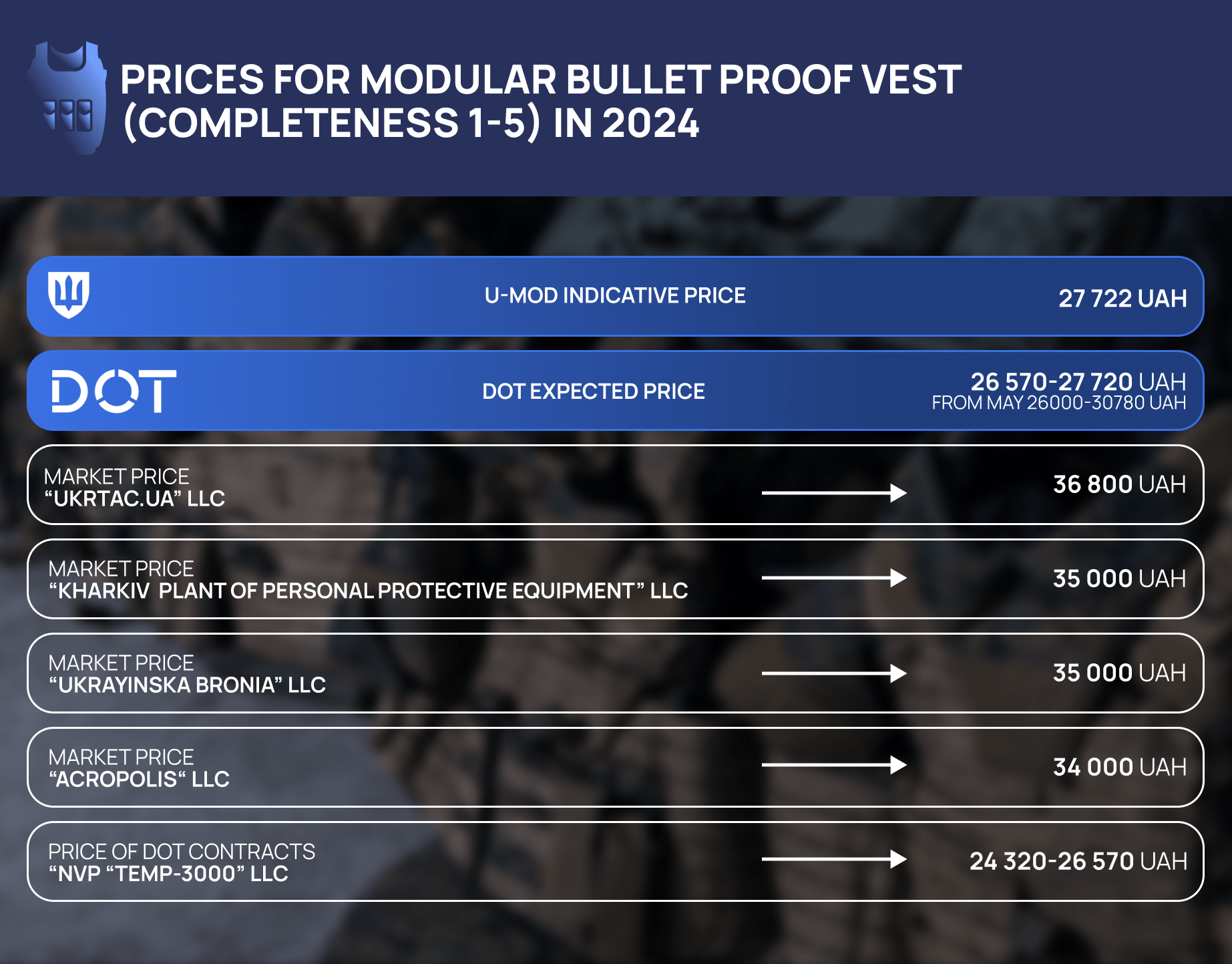
This problem is evident in the DOT’s procurement of bulletproof vests, most of which was cancelled in January-April 2024. Between January and April 2024, 9 out of 15 (60%) lots for the supply of 109,300 complete sets of bulletproof vests for a total expected value of UAH 2.98 billion were declared unsuccessful. The primary reason for this was the discrepancy between the indicative and expected prices and the market offers of the majority of UMOD-certified suppliers, which at that time included a total of five companies. The indicative price in 2024 for modular body armour with configuration 1-5 was set 20% lower than the offers of the vast majority of suppliers, except for TEMP-3000 LLC. This led other companies to decline participation in the tender process. At the same time, the manufacturer with the lowest price of the goods, TEMP-3000 LLC, did not participate in all the tenders. StateWatch assumes that this may be due to the lack of production capacity to fulfil the entire order.
The expected price of one bulletproof vest with config. 1-5 in January-April 2024 was between UAH 26,570 and UAH 27,720. The indicative price was approved at UAH 27,722, which corresponded to the offer made mostly by TEMP-3000 LLC. DOT purchased UAH 1.3 billion worth of bulletproof vests from this supplier at a price of UAH 24,320-26,570. By May 2024, only one contract for the purchase of 5,000 complete sets of bulletproof vests worth UAH 132.4 million (UAH 2,480 per unit) was concluded with another supplier, UKRTAK.ua LLC. However, in its quotation to StateWatch dated 30 May 2024, UKRTAK.UA LLC estimated a similar product at UAH 36,800 per set, which demonstrates a discrepancy between the company’s market price and the price set out in the DOT contract of 13 March 2024. In response to StateWatch’s request, quotations for the product were provided from three other UMOD-certified suppliers, which did not participate in the bidding process between January and April 2024. These quotations can be seen below.
As of early July, the situation remains unchanged. This is evidenced by the results of the procurement announced in June for the purchase of 105,200 sets of modular bulletproof vests for a total expected cost of UAH 2.735 billion (UAH 26,000 per set). This amount is necessary to fully supply the AFU with bulletproof vests by the end of 2024, according to the List and volumes of procurement, as reported by DOT in response to a StateWatch request. In particular, 8 out of 9 lots of this tender for the purchase of 90,200 sets of bulletproof vests worth UAH 1.98 billion were cancelled due to the lack of offers. The sole successful bid for 15,000 sets was submitted by TEMP-3000 LLC, with which DOT intends to enter into a contractual agreement. This effectively indicates that the Armed Forces of Ukraine is deficient in at least 90,000 bulletproof vests.
Establishing of dominance of a single supplier in procurement
The discrepancy between the indicative price and market offers resulted in the establishment of an expected price that corresponds to the price of a single supplier. This, in turn, led to disruptions in deliveries to the AFU warehouses due to the refusal of other manufacturers to participate and the inability of TEMP-3000 LLC to satisfy the AFU’s orders in full, as reported by Nashi Groshi with reference to DOT. Furthermore, the demand for bulletproof vests is projected to increase in 2024 due to the need to replace previously purchased kits that have a service life of no more than two years and will soon expire. The request for bulletproof vests is likely to be adjusted upwards in terms of quantity also due to the planned mobilisation activities. In light of this, the continued dominance of a single manufacturer in the market could potentially exacerbate existing challenges in the supply chain.
In the absence of a framework for setting and revising the estimated price, there is a potential for additional risks to emerge during the tender process for the purchase of bulletproof vests for servicewomen, the number of whom exceeds 45,500.
Although women’s bulletproof vests have not yet been centrally procured, the UMOD has approved reference designs from only two manufacturers (TEMP-3000 and Ukrainian Armour). It is anticipated that the cost of servicewomen’s kits may exceed that of men’s, potentially leading to the cancellation of procurement and supply disruptions if a biased or unadjusted estimated price for bulletproof vests armour is employed.
Increasing the expected price in a closed tender
In April, DOT received an explanation from the UMOD Procurement Policy Department that it was at liberty to independently decide to adjust the expected price. Consequently, in April and May, the procurement agency entered into two direct contracts with UKRTAK.UA LLC for the purchase of bulletproof vests with config. 1-5 at a price of UAH 30,780. Subsequently, the agency entered into an agreement with Kharkiv Plant of Personal Protective Equipment LLC (UAH 30,390 per set) and Ak-Investprom LLC (UAH 30,700 per set).
Nevertheless, the conclusion of direct contracts with savings does not constitute a solution to the problem. Firstly, the amount of such savings is limited and is therefore unable to cover all the under-contracted volumes. Furthermore, DOT is obliged to procure the exact amount of goods specified in the approved List and volumes of procurement. This List is calculated once a year on the basis of indicative prices. Consequently, should the expected price increase, it will not be possible to procure the required volume of products without additional allocations from the state budget or international assistance.
What Is proposed to amend?
The Ministry of Defence of Ukraine (UMOD) is recommended to:
- develop and implement a methodology for the setting and revising the indicative price of goods based on market consultations with suppliers and the determination of the average market price;
- introduce quarterly monitoring of market prices for key logistics goods;
- develop a procedure for reallocating savings from logistics procurement to cover the difference between the indicative and market price of goods for other procurements, as well as to purchase additional logistics goods;
- develop and adopt a framework to enable DOT to approve the use of expected prices in excess of the indicative prices in procurement.
The State Logistics Operator (DOT) is recommended to:
- conduct market consultations with potential suppliers to clarify participation in the procurement process, including obtaining certificates and other permits;
- establish a requirement to provide a certificate of compliance with the technical specifications from the Main Directorate for Development and Maintenance of Material Support of the AFU (or another authorised body if the developer of the technical documentation is not the UMOD) when submitting a tender proposal on Prozorro;
- divide procurement volumes into smaller lots to avoid the lack of bids from suppliers due to large order volumes.
The expected outcome of the implemented changes will be the practice of setting proper indicative and expected prices, along with a framework for their adjustment in response to market fluctuations, which will help expand the range of suppliers and stabilise supplies to military units.
The main beneficiaries of the proposed amendments are the Ministry of Defence of Ukraine (UMOD), the State Logistics Operator (DOT), and the Armed Forces of Ukraine (AFU).
For the UMOD, the amendments will allow it to systematically monitor market conditions and adjust the indicative price to ensure timely supply to the AFU.
DOT will be able to conduct procurement on the most favourable terms, while maintaining competition and sustainability of the process.
The AFU will be provided with the best quality goods in the established volumes within the specified timeframe.
Alternative Mechanisms
1. The ordering entity is entitled to utilise a “framework agreement”, which serves to confirm the parties’ commitment to cooperate for a specified period of time. This allows for reliable partnerships for long-term collaboration. However, firstly, the implementation of such a procedure may be a more protracted process than the other proposed options. Secondly, this mechanism is less efficient and limits competition and public control.
2. DOT may utilise international financial assistance funds, including with the approval of the UMOD, from the UNITED24 special account for defence. However, UNITED24 revenues will be allocated for different purposes between different defence structures. Therefore, these funds will not be able to guarantee the sustainability of logistics procurement in the event of a significant increase in prices and a budget deficit for DOT.
Conclusion
StateWatch suggests that the UMOD take into account the recommendations on the development and implementation of a framework for setting and revising the indicative price while compiling the List and volume of bulletproof vests procurement. Implementation of the proposed changes will contribute to preventing the risk of disruption of the Armed Forces of Ukraine’s needs, sustainability of the procurement process, and expanding the market of body armour suppliers.
The urgency of solving the problem is due to the projected increase in the number of personnel in the AFU, as well as the expiration of bulletproof vests purchased at the beginning of the full-scale invasion.
This policy brief is a part of the support programme led by the UK Special Defence Advisor Team (SDA), implemented by the EDGE Foundation and StateWatch.