


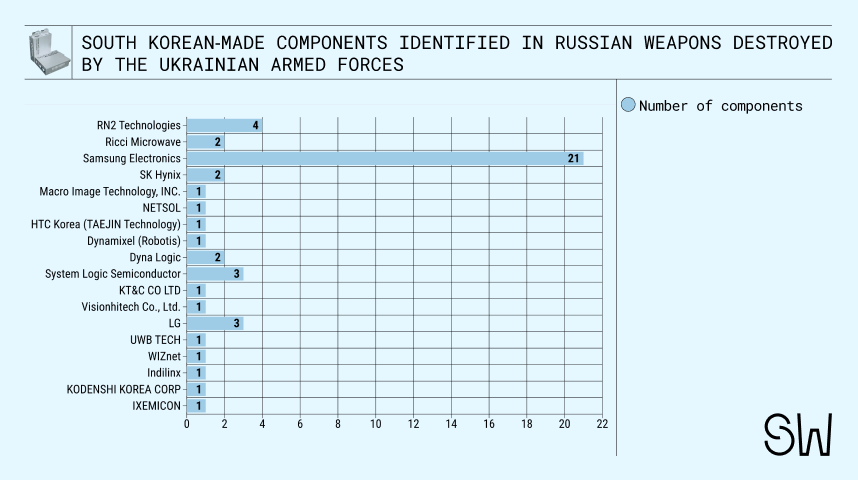
Overall, from February 24, 2022, to March 2025, more than $300 million worth of CHPL goods (high-priority products) were shipped from South Korea to Russia. Exports dropped sharply almost immediately after the start of Russia’s full-scale invasion of Ukraine. On the eve of Seoul’s expansion of the list of products subject to export restrictions to Russia, in February 2023, there was a sharp spike in exports to a record $46.7 million per month – likely an attempt by suppliers to fulfil contracts before the new sanctions rules entered into force.
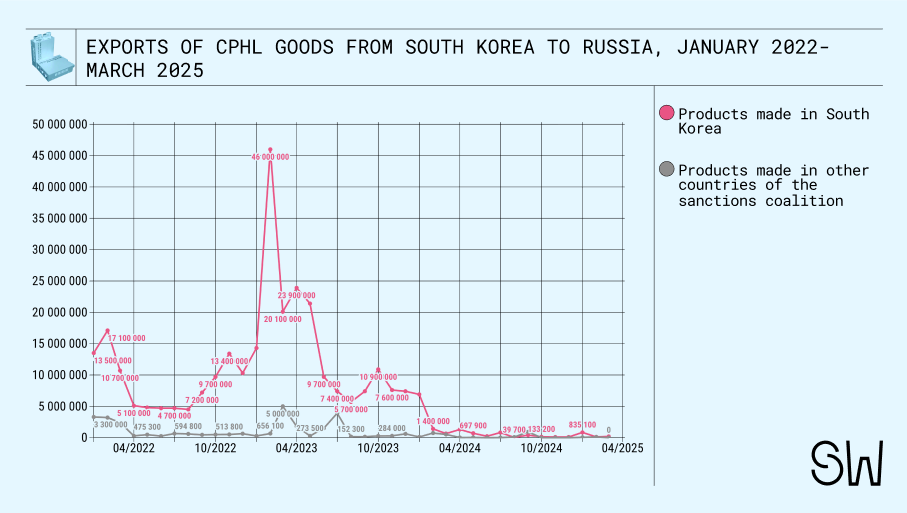
Despite the significant reduction in exports from January 2024 to March 2025, at least $16.5 million worth of sanctioned products still reached Russia from South Korea. Of this amount, $14 million accounted for Korean goods and $2.5 million for products of foreign origin. Particularly notable is the supply of high-precision metalworking equipment. Russia, which before the war imported 70-90% of its machine tools, is critically dependent on these machines, as they are necessary for producing most types of modern weapons. Through Korea, in addition to local manufacturers, components and bearings produced in Taiwan, the United Kingdom, Japan, and Germany also reached Russia.
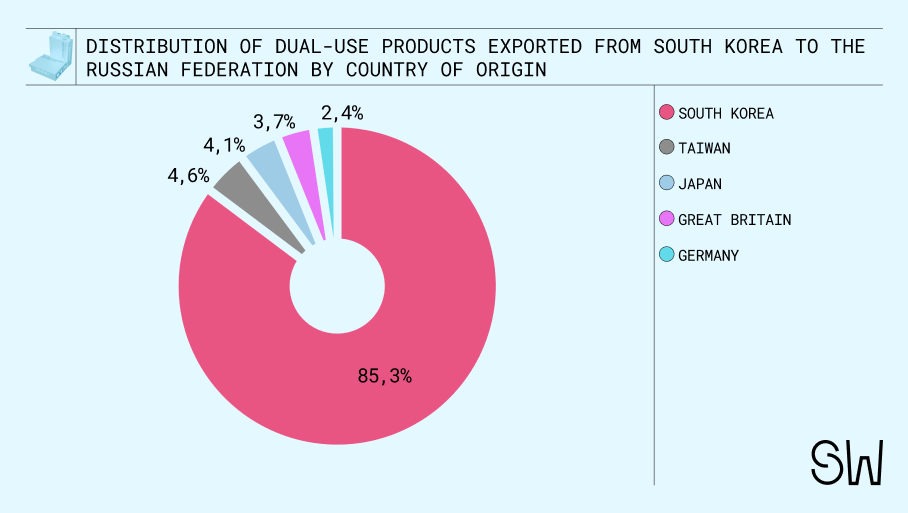
Among high-priority products manufactured directly in South Korea that reached Russia, high-precision equipment dominates – particularly CNC lathes (computer numerical control). Products from Korean manufacturers such as Koma Tech, SMEC (Samsung Machine Engineering Company), FFG DMC, and Namsun Machinery ended up at Russian enterprises directly involved in the production of military satellites, ships, and armoured vehicles.
Despite the cases described, the example of Korean sanctions can be considered a success. However, the existence of residual supply channels – especially for critical equipment – indicates the need for further coordination among countries of the sanctions coalition and stronger export controls.
To learn more about the geopolitical background of Seoul’s current sanctions policy, supply schemes, and specific recommendations for halting these exports, read the full report.
The research was conducted in cooperation with the NGO Liberal Democratic League of Ukraine with the support of the International Renaissance Foundation.