This report contains information current as of 1st March 2025.
In February 2025, the State Logistics Operator (DOT) issued procurement tenders worth UAH 5.63 billion. Contracts totalling UAH 5.42 billion were finalised from bidding processes initiated both in February and earlier months. StateWatch analysts have assessed the efficiency of these February procurements and developed recommendations for enhancing non-lethal supply chains.
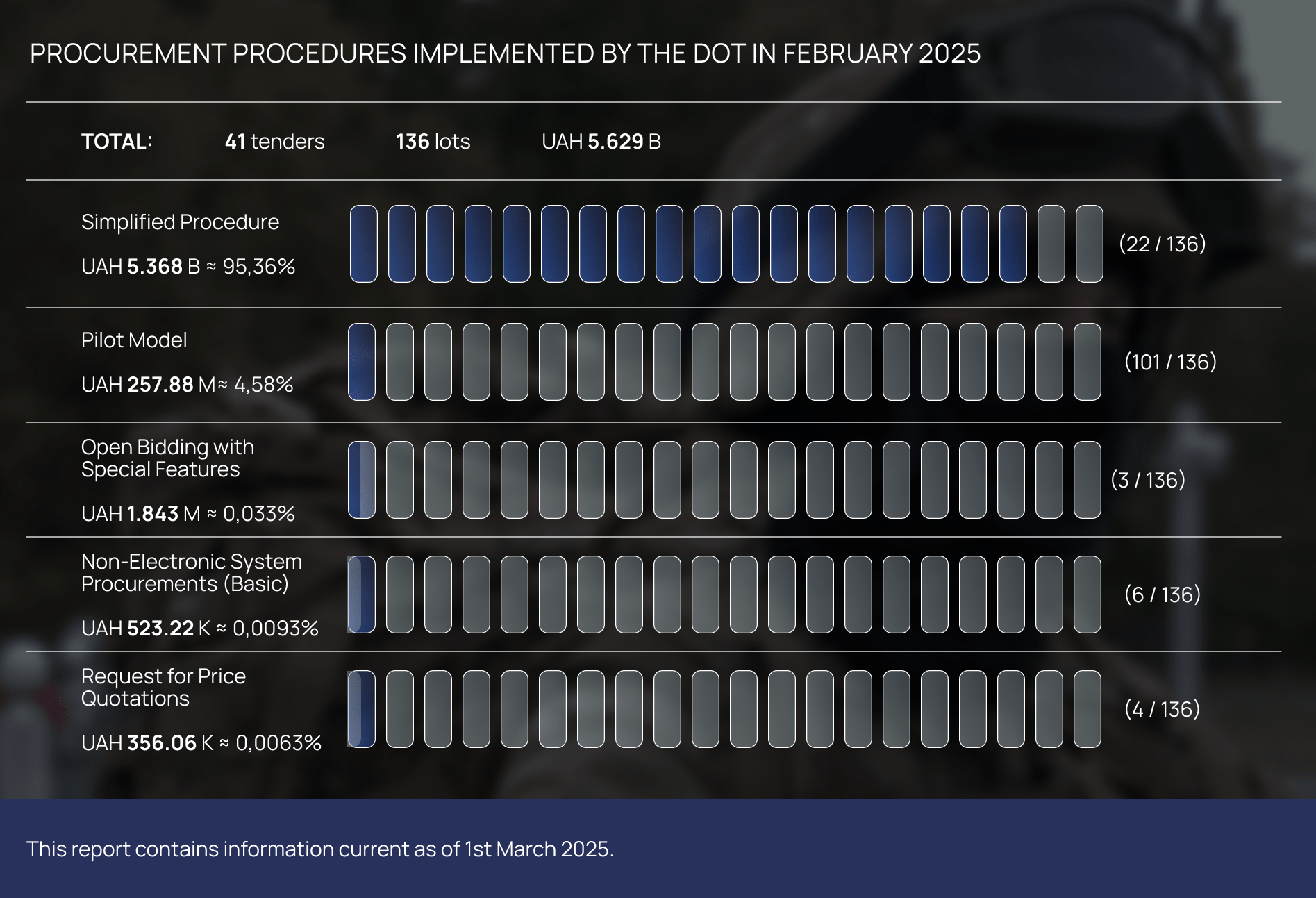
During February, the DOT initiated 41 tenders (featuring 136 lots) with a combined expected value of UAH 5.63 billion. The vast majority of this procurement value (UAH 5.36 billion) came through simplified procedures, which accounted for 16 tenders comprising 22 lots. The bidding attracted 43 companies, with tenders receiving an average of 2.31 proposals each.
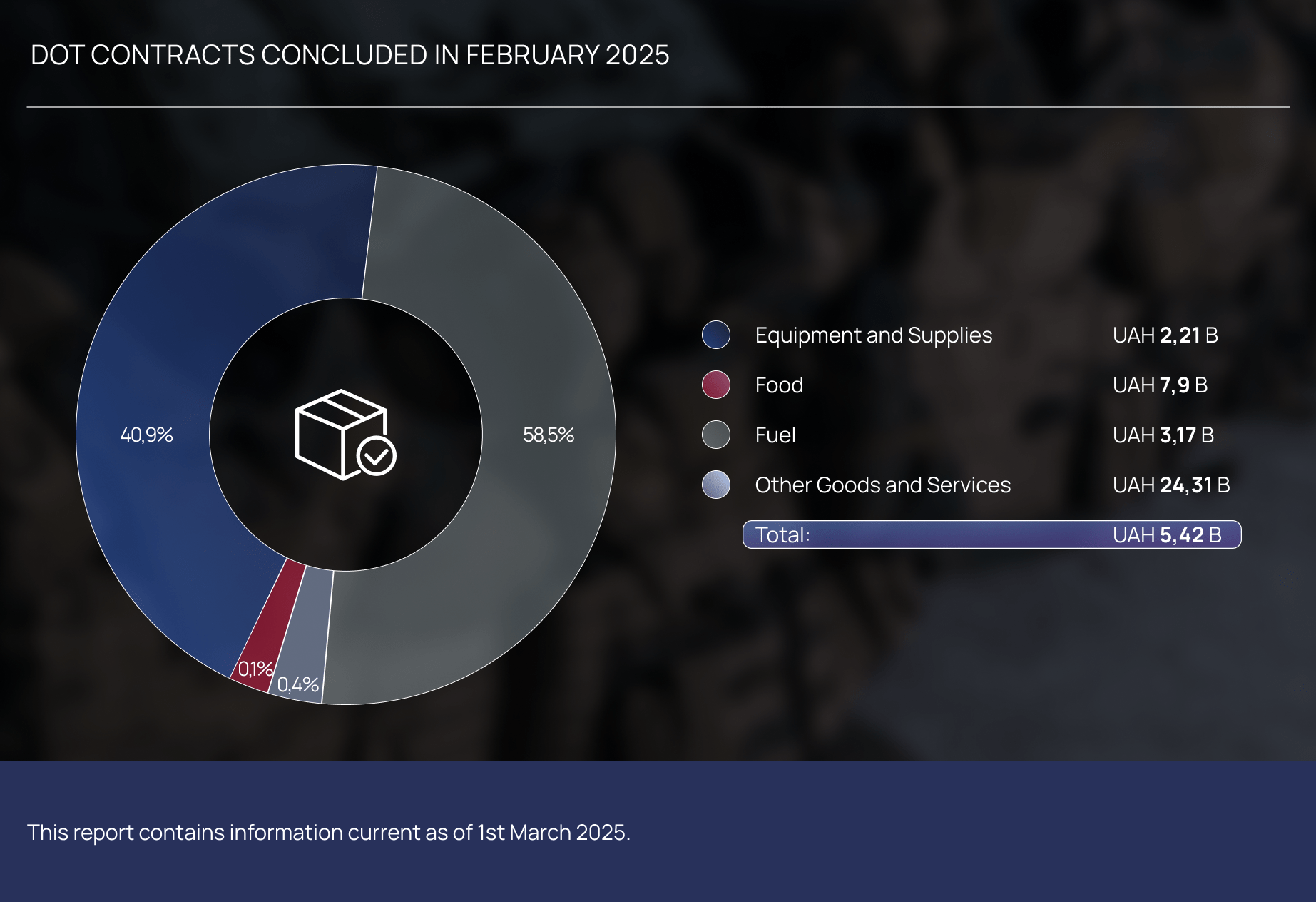
Throughout February, DOT finalised 35 contracts with a combined value of UAH 5.42 billion. Fuel procurement represented the largest expenditure at UAH 3.17 billion (58.48%), whilst equipment and supplies accounted for UAH 2.21 billion (40.91%). Notably, only UAH 7.9 million (0.14%) was allocated to food products, reflecting the agency’s earlier procurement of substantial volumes for the coming quarters. The remaining UAH 24.31 million (0.44%) was distributed across other goods and services.
Fuel and Lubricants
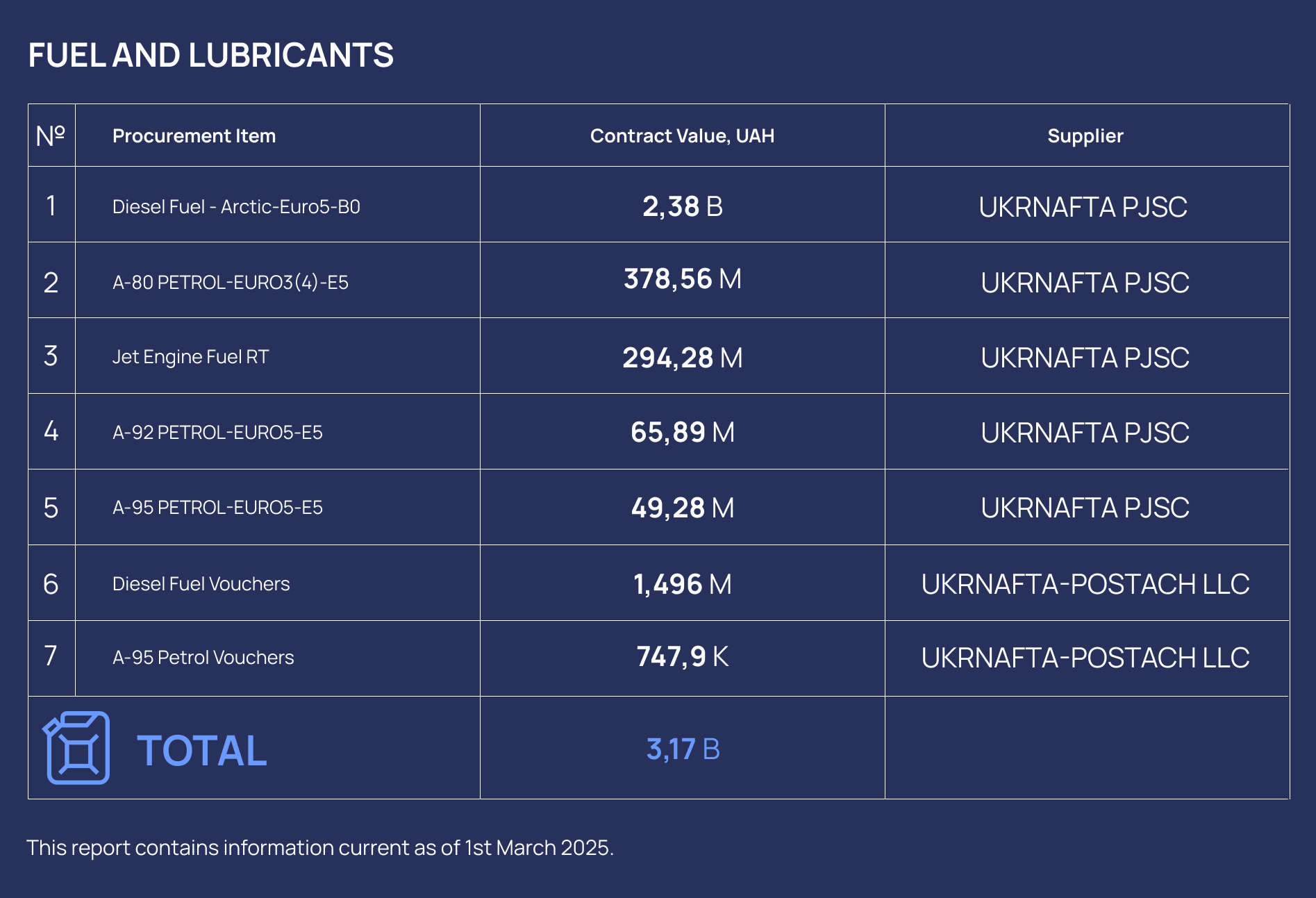
In February, contracts for fuel and lubricants procurement reached a total value of UAH 3.17 billion. DOT continues to refine its regional model as part of its strategy to enhance competition and optimise logistics. Last year, the agency introduced a fuel procurement framework dividing supply into four regions – Eastern, Southern, Central and Western – overing between 4 and 6 supply points. This approach has now been expanded, with the number of lots doubling from four large regional lots to eight smaller ones, each serving fewer supply points (1 to 2).
The bulk of fuel products contracted in February (UAH 2.38 billion) comprised diesel fuel for various regions across the country. Additionally, contracts for aviation fuel amounted to UAH 294.3 million. Petrol purchases amounted to UAH 494 million, with A-80 grade accounting for the largest share at UAH 378.6 million, followed by A-92 (UAH 65.9 million) and A-95 (UAH 49.3 million).
The vast majority of contracts were awarded to UKRNAFTA PJSC, with a combined value exceeding UAH 3 billion. In separate arrangements, UKRNAFTA-POSTACH LLC secured contracts for the supply of petrol vouchers worth UAH 747,900 and diesel vouchers valued at UAH 1.5 million.
Equipment and Supplies
Five contracts totalling UAH 2.21 billion were finalised for equipment and supplies procurement. Of these, three contracts cover the delivery of 95,000 modular bulletproof vests (levels 1-5) with a combined value of UAH 2.12 billion. Nearly 90% of the contracted value was awarded to SPE “TEMP-3000” LLC (UAH 1.90 billion). Other bidders included UKRTAK.UA LLC and MILICON UA LLC. The latter company won its first DOT tender, securing a contract for 10,000 bulletproof vests worth UAH 217.52 million (10.3%) at a unit price of UAH 21,752. However, the State Audit Service identified irregularities in this procedure, as detailed below.
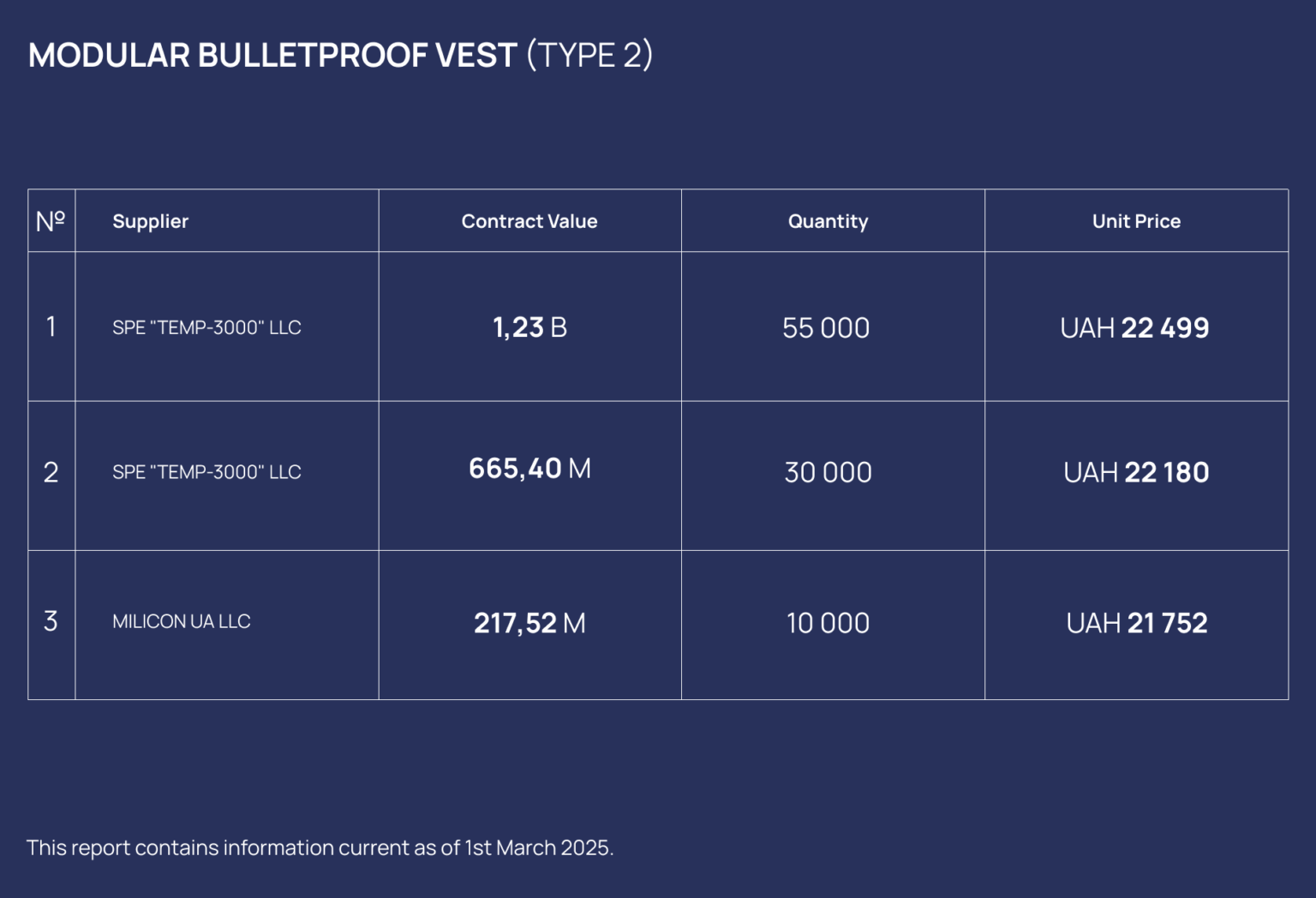
In addition, the agency procured windproof and waterproof winter jackets totalling UAH 14.8 million and winter camouflage suits valued at UAH 69.5 million.
Food and Catering Services
In February 2025, the agency announced food procurement tenders worth UAH 769.3 million. Of this total, UAH 511.4 million was allocated through simplified procedures, whilst UAH 257.8 million was channelled through the pilot model. During the month, a single contract was signed with RAMEDAS UKRAINE LLC for catering services totalling UAH 7.9 million.
DOT continued expanding its updated pilot model in February by introducing several additional product categories. The benchmark bidding process established reference prices for meat, dairy and confectionery products, as well as eggs. In total, 101 lots were announced, with 38 classified as unsuccessful at the time of this monitoring report’s preparation.
The agency was unable to establish current market rates for the following food categories:
1. Long-shelf-life products (tinned meat and fish, pâtés, dried fruits, preserved vegetables) – UAH 11.5 million;
2. Fresh produce (carrots, cabbage, beetroot, herbs, apples, pears) – UAH 9.9 million;
3. Basic ingredients (flour, grains, cooking oil, spices) – UAH 3.87 million;
4. Prepared and convenience items (preserves, jams, condiments, sauces, dressings) – UAH 9.1 million.
Cancelled and Unsuccessful Procurements
In February, eight tenders with a combined value of UAH 1.67 billion failed to proceed. Notably, a food products procurement valued at UAH 511.4 million was deemed unsuccessful after authorities identified irregularities in expected value calculations that could not be addressed within the parameters of the announced procedure.
Additionally, the pilot model designed to establish current market prices across various product categories saw a significant failure rate. In total, 38 lots failed to attract any bids, rendering them unsuccessful.
A further procurement for full-size and high-cut combat ballistic helmets, valued at UAH 978.49 million, was cancelled due to a complete absence of bids.
Challenges
In February, for the second consecutive month, the DOT failed to conduct signal trading to establish prices across several product categories within the pilot model. Pricing could not be determined for long-shelf-life products, fresh fruit and vegetables, basic ingredients, and pre-prepared foods and sauces. Of the 101 lots announced under the pilot model, 38 failed to materialise, indicating substantial implementation difficulties.
By March, the agency had issued a statement acknowledging that various aspects of the pilot procedure required refinement, particularly regarding logistics and supplier engagement. In response to these identified shortcomings and to maintain uninterrupted supply, the DOT enlisted an additional supplier from a neighbouring region to fulfil requirements in Kyiv and its surrounding region, while also implementing a series of corrective measures.
It should be noted that TEMP-3000 LLC, a company displaying market dominance, was again awarded the majority of modular body armour contracts in February, amounting to UAH 1.9 billion. Concurrently, MILIKON UA LLC, representing Israeli manufacturer Masada Armor Ltd, won a simplified procurement tender for 10,000 modular body armour units valued at UAH 224.99 million.
This represented MILIKON UA’s first successful bid with the DOT. TEMP-3000 subsequently lodged a complaint with the ordering entity, alleging irregularities in the selection process. The State Audit Service’s subsequent investigation confirmed these procedural violations. In particular, MILIKON UA failed to provide documentation verifying their product’s compliance with MoD technical specifications, instead submitting only a letter from the Central Logistics Development Directorate that had been issued to FORTRESS PROTECTION LLC – another Masada Armor distributor whose previous bids had been rejected due to documentation irregularities. Moreover, MILIKON UA could not produce evidence of any formal business relationship with FORTRESS PROTECTION. Based on these findings, the State Audit Service directed the DOT to terminate its agreement with MILIKON UA.
Recommendations for the DOT Based on February 2025 Challenges Analysis:
1. Establish clear criteria regarding required documentation for all tender participants.
2. Apply legislative verification and approval requirements consistently across all bidders.
3. Implement a swift response protocol for addressing irregularities before contracts are finalised.
4. Institute regular internal compliance checks to ensure tender documentation satisfies all statutory requirements.
5. Develop practical guidelines for foreign entities and their representatives participating in procurement procedures.
DOT procurement monitoring has been supported by the Office of the United Kingdom’s Special Defence Advisor and delivered by EDGE Foundation and StateWatch Think Tank.