
Cybersecurity concerns are growing in the United States due to the massive use of Chinese drones. The Bureau of Industry and Security is collecting public comments to potentially develop rules that would restrict the import and use of foreign UAVs due to the cyber threat. Possible regulatory measures are currently being discussed, which may include restrictions on certain technologies and manufacturers. After all, according to Chinese law, intelligence agencies have access to information collected by private companies, and this applies not only to data from China but also from around the world. Why do the Americans want to abandon affordable Chinese drones and how could this affect the global drone market? Trap Aggressor analysts investigated this question.
The first civilian drone took to the skies in 2006. Since then, the drone industry has been developing rapidly and gradually expanding the scope of its use. Remote control makes it possible to use drones to perform tasks with a high risk to human life and to automate processes. For example, drones are used in rescue missions in difficult climatic conditions, to cultivate fields, and to check the condition of gas pipelines.
Currently, China is the strongest player in the drone market. China offers low cost and mass production. However, the extremely attractive price of Chinese drones hides the risk of third-party information collection. The fact is that since the 90s, the Chinese Communist Party has been implementing a strategy of civil-military fusion (CMF). China wants to lead the 4th Industrial Revolution, so it is investing all available resources to achieve its goal. The main idea of this plan is to unite the state, commercial and military sectors. The key goal is to create the most technologically advanced army in the world by 2049.
The HLC strategy blurs the classic boundaries between civilian and military goods. Since such goods can be used by both civilians and the military at the same time, they are called dual-use goods. And this is a big problem for export control. First, the producers of such goods do not always specify who their end user is. A civilian company may officially buy their products, but then it may resell them to the military. Secondly, it is impossible to completely ban the trade in such goods. This will lead to significant losses in the civilian sector of the economy and, accordingly, will have a negative impact on the economy as a whole.
The development of unmanned systems is one of the key technologies within the framework of the EWC. Universities, companies from the Chinese military-industrial complex, and private manufacturers, which are mostly part of the country’s military ecosystem, are involved in this process. It is this nuance that causes concern in the United States. Back in 1999, the U.S. Congress instructed the Department of Defense to identify “Communist Chinese military companies” operating in the United States. In this way, American taxpayers can control whether their money is being used to “finance the People’s Liberation Army.” Recently, such companies include the Chinese drone manufacturer Shenzhen DJI Innovation Technology Co., Ltd. (DJI), whose drones have the largest share of the American market.
In 2017, China passed laws that allow the government to control data stored by companies in China. At the same time, the law on national intelligence obliges Chinese companies to cooperate with state intelligence services. That is, to provide access to data collected both in China and around the world. These companies include well-known Chinese UAV manufacturers, including DJI.
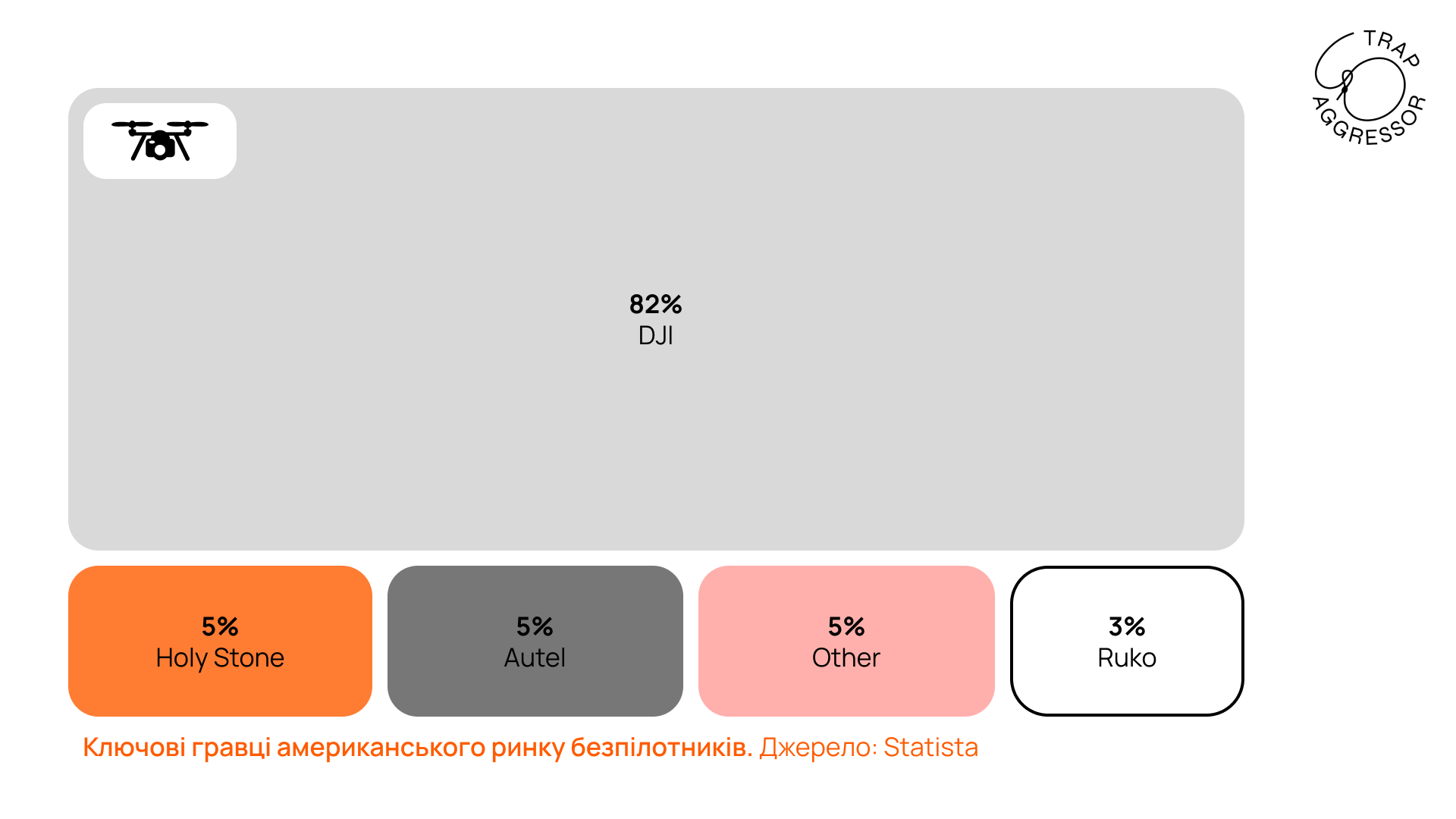
In May 2019, the U.S. Department of Homeland Security expressed concern about cybersecurity risks posed by drones created by authoritarian states. The same year, Congress passed a law prohibiting the Pentagon from purchasing and using Chinese-made drones. Nevertheless, even in 2022, Chinese manufacturers were still the main players in the American drone market: 82% of DJI, another 5% each for Autel Robotics and Holy Stone.