
On a crisp morning in April 2021, as satellite images showed Russian tanks massing along Ukraine’s borders in the largest military buildup since the Cold War, another kind of mobilisation was quietly taking shape across Europe.
German, Italian, and Polish manufacturers were rushing high-precision CNC lathes, industrial furnaces, and measuring instruments to Russia. Baltic freight forwarders were processing million-dollar shipments through customs warehouses. Meanwhile, in Moscow, Russian procurement officers were scrambling to stockpile the very machinery needed to build modern weapons, shaping up Western technology before the opportunity would slip away.
That single month, April 2021, saw tens of millions of dollars worth of precision manufacturing equipment pour into Russia. The timing was no coincidence. As Russian troops practised for invasion, Russian industry was gearing up for war. European companies, their national export authorities, and Baltic intermediaries made it all possible.
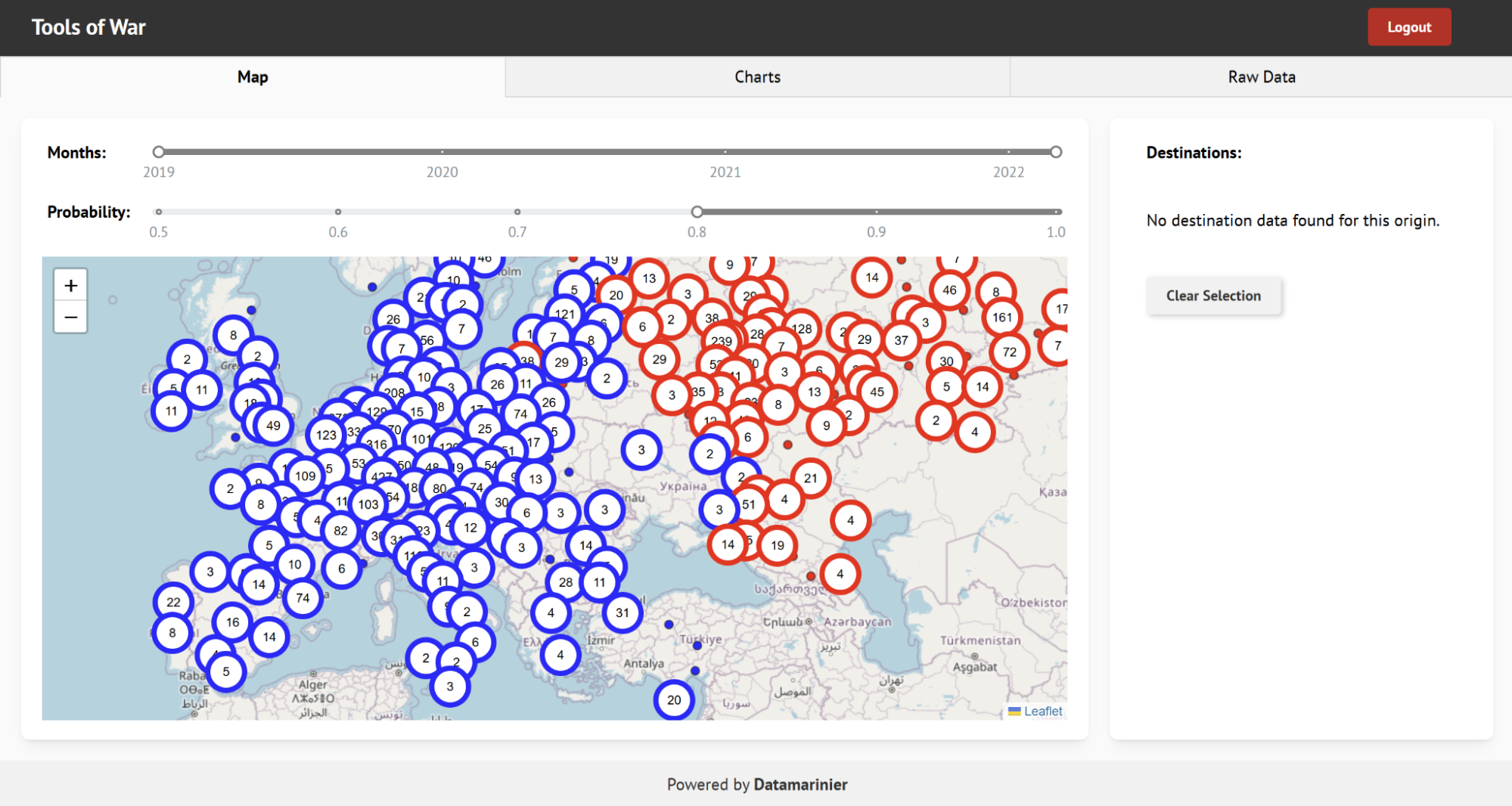
Fresh data from the Tools of War project, based on an analysis of 2.7 million customs records, reveals the full scope of how this happened. Between 2019 and March 2022, while Russia was preparing for invasion, European companies exported about $3.4 billion in machine tools and precision manufacturing equipment through 125,000 shipments identified as having heightened dual-use potential. These weren’t weapons in themselves, yet in some ways, they were even more powerful. They formed the nuts and bolts of a war machine, the backbone of Russia’s ability to produce arms for years to come.
On the machining front
Machine tools form the backbone of every modern military. Computer-numerically-controlled, or CNC, machines bend, shape, and cut metal with precision measured in micrometres. These are the tools that turn raw titanium into turbine blades, steel billets into artillery shells, and aluminium blocks into missile guidance housings. Without them, producing advanced weapons is next to impossible.
Russia understood this all too well. Before the 2022 invasion, the country imported between 70 and 90 percent of its CNC machinery, according to the Economic Security Council of Ukraine. Soviet-era lathes and mills, though still running, simply cannot deliver the pinpoint precision required by today’s weapons systems. A jet engine part produced on 1980s Soviet equipment might work. The same component produced on a 2019 German five-axis machining centre will work flawlessly, withstand higher stress, and last far longer. In combat, that difference can mean life or death.
In 2021 alone, Russia bought more than $800 million worth of foreign metalworking equipment from multiple sources, according to the Russian Union of Suppliers of Equipment and Tools for Metalworking. The machines delivered in 2019, 2020, and 2021 are almost certainly still humming today. These are capital assets with lifespans of twenty to thirty years. The industrial base built in the years leading up to the invasion is the same base now keeping Russia’s war production alive, three years into the war.
In 2021 alone, Russia bought more than $800 million worth of foreign metalworking equipment from multiple sources, according to the Russian Union of Suppliers of Equipment and Tools for Metalworking. The machines delivered in 2019, 2020, and 2021 are almost certainly still humming today. These are capital assets with lifespans of twenty to thirty years. The industrial base built in the years leading up to the invasion is the same base now keeping Russia’s war production alive, three years into the war.
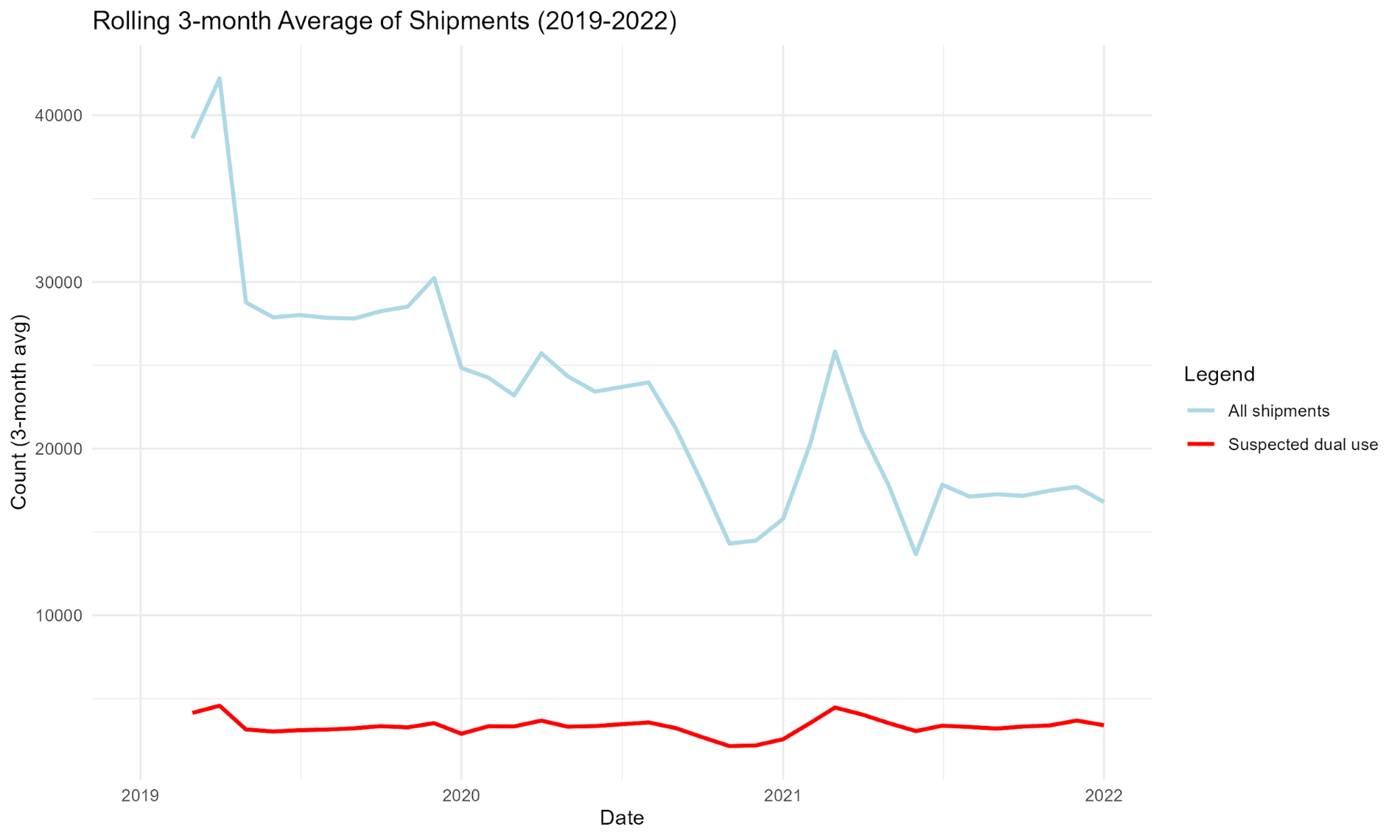
The dataset tracks 1.57 million exports from EU countries, involving 74,597 European exporters and 20,959 Russian importers. Using an AI model trained on thousands of manually classified examples, investigators identified 125,536 shipments between 2019 and 2022 as having “heightened probability” of dual-use military potential, valued at $3.4 billion. These flagged shipments came from 38,209 EU exporters, roughly half of all European suppliers in the dataset, and went to 14,107 Russian importers, representing two-thirds of all recipients.
The dataset tracks 1.57 million exports from EU countries, involving 74,597 European exporters and 20,959 Russian importers. Using an AI model trained on thousands of manually classified examples, investigators identified 125,536 shipments between 2019 and 2022 as having “heightened probability” of dual-use military potential, valued at $3.4 billion. These flagged shipments came from 38,209 EU exporters, roughly half of all European suppliers in the dataset, and went to 14,107 Russian importers, representing two-thirds of all recipients.
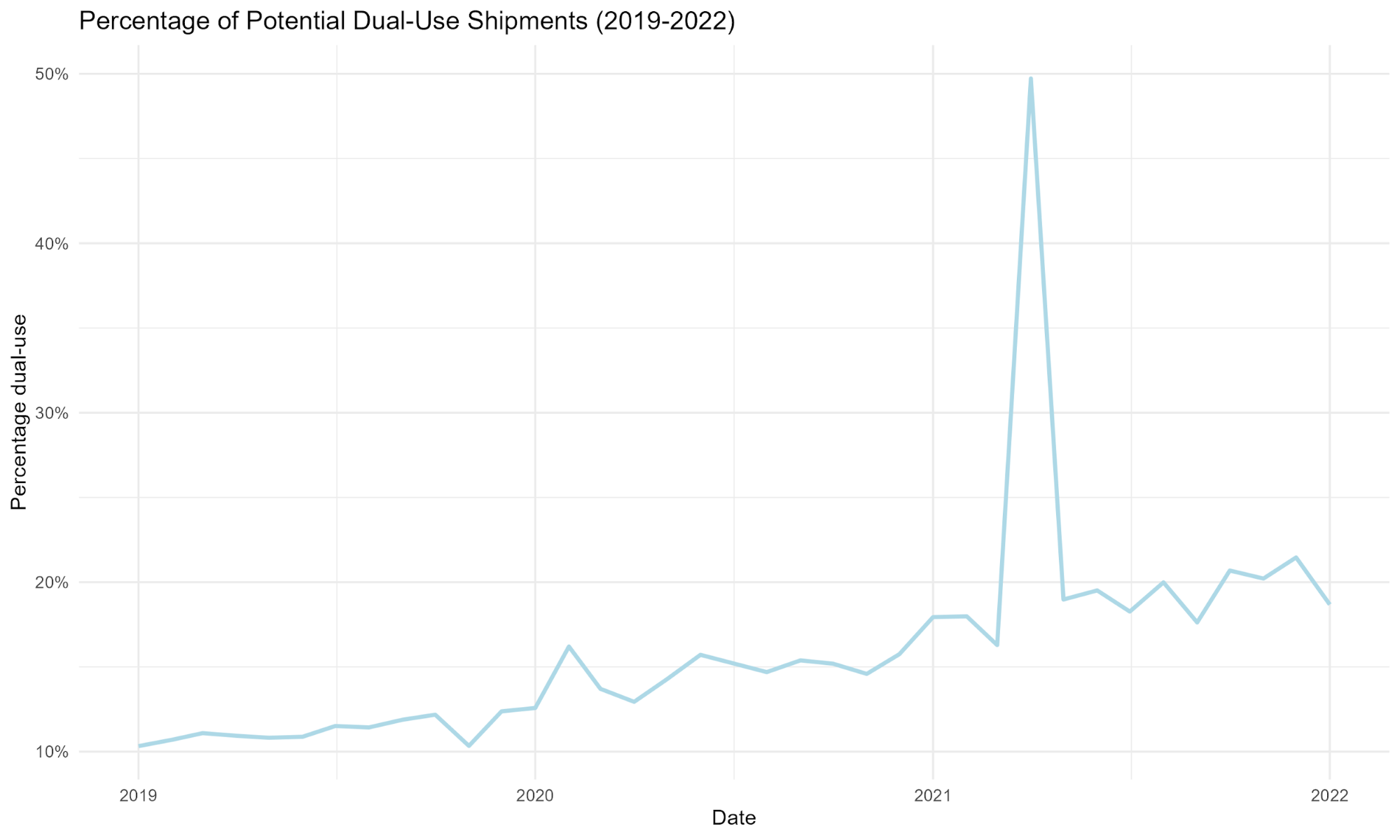
The numbers tell a story of sanctions that failed to stem the tide. Despite the tightening of EU export controls on dual-use goods after Russia’s 2014 annexation of Crimea, between 2019 and March 2022, $3.4 billion in precision manufacturing equipment with high dual-use potential still found its way to Russia in 125,536 shipments.
These weren’t one-off deals. European companies and their national export-control authorities allowed more than 125,000 shipments of high-precision equipment during the very years when Russia’s military buildup was becoming impossible to miss, when diplomatic warnings escalated, and when the threat of invasion loomed ever larger.
Then came April 2021, and the spike in that month’s data was striking. Russian buyers imported tens of millions of dollars in CNC machinery, precision lathes, industrial furnaces for heat-treating defence metals, gas-filtering and centrifuge equipment, and the measuring instruments needed to ensure that components met weapons-grade standards. It was, in effect, a shopping list for war.
Europe feeds Russia’s military sector
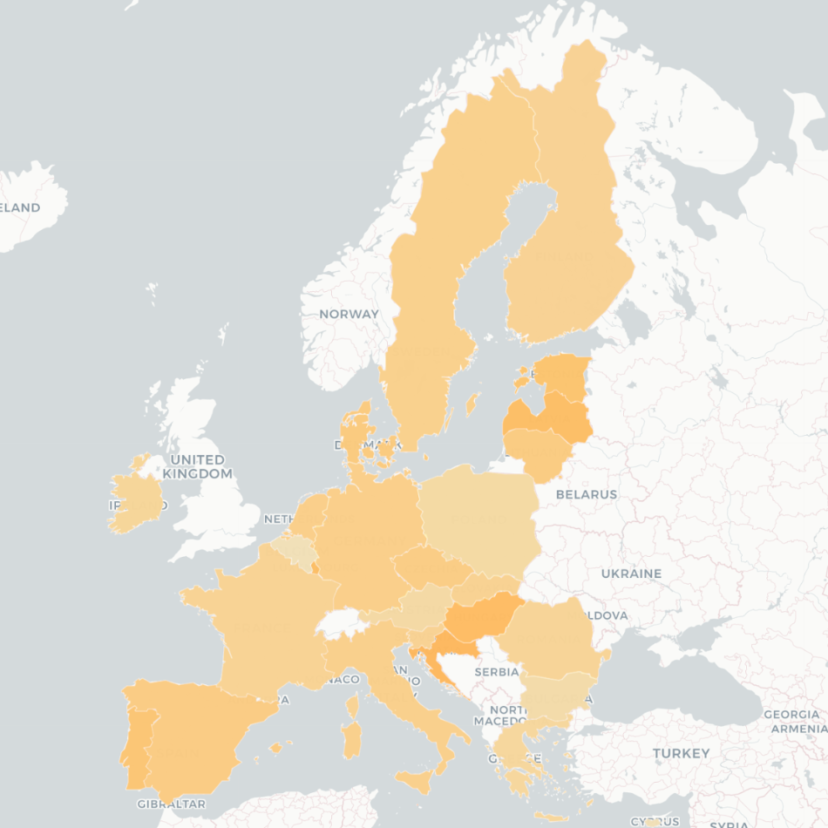
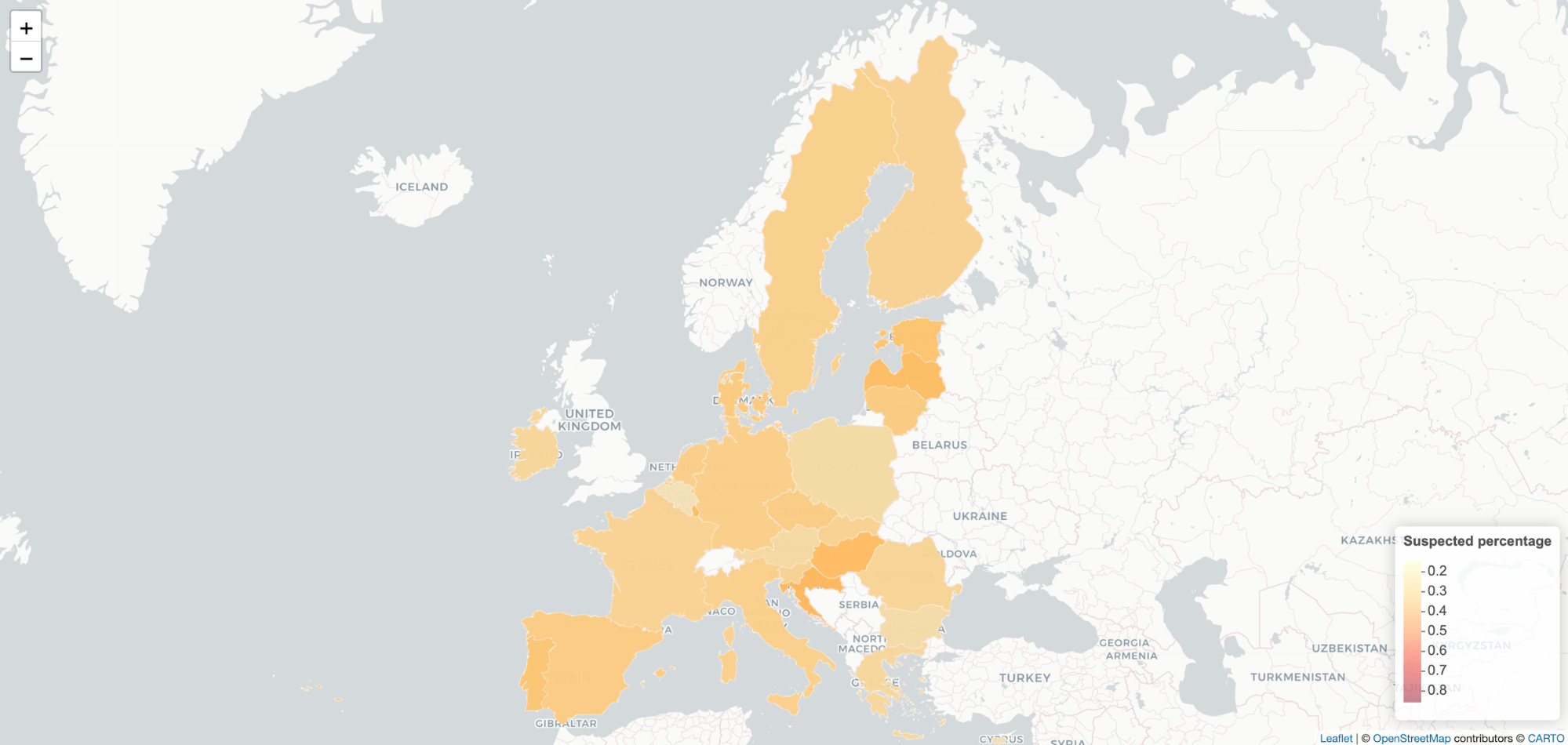
Since EU sanctions on Russia’s military sector came into force in 2014, German manufacturers have remained the leading suppliers of advanced production technology. Between 2019 and 2022 alone, Germany accounted for roughly $1.36 billion in machine tool exports to Russia across approximately 50,000 shipments, more than twice Italy’s $492.7 million.
This reflects Germany’s position as Europe’s powerhouse of precision engineering. The country produces the world’s most advanced CNC systems, the most accurate measuring equipment, and the most sophisticated industrial furnaces. For Russia, keeping the door open to German manufacturing technology was a strategic necessity. For German companies, Russia remained a lucrative market. The result was steady trade even as geopolitical tensions reached a boiling point.
This reflects Germany’s position as Europe’s powerhouse of precision engineering. The country produces the world’s most advanced CNC systems, the most accurate measuring equipment, and the most sophisticated industrial furnaces. For Russia, keeping the door open to German manufacturing technology was a strategic necessity. For German companies, Russia remained a lucrative market. The result was steady trade even as geopolitical tensions reached a boiling point.
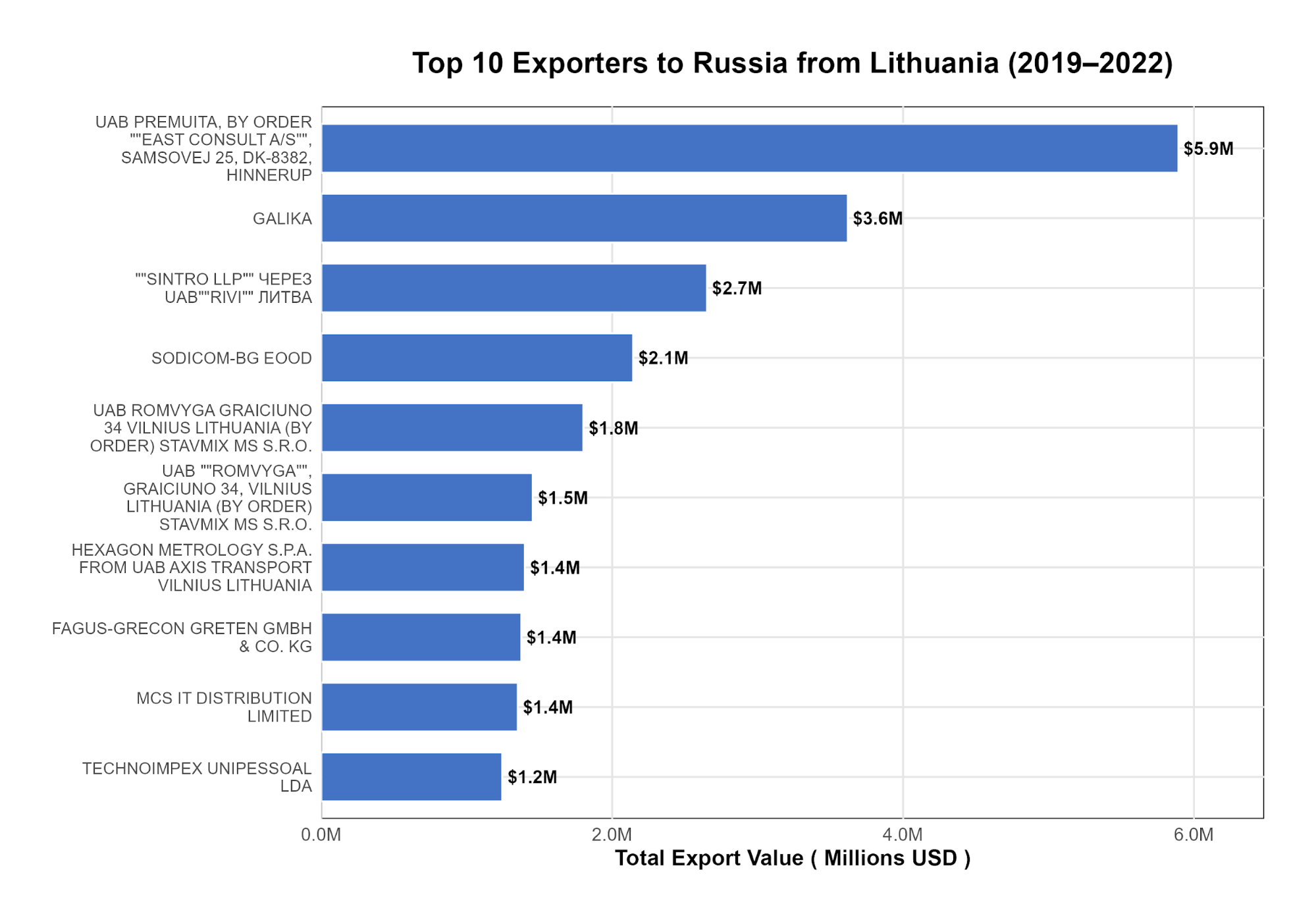
Three small Baltic States, namely Lithuania, Latvia, and Estonia, emerged as surprisingly significant origin points for machine tools bound for Russia, at least according to customs declarations. Lithuania exported $118.9 million between 2019 and 2022, Latvia $94.2 million, and Estonia $102.9 million.
These countries don’t manufacture precision machine tools in any significant quantity. What they do have are ports, road connections to Russia, and logistics companies ready to act as middlemen. Russian customs data reveal the method at work: freight forwarders and customs warehouses serving as waystations for equipment originally made in Germany, Italy, or elsewhere in Western Europe.
The names of the shippers tell their own story, showing how intermediaries were used to import sensitive technology even before the invasion. Long, compound names frequently include phrases like “by order of” the actual manufacturer, suggesting exporters deliberately inserted extra layers of opacity.
Russian-owned but Estonian-registered Express Shipping Service OU, acting on behalf of now U.S.-sanctioned Silver Technology Ltd of Hong Kong, moved hundreds of millions of dollars in machinery to Russia in the years before the invasion.
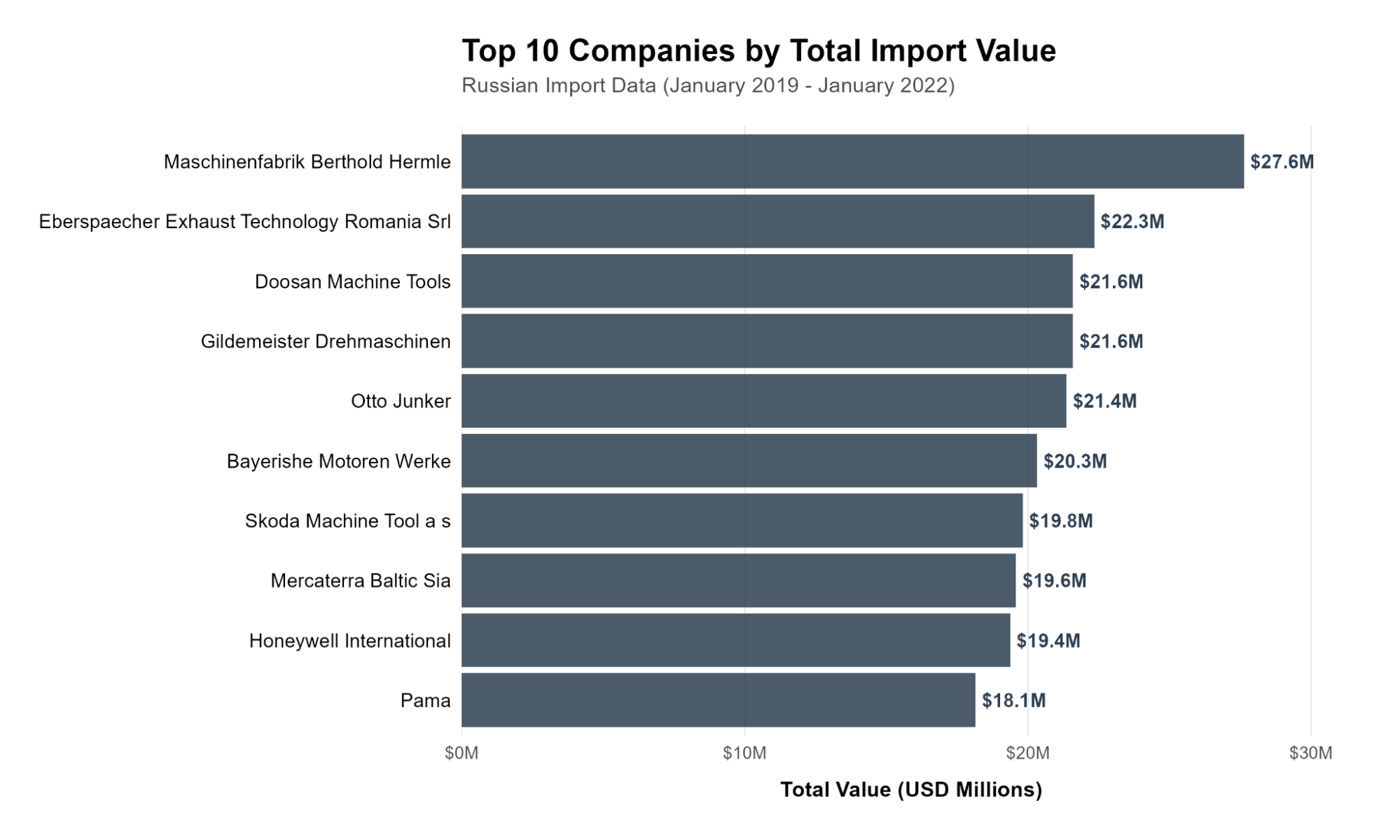
Similarly, Latvian company Mercaterra Baltic SIA appears in the data with $19.6 million across just two transactions, averaging nearly $10 million per shipment. Another little-known company, Sapphire Universal LLP of Hong Kong, working through a Lithuanian logistics partner, handled $306.5 million across fourteen transactions. None of these are manufacturers. They’re middlemen, adding layers between the original producer and the Russian recipient as end user.
The pattern shows adaptation in real time. As direct trade from Germany to Russia came under the spotlight , shipments began to flow through alternative routes. These same skills later proved useful when Russia developed more sophisticated sanctions evasion systems after 2022.
Eager Russian clients
Nearly 9,000 distinct Russian entities received machine tools between 2019 and 2022. Some had unmistakable military ties.
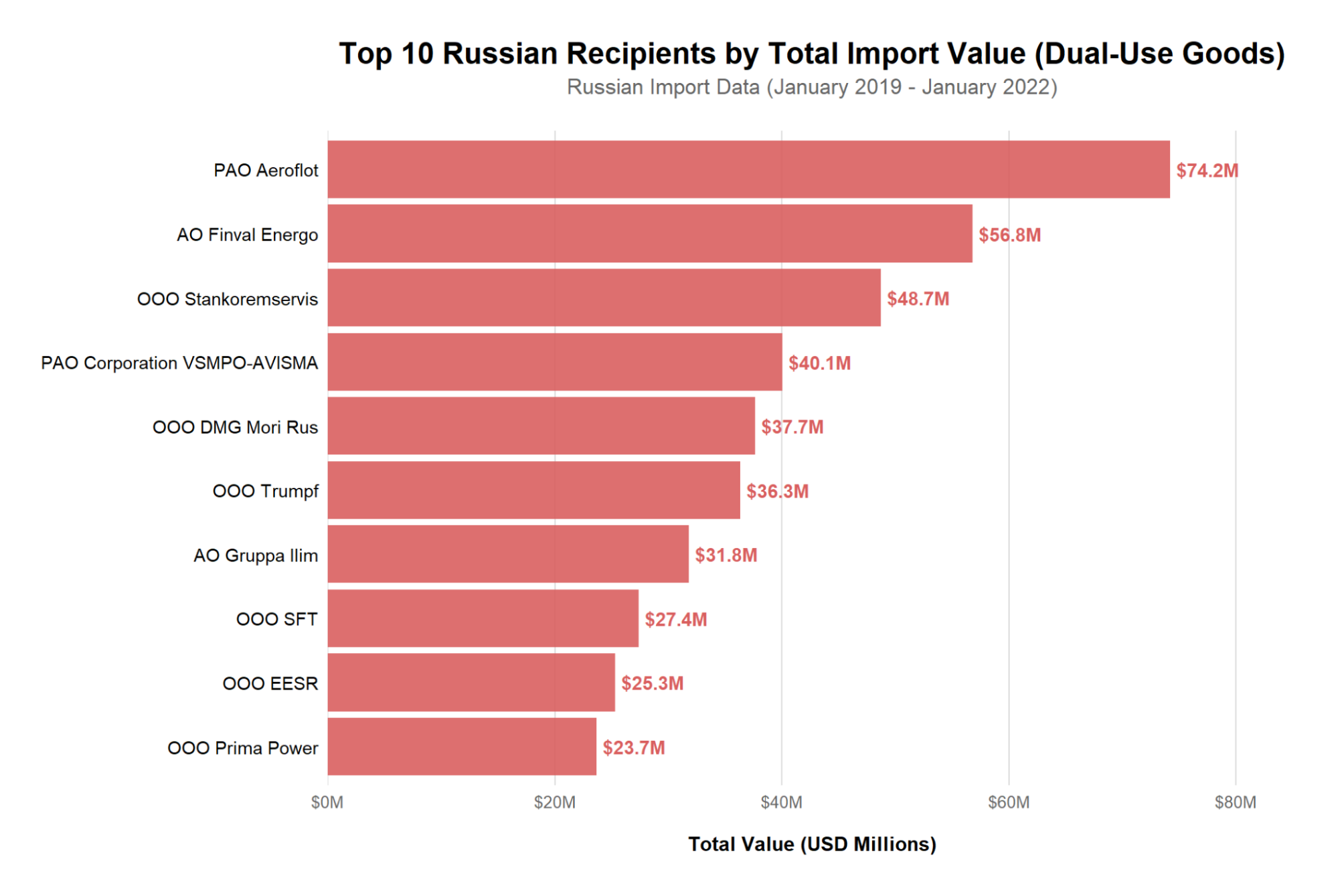
VSMPO-AVISMA, the world’s largest titanium producer and long-standing supplier to Russia’s aerospace and defence sectors, imported $40.1 million worth of equipment across 28 shipments averaging $1.4 million each. The company’s defence role is well known, as it openly provides titanium components for Russian military aircraft.
KAMAZ, Russia’s largest truck manufacturer and a major defence contractor, received $21.9 million in 137 shipments. These weren’t spare tyres. The machine tools delivered to KAMAZ facilities could just as easily be used to produce components for military vehicles as for civilian ones.
The single largest recipient in the 2019-2022 period was Aeroflot, with $74.2 million in 944 shipments. Although it is Russia’s civilian flag carrier, Aeroflot also supports military logistics when directed by the state. The equipment it received from former Western aviation partners now helps keep a heavily sanctioned fleet in the air three years into the war.
Beyond aviation and defence, Russian energy companies also scooped up precision tools. Finval Energo, a leading supplier to Russia’s energy sector, imported more than $56 million across only 67 shipments. Other Russian distributors with documented links to both defence and energy industries also feature prominently in the records.
OOO Stankoremservis received $48.7 million. Russian corporate registers describe it as a supplier of high-tech metalworking machinery to the aircraft, shipbuilding, transport, and power-engineering industries.
Then there were the Russian subsidiaries of Western manufacturers, raising perhaps the most uncomfortable questions of all.
DMG Mori Rus, the Russian arm of the German-Japanese machine-tool giant, received $37.7 million in 305 shipments. Similarly, the Russian arm of German tooling firm Trumpf imported $36.3 million in 557 shipments. Equipment from both companies has since been identified in Russian defence and energy facilities. The corporate structures that kept supplies flowing under sanctions meant Western manufacturers were, in effect, stocking their own Russian operations with the tools now feeding the country’s war production.
DMG Mori Rus, the Russian arm of the German-Japanese machine-tool giant, received $37.7 million in 305 shipments. Similarly, the Russian arm of German tooling firm Trumpf imported $36.3 million in 557 shipments. Equipment from both companies has since been identified in Russian defence and energy facilities. The corporate structures that kept supplies flowing under sanctions meant Western manufacturers were, in effect, stocking their own Russian operations with the tools now feeding the country’s war production.
Under EU dual-use regulations, exporters carry the responsibility of proving that their goods won’t end up in military production. Yet the scale of shipments revealed by the data, particularly those destined for entities with clear defence connections, suggests that this obligation was rarely enforced in practice.
Implementation of EU dual-use controls varied widely from one member state to another. What might trigger a thorough review in one country could pass almost unchecked in another. This inconsistency led to uneven enforcement across the bloc, creating cracks that savvy operators could slip through. The frequent routing of shipments through Baltic intermediaries strongly indicates that some exporters and importers knew how to take advantage of these gaps.
The consequence is visible today. Russia’s military-industrial base was meaningfully strengthened in the years immediately before the invasion, supplied with heavy equipment designed to operate for decades. The CNC machines delivered in 2019, 2020, and 2021 are still running, still turning out precision components for weapons now being used on the battlefield in Ukraine.