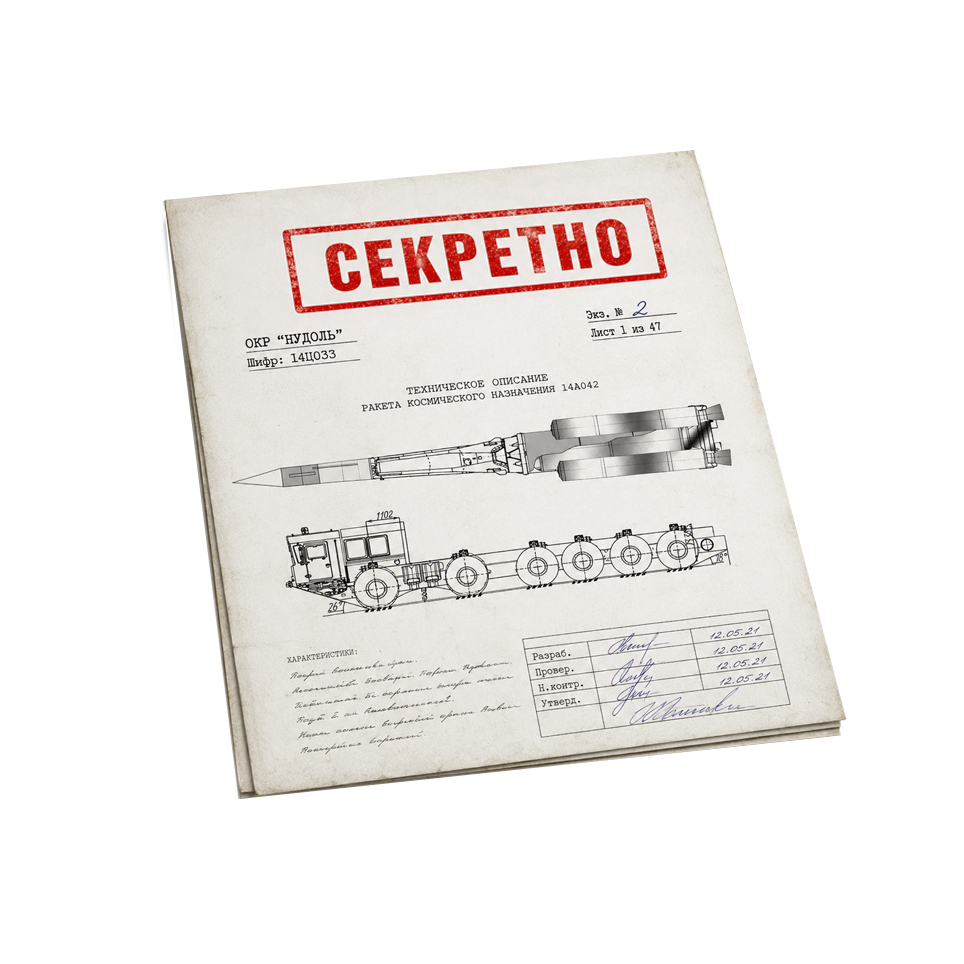


The anti-missile and anti-space defense Nudol system has been under development for years by the sanctioned Almaz-Antey defense conglomerate. Russian media call the complex one of the country’s biggest military secrets, a “satellite killer”, and have even threatened to use the missile against SpaceX’s low-orbit Starlink satellites. Little is publicly known about how the system is produced – but partners of the StateWatch Think Tank have obtained a package of documents shedding light on previously unknown details.
Key findings:
- In 2021, Russia used the Nudol system to test-destroy a satellite in an orbit dangerously close to the International Space Station.
- The developer of the 14A042 missile for the 14Ts033 complex is the Novator Design Bureau, part of the Russian Almaz-Antey defense conglomerate.
- The Novator bureau is also developing the 102A6 missile for the 103T6 complex, known from the documents as “Svyatogor”.
- Both missiles consist of shared components, produced by an entire cooperation of enterprises from Russia’s military-industrial complex.
- The missiles’ construction uses substances of foreign origin, including Chinese-made Centralite II and cellulose acetate from the Swiss manufacturer Cerdia (formerly French Rhodia Acetow).
On November 15, 2021, just months before the full-scale invasion, an alarming signal reached the ISS from Earth: cosmonauts were ordered to immediately take their seats in the emergency return spacecraft in case the station was damaged and depressurized. According to the U.S. Space Command, a satellite in an orbit close to the ISS had been destroyed, creating more than 1,500 fragments of space debris that posed a potential threat to crew safety.
It later became known that the cause of the incident was a test of Russia’s Nudol anti-satellite system. The Russians had already conducted at least nine trial launches of the missile before this – but this was the first time the complex struck a real object in space. The target was the defunct Soviet satellite Kosmos-1408 of the Tselina-D series, launched in 1982. The debris created by the strike remained in a hazardous orbit for years, threatening the normal operation of many spacecraft, including the ISS.
What the Published Documents Reveal
The history of Nudol dates back to Soviet times, when the USSR Council of Ministers ordered the modernization of the A-135 Amur anti-missile and anti-space defense system, built to protect Moscow from a nuclear strike. The modernization program received the military designation A-235, but with the collapse of the Soviet Union, development work was put on hold.
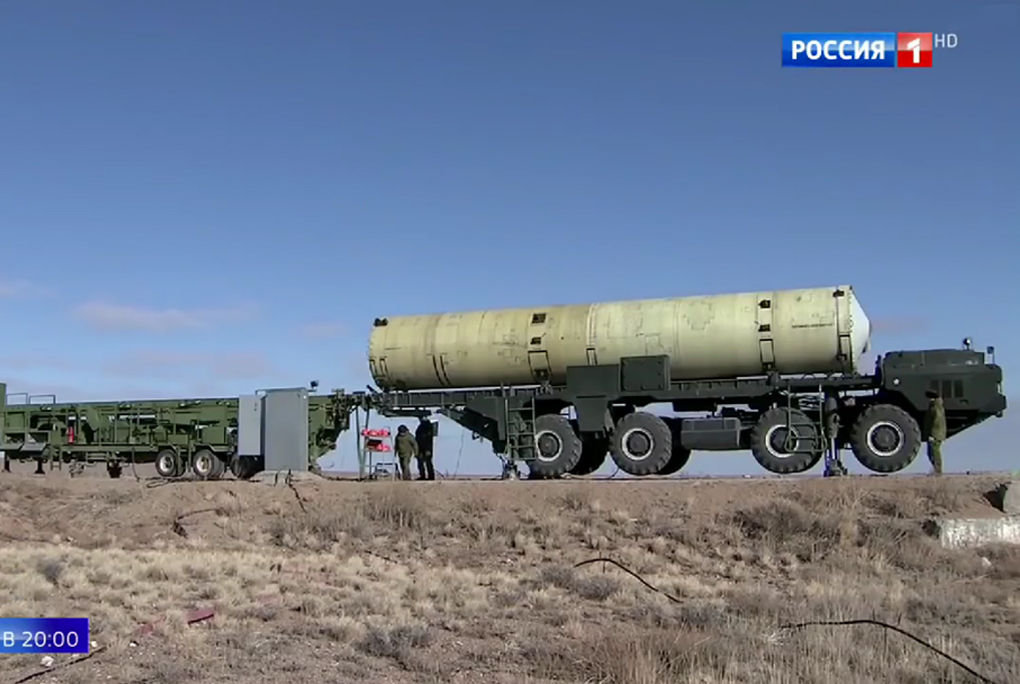
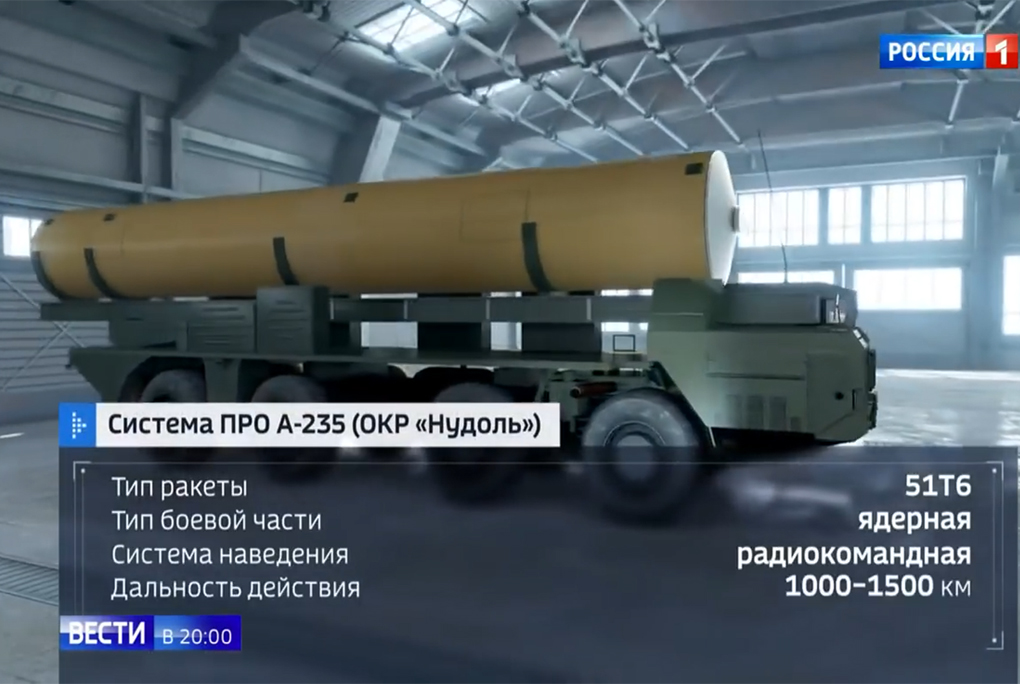
From the early 2000s, the Almaz-Antey conglomerate resumed work on the system, and Russian media increasingly began associating the A-235 designation with the new Nudol anti-satellite project. Images of a mysterious next-generation complex, presented as a future part of the A-235 system, began appearing in the conglomerate’s annual reports and corporate calendars, as well as on state television and Russian Wikipedia.
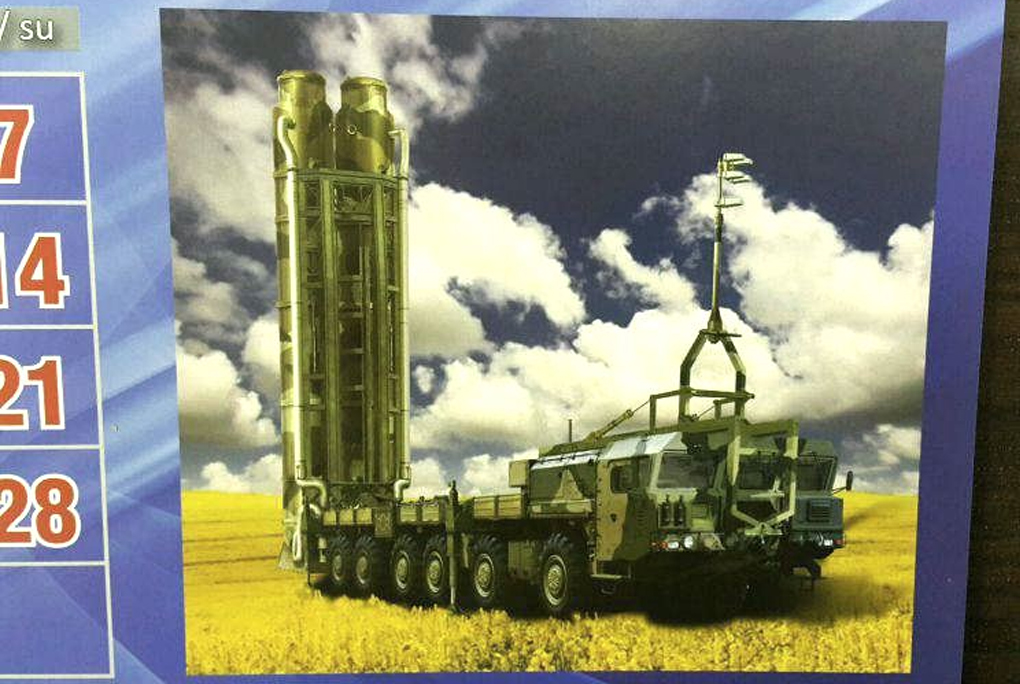
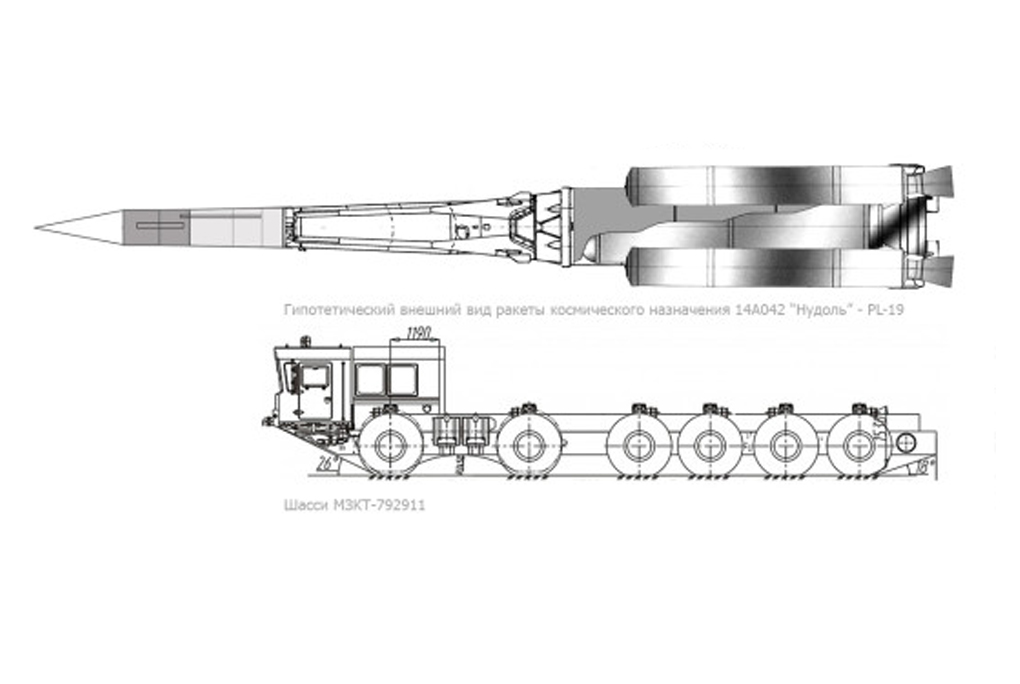
The core elements of the Nudol system are the 14Ts033 firing complex, the 14A042 missile with its launcher, and a transport vehicle based on an MZKT chassis (Minsk Wheel Tractor Plant, Belarus). The missile was developed under a state contract between Russia’s Ministry of Defense and the Almaz-Antey aerospace defense conglomerate. The lead supplier and manufacturer of the 14A042 missile is the Novator Design Bureau, a subsidiary of the same conglomerate.
Internal documents from this enterprise reveal an important finding: alongside the 14A042 missile for the 14Ts033 complex (Nudol), the Novator bureau is also developing the 102A6 missile, intended for a separate complex designated 103T6. According to the documentation, both products are similar and partly consist of identical components – fiberglass casings, engines, gas generators, pipelines, steering actuators, sensors, woven composite materials, and explosive components.
The same Russian companies work on both missiles. Shared components for the 102A6 and 14A042 products are produced by JSC PO Sever, PJSC NPO Iskra, JSC NIIPM, the Federal State Enterprise Perm Powder Plant, JSC Kazan Design Bureau Soyuz, JSC NPP Krasnoznamenets, JSC Avangard, JSC Signal Design Bureau named after A.I. Glukharev, and JSC Tri-D. The supply chain also includes JSC Precision Engineering Design Bureau named after A.E. Nudelman and JSC Tikhomirov Scientific Research Institute of Instrument Design.
Documents from Russia’s Perm Powder Plant contain the first mention of a potential name for the 103T6 complex – “Svyatogor”. Work on the Svyatogor and Nudol projects proceeds in parallel at the Perm Powder Plant as well. In investment project applications, production records, and correspondence with Almaz-Antey, both projects are consistently listed together. Nudol is classified in them as “a mobile strike anti-satellite complex”, while Svyatogor is described as “a multifunctional missile complex” or “an air defense system”.
But why would the Novator bureau simultaneously develop two nearly identical missiles? One possible explanation is that the missiles are intended for different basing modes – stationary and mobile. The 102A6 missile, as part of the 103T6 complex, could become one of the layers of the stationary A-235 missile defense system. This is suggested by the “T6” index, which also appeared in the 51T6 and 53T6 interceptor missiles of the earlier A-135 system that has protected Moscow since Soviet times.
The 14A042 missile, as part of the 14Ts033 complex, could instead be adopted as a mobile anti-satellite complex on a wheeled chassis, similar to the S-500 Prometey system – a fate Russian military experts already predict for Nudol.
In addition to details about the Russian manufacturers of the system, the documents contain information about the use of foreign-made raw materials in the 103T6 and 14A042 products, including cellulose acetate from the Swiss manufacturer Cerdia (formerly French Rhodia Acetow) and Centralite II, a compound made in China. Due to their chemical properties, both substances can be used to produce solid rocket fuel – the same two compounds are used to produce the Kalibr cruise missiles that Russia regularly uses to strike Ukrainian cities.
One component of the Nudol missile also requires another compound – FL-39 glyphthalic resin, which the documents describe as being in short supply. According to the documents, projected consumption of the substance was expected to grow sevenfold over two years, reaching 840 kg in 2026. The main supplier of this raw material to the Perm Powder Plant is the company Raduga-Sintez LLC, based in the Russian city of Elektrougli.
Overall, the documents show that Russia continues to invest in the development and production of military hardware for the further militarization of space and threats to the civilized world. The Nudol anti-satellite system poses a threat to both military and civilian spacecraft of all countries, including Ukraine’s international partners. At the same time, Russian factories continue to receive foreign-made raw materials, and companies such as JSC Tri-D and Raduga-Sintez LLC, which supply missile manufacturers with scarce components, remain outside international sanctions.
This material was prepared as part of a collaboration between the StateWatch Think Tank and UNITED24 Media. The full investigation, with contracts and documents from the enterprises, is available at the link.
This material was produced with the support of the International Renaissance Foundation. The material represents the views of the authors and does not necessarily reflect the position of the International Renaissance Foundation.