

Nuclear licenses
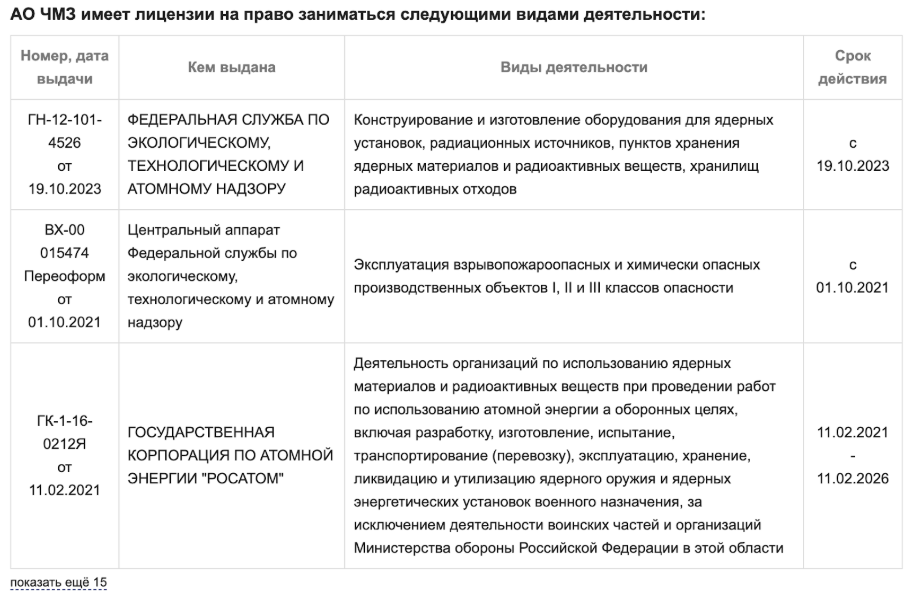
In 2015, the plant received a license for “Development, production, testing, installation, assembly, maintenance, repair, utilization and sale of weapons and military equipment”. In 2021, it was granted a license for “Activities of organizations for the use of nuclear materials and radioactive substances in the course of work on the use of nuclear energy for defense purposes, including the development, manufacture, testing, transportation, operation, storage, elimination and disposal of nuclear weapons and nuclear power plants for military purposes.” The license is valid until February 2026. In 2023, the plant received a license for “Design and manufacture of equipment for nuclear facilities, radiation sources, storage facilities for nuclear materials and radioactive substances, radioactive waste storage facilities”.
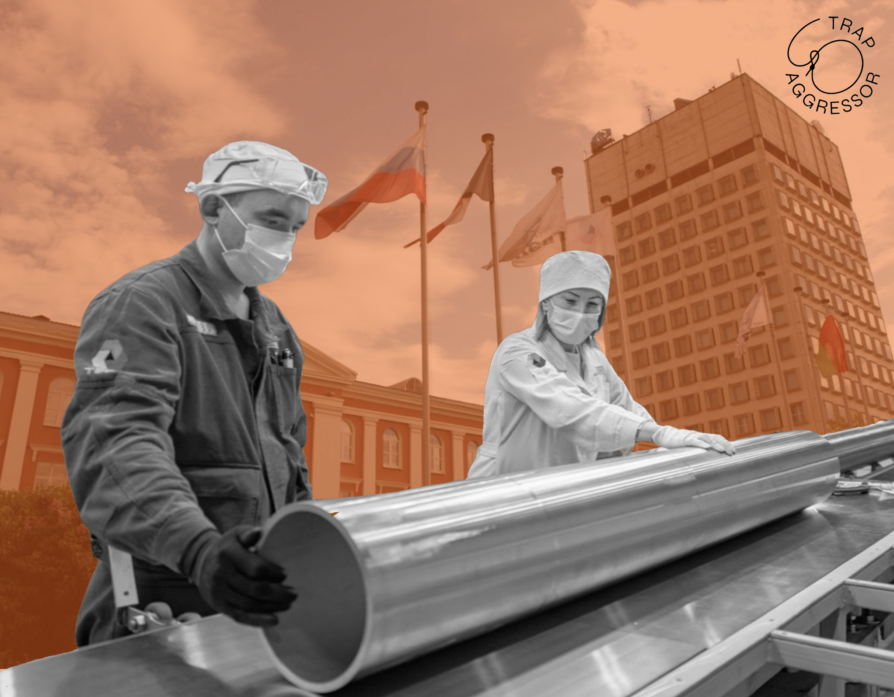
CMP produces 70% of titanium welding wire in Russia. Its products account for 18% of the global market for rolled zirconium (in the form of sheets used in the nuclear power industry, Ed.)
Chepetsky Mechanical Plant: innovations for the nuclear industry and Putin’s support
Chepetsky Mechanical Plant’s CEO is Sergey Chineikin. Under his leadership, the plant is actively introducing new technologies for nuclear energy and the military-industrial complex. In 2024, ChMZ began manufacturing chrome cladding for fuel rods (fuel rods are heat-emitting elements, Ed. note), a technology that improves the safety of nuclear reactors. Such developments are important for the development of nuclear fuel in Russia.
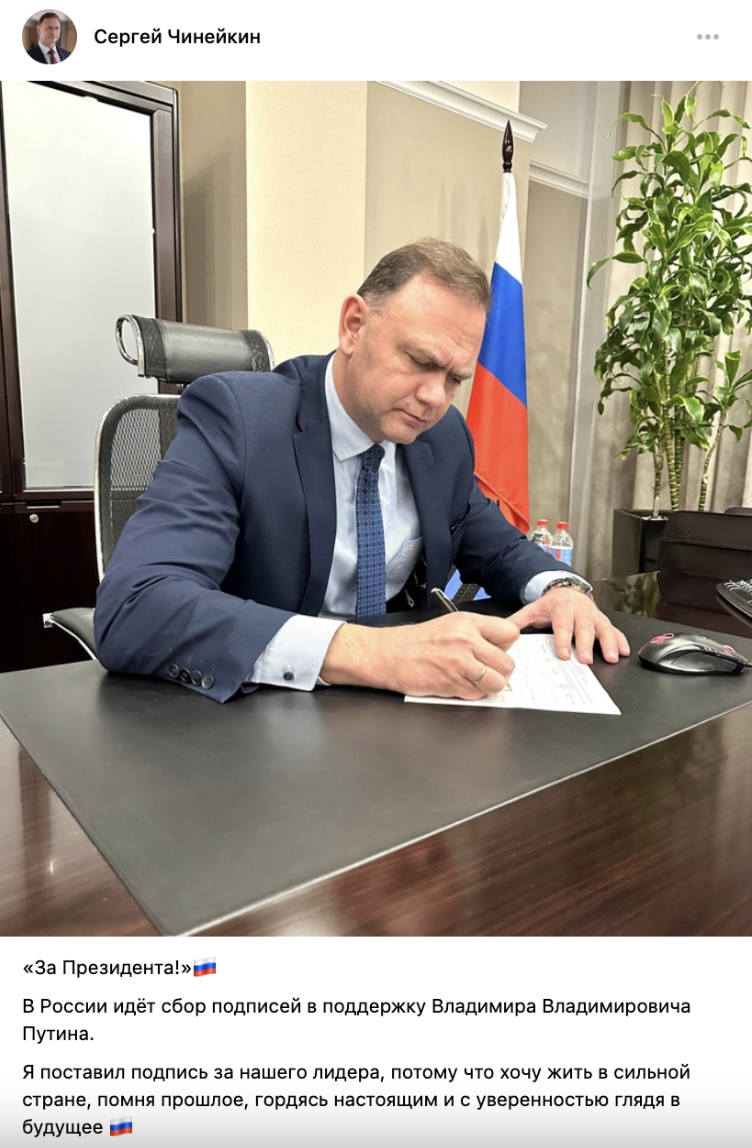
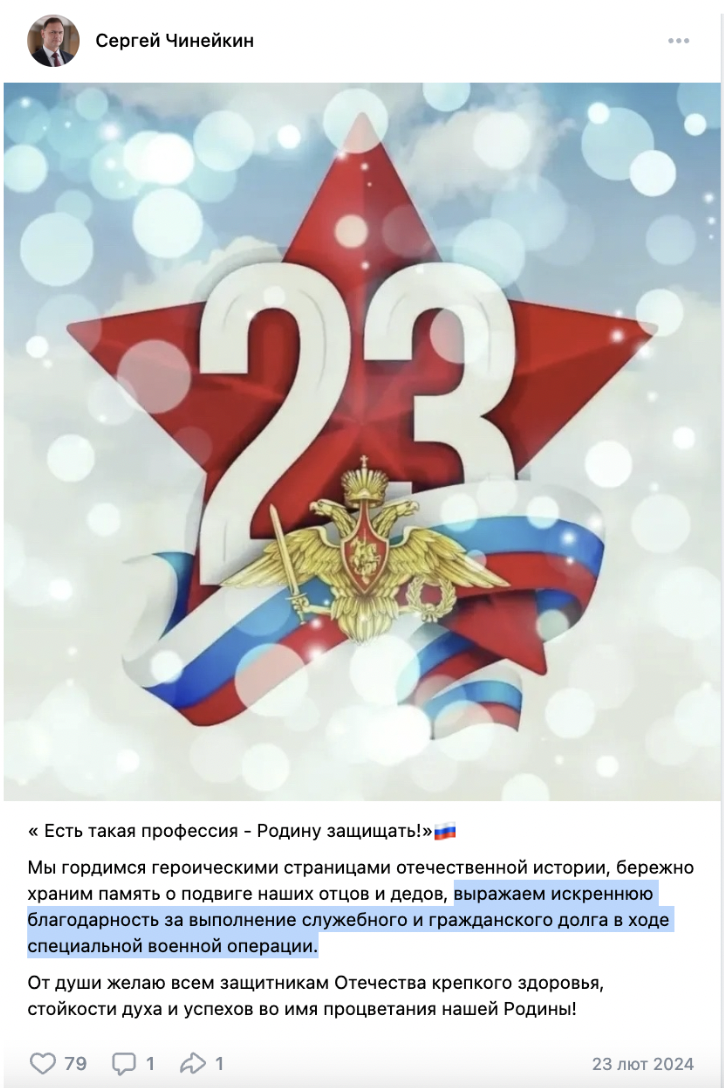
Sergey Chineikin is a member of Putin’s United Russia faction in the Council of the Udmurt Republic and a member of the Standing Committee on Budget, Taxes and Finance. Accordingly, he actively supports Putin in his social media and thanks the Russian military for fulfilling their civic duty during the so-called “special military operation“.
Titanium produced at the Chepetsky Mechanical Plant has become a strategic export commodity that freely overcomes sanctions barriers thanks to a well-established system of international intermediation. In particular, the plant has established stable supply channels through a front company, Hermith GmbH, a German company, and a Turkish company, Ti̇tan 2 Ic İçtaş İnşaat Anoni̇m Şi̇rketi̇, which is actually a joint venture with a Russian concern, allowing it to circumvent international restrictions and continue exporting critical raw materials to Western companies.
Fictitious partners: how Russian titanium gets to Western markets
The so-called “German” company Hermith GmbH was registered in Munich in 2004. Since then, it has been headed by Alexey Rasskazov, a native of Russia.
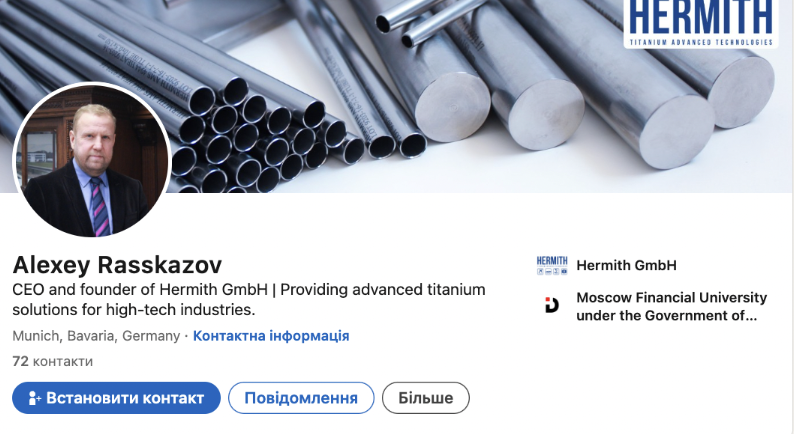
Until 2000, he worked as a manager in several large companies in Moscow. After that, he moved to London and then to Serbia. And now he manages the German Hermith GmbH in Munich.
In 2017, a delegation from Germany, led by Bavarian Prime Minister Horst Seehofer, paid a working visit to Moscow. The meeting resulted in the signing of a long-term contract between the Bavarian company Hermith GmbH and JSC Chelyabinsk Metallurgical Plant for the supply of more than 1,000 tons of titanium products to Europe.
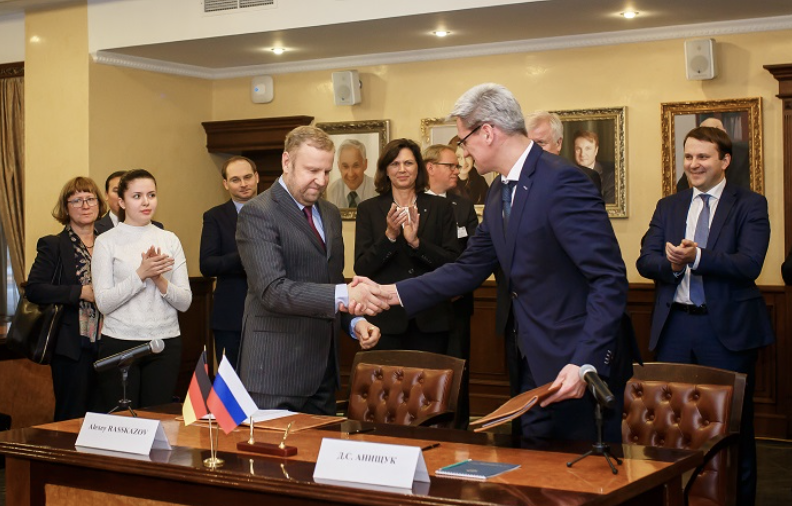
“Thanks to the well-established interaction between our engineering staff and the production base located in Russia, we can quickly respond to changes in market demands and provide the consumer not only with the material but also with a ready-made integrated solution for its use,” said Alexey Rasskazov, CEO of Hermith GmbH, at the time.
Already in 2019, Hermith GmbH and Rosatom’s TVEL agreed to jointly produce finished titanium alloy products at the Atomexpo-2019 forum in Sochi (Russia).
The Turkish Ti̇tan 2 Ic İçtas İnşaat Anoni̇m Şi̇rketi̇ is a joint venture of the Turkish construction company IC İçtas İnşaat and the Russian concern TITAN-2, which is closely associated with the state corporation Rosatom (TITAN-2 is one of the key contractors and partners of the state corporation, Ed. Ed). This ownership structure allows Russia to circumvent sanctions, maintain its presence in Western markets, and continue to finance military aggression by using titanium products to produce weapons.
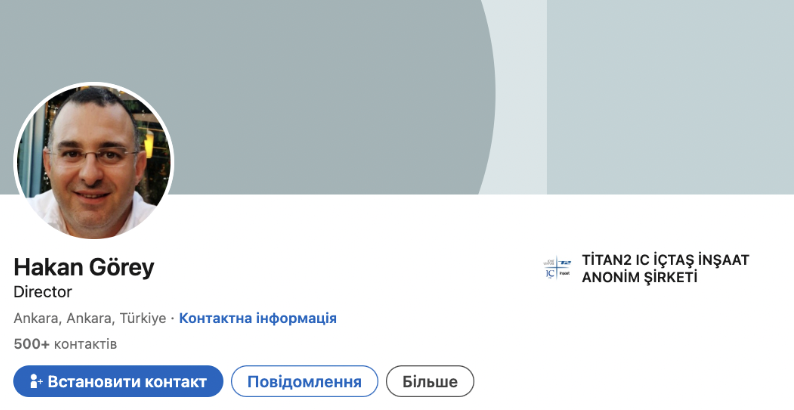
The director of Ti̇tan 2 Ic İçtaş İnşaat Anoni̇m Şi̇rketi̇ is Hakan Gorey, who also indicates his work in the Russian Federation in his LinkedIn profile. From 2014 to 2015, Hakan worked as a team leader in a joint venture between the Swedish company ICA and the Turkish company İztaş, which implemented the project for the construction of the Pulkovo terminal in St. Petersburg.
Despite their systematic work for the Russian military-industrial complex, neither Chineikin nor ChMZ have been included in the US and EU sanctions lists. This allows the plant to continue earning millions by supplying raw materials for the Kremlin’s military needs.