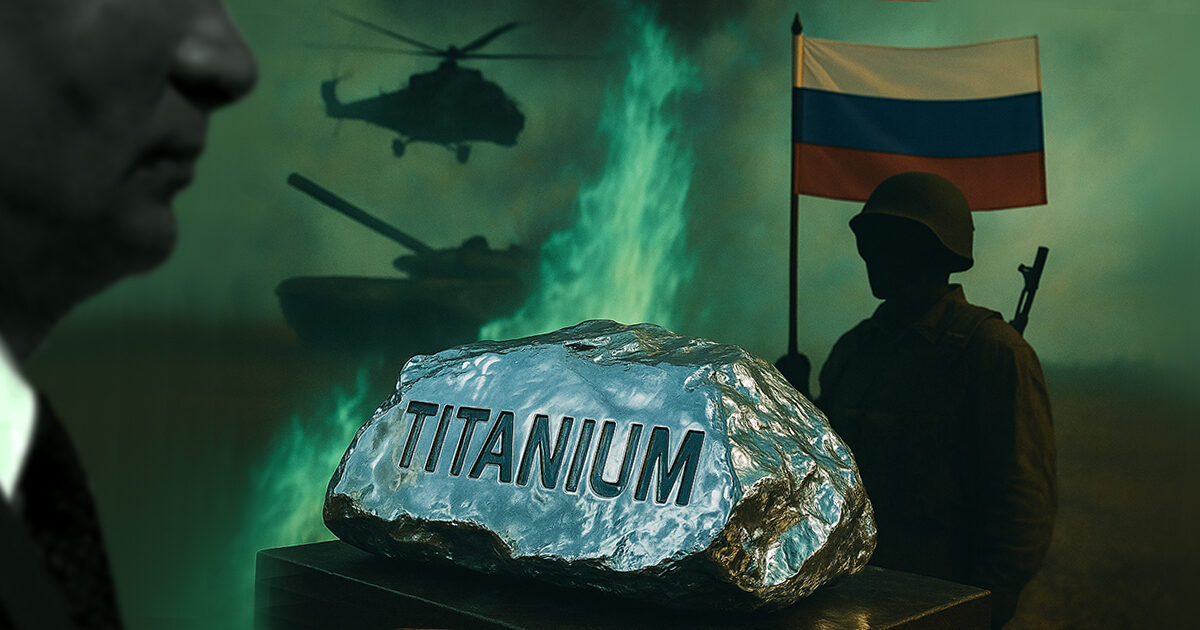

Despite sanctions and its ongoing war against Ukraine, Russia continues to obtain critical materials for weapons production from its seeming adversaries – the US and Europe. One such material is titanium, a key strategic resource in modern warfare. It is light, super-strong, resistant to high temperatures and corrosion, making it essential for producing advanced weaponry — especially in aviation, engine manufacturing, and precision equipment. Trap Aggressor analyst Sofiya Maksymiv has conducted an in-depth investigation into the mutual dependency between Russia and Western nations when it comes to titanium. Her research reveals how Western countries remain reliant on Russian titanium, while Russia still benefits from access to their markets and money.
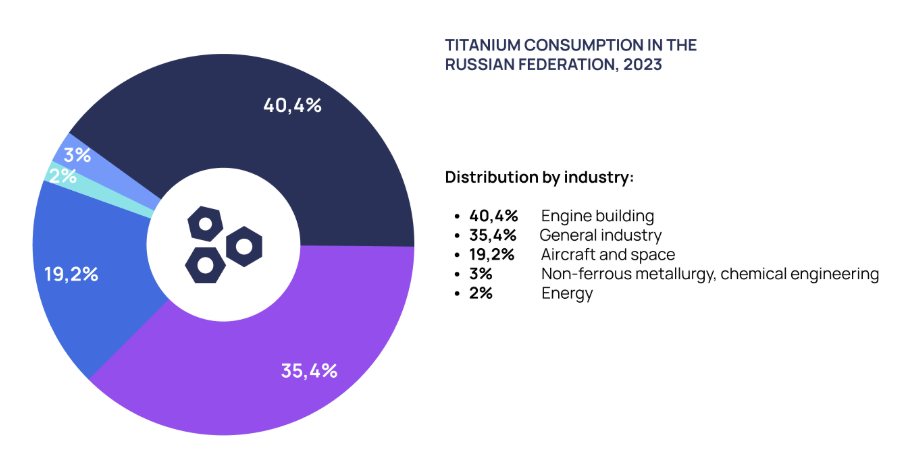
May, 2024. Titanium 2024 conference in Suzdal (Russia). Dmitriy Kurochkin, a marketing executive at PJSC VSMPO-Avisma, Russia’s largest titanium producer and one of the world’s biggest, delivered a boastful speech on the state of the country’s aerospace sector. He revealed that in 2023, the aerospace industry consumed 59% of Russia’s titanium output. Over 40% of this was used in engine manufacturing, while another 19% supported the production of aircraft, helicopters, and space technologies. In practice, the vast majority of titanium in Russia was either directly or indirectly used for the military-industrial complex.
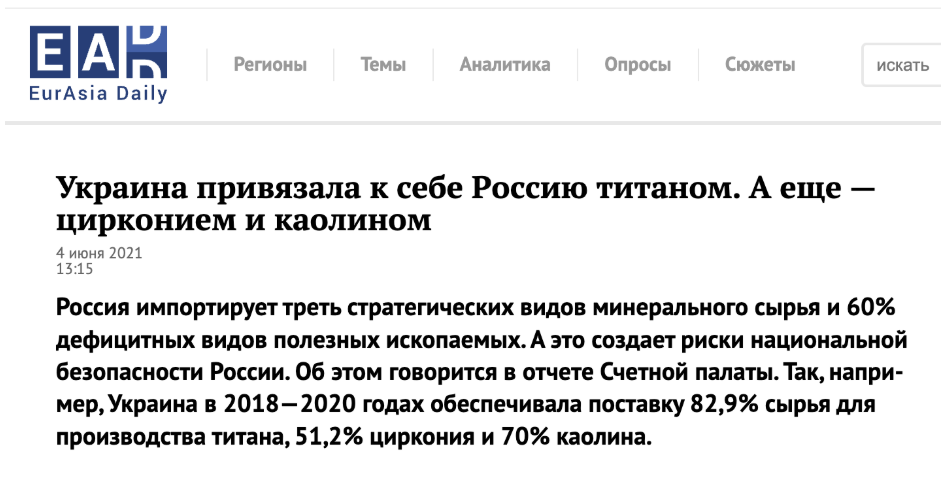
With the beginning of the full-scale invasion of the Russian Federation into Ukraine, supplies of these products from Ukraine became impossible, and the Russians found themselves in a difficult situation. The occupiers began to establish cooperation with other countries to purchase titanium. Obviously, they could not do without the help of Europe and the USA.
According to international trade databases, from February 2022 to November 2024, the Russian Federation directly imported titanium ore and metal products worth more than $275 million from Europe and the USA. Even more supplies were made through other countries. China remains Russia’s primary partner in the titanium sector, as ever.
Trap Aggressor has released a comprehensive report titled “World Titanium Dependence on Russia: Economy, Army, and Global Risks”. The study explores the global titanium market, its unique characteristics, Russia’s role in international trade of the metal, and why titanium is so vital for modern warfare.
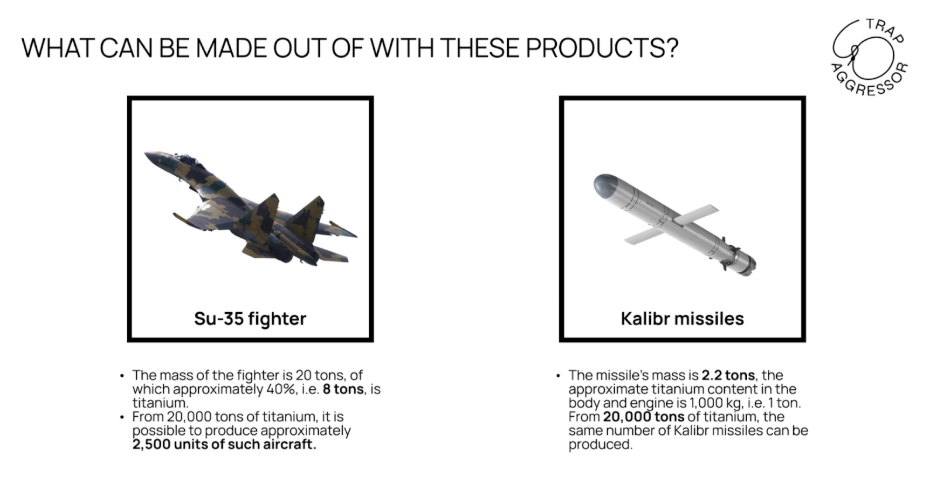
How much military equipment can Russia produce using imported Western titanium?
Products made of titanium and its alloys are used to manufacture a wide range of military products:
- mortar tubes,
- high-quality materials for barrels, nozzles, starting pistons, and gun mounts,
- parts for artillery systems,
- protective clothing and helmets,
- plates for body armour,
- aviation, in particular aircraft engines, etc.
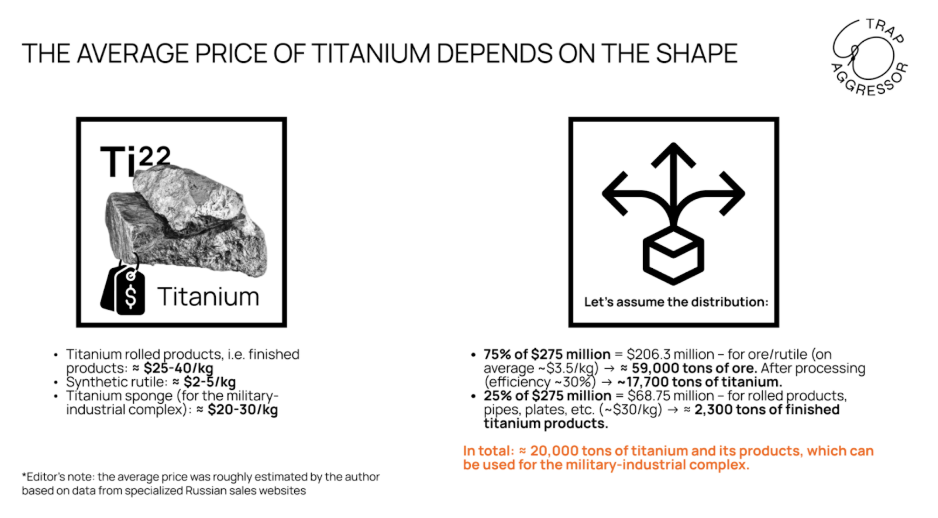
Let’s try to estimate how many units of military equipment Russia could theoretically produce from titanium imported from Europe and the USA during three years for the amount of $275 million.
Approximately 75% of Russia’s total titanium imports consist of ore and synthetic rutile (TiO₂), as the country faces difficulties developing new deposits and has lost access to Ukrainian raw materials it previously relied on. The remaining 25% of imports are finished titanium products such as plates, pipes, and rods. We’ll use this ratio for comparison.
The average price of titanium varies depending on its form (Editor’s note: the average price was roughly estimated by the author based on data from specialized Russian sales websites).
Previously, Trap Aggressor investigated the full-cycle metallurgical enterprise JSC Ruspolymet, which exports and imports titanium products through its German subsidiary Ruspolymet GmbH. We also investigated JSC Stupinsk Metallurgical Company (SMK), which specializes in the production of metal parts from heat-resistant nickel, titanium alloys, and special steels for the aviation industry and is used in all Russian aircraft, in particular in the engine designs of MiG and Su fighter jets. Both companies count numerous Russian military-industrial enterprises among their clients, as they supply raw materials to arms factories where these materials are used to produce military equipment.
Schrödinger sanctions
There is still no official ban on the supply of titanium to and from Russia. Major supplies do not violate the sanctions if they do not go directly to a sanctioned enterprise. However, a significant part of these products and raw materials end up at the enterprises of the Russian military-industrial complex through a chain of foreign and Russian companies.
In 2022, Russian titanium was excluded from proposed sanctions lists at the last moment. The move was blocked by France and other EU member states due to the reliance of Airbus, the leading commercial aircraft manufacturer, on Russian titanium. As a result, Russia has continued trading titanium products with European companies, generating revenue and acquiring essential equipment and materials for its operations.
On September 27, 2023, the U.S. Department of Commerce’s Bureau of Industry and Security imposed export restrictions on PJSC VSMPO-Avisma Corporation. Under these measures, any goods made in the United States and destined for VSMPO-Avisma now require an export licence. However, this action does not freeze the company’s assets or fully prohibit business activities—as would be the case if it were placed on the U.S. Treasury’s SDN List. Consequently, the Russian corporation continues to profit, albeit under stricter regulatory oversight.
In February 2024, Canada imposed sanctions on the company. Still, later it had to allow the French company Airbus to purchase titanium from the corporation due to the requests of the French government, including Macron himself.
Various sanctions are imposed on individual companies related to the Russian titanium market: the aforementioned VSMPO-Avisma Corporation, Uralredmet, Chepetsk Mechanical Plant, Ruspolymet, etc. However, sanctions on these companies should cover more jurisdictions to isolate their ability to earn money and saturate the Russian military-industrial complex.
The actual participation of European companies in the supply of titanium to and from the Russian Federation is the Achilles heel of the sanctions policy against the Russian Federation. Control over such flows should be strengthened, since every kilogram of titanium from Europe may well become part of a tank or missile that will hit Ukrainian cities tomorrow.
#ResourcesofWar is a new series of materials within the Trap Aggressor project. In it, the team’s analysts and journalists investigate subsoil, minerals, and other resources that help the Russians wage war and support their military-industrial complex.
The material was prepared with the support of the International Renaissance Foundation. The material represents the position of the authors and does not necessarily reflect the position of the International Renaissance Foundation.
