
Shahed-131
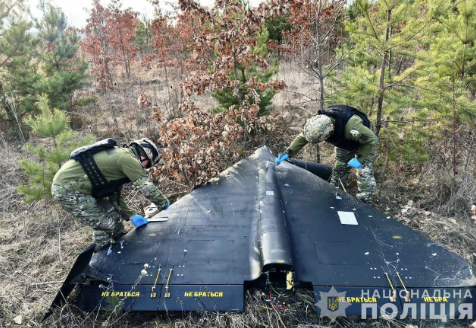
The history of Shahed use in Ukraine began with Shahed-131, also known as Geran-1 and IRN-05. The UAV is made of carbon fiber reinforced with internal metal supports. The piston internal combustion engine drives the platform with a fixed-pitch wooden screw. The electronic system inside was interconnected using a specially marked wire. It is estimated that it can be launched from static rails or a truck.
The original Shahed-131 is equipped with a 38-horsepower Wankel Serat 1 rotary engine, which was designed in Iran based on the British AR 731. According to the Kyiv Institute of Forensic Expertise, only spark plug caps are of Iranian origin. The spark plugs were previously Japanese, now they are Chinese.
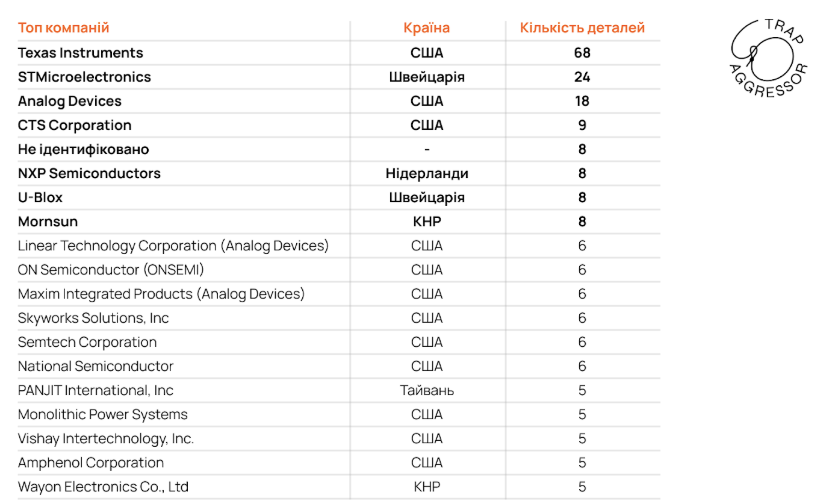
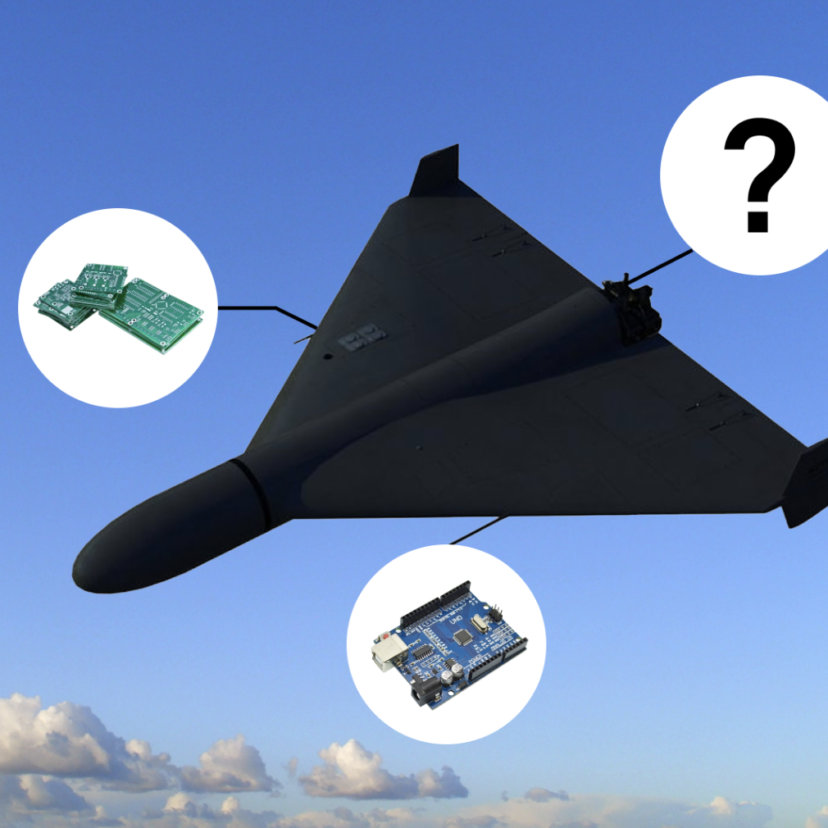
The Shahed-131 (Geran-1) had a Flight Control Unit (FCU) containing five custom-made printed circuit boards with TMS320 F28335 processors from American Texas Instruments. A printed circuit board with a processor from the same company was also found inside the Engine Control Unit (ECU).
The Shahed-131 model was later used as the basis for the Shahed-136.
Shahed-136
The updated kamikaze UAV Shahed-136 (Geran-2) can be launched in a volley from mobile launchers disguised as a truck, each of which can simultaneously launch up to 5 UAVs.
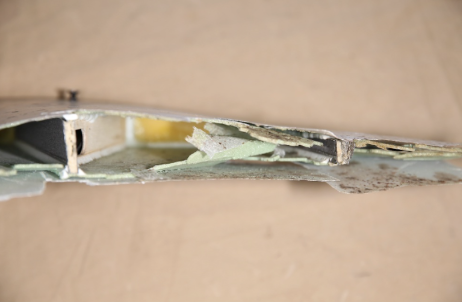
Its frame is made of carbon fiber and honeycomb and can be made by anyone without serious design knowledge. In later versions, there is no honeycomb structure – instead, it is made of polystyrene foam.
“The frame can also be made of aluminum alloy, which is a more complex solution, but faster and easier to manufacture. A honeycomb is a structure that is most often made of cardboard and resembles a bee’s honeycomb, hence the name. Such material allows you to fill all the cavities in the drone’s structures to evenly distribute the loads that arise during the flight. Polystyrene foam is better suited for this: it is just as light, but it is not as affected by humidity and temperature as cardboard,” explains Andriy, an expert in the development of UAV complexes.
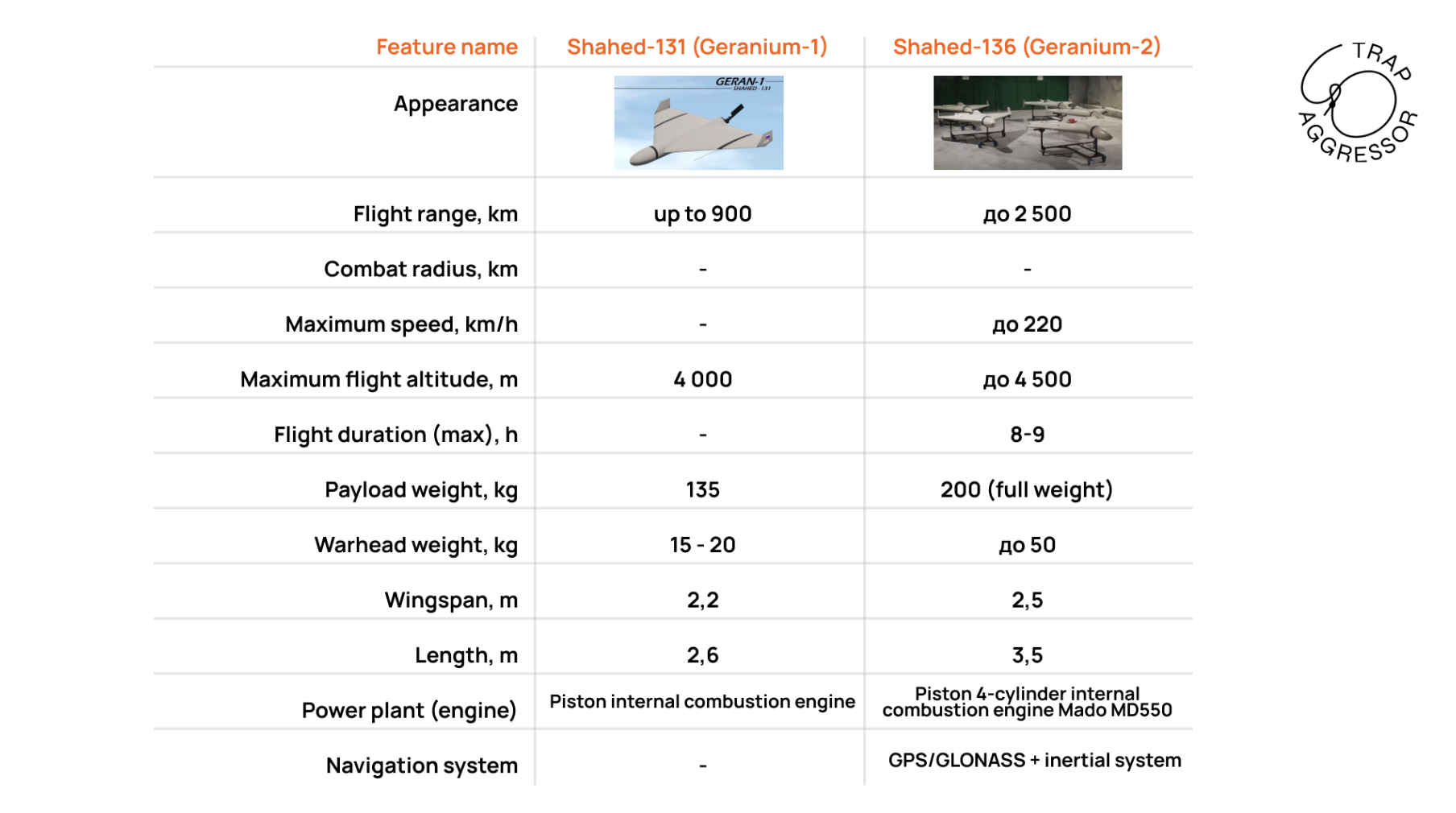
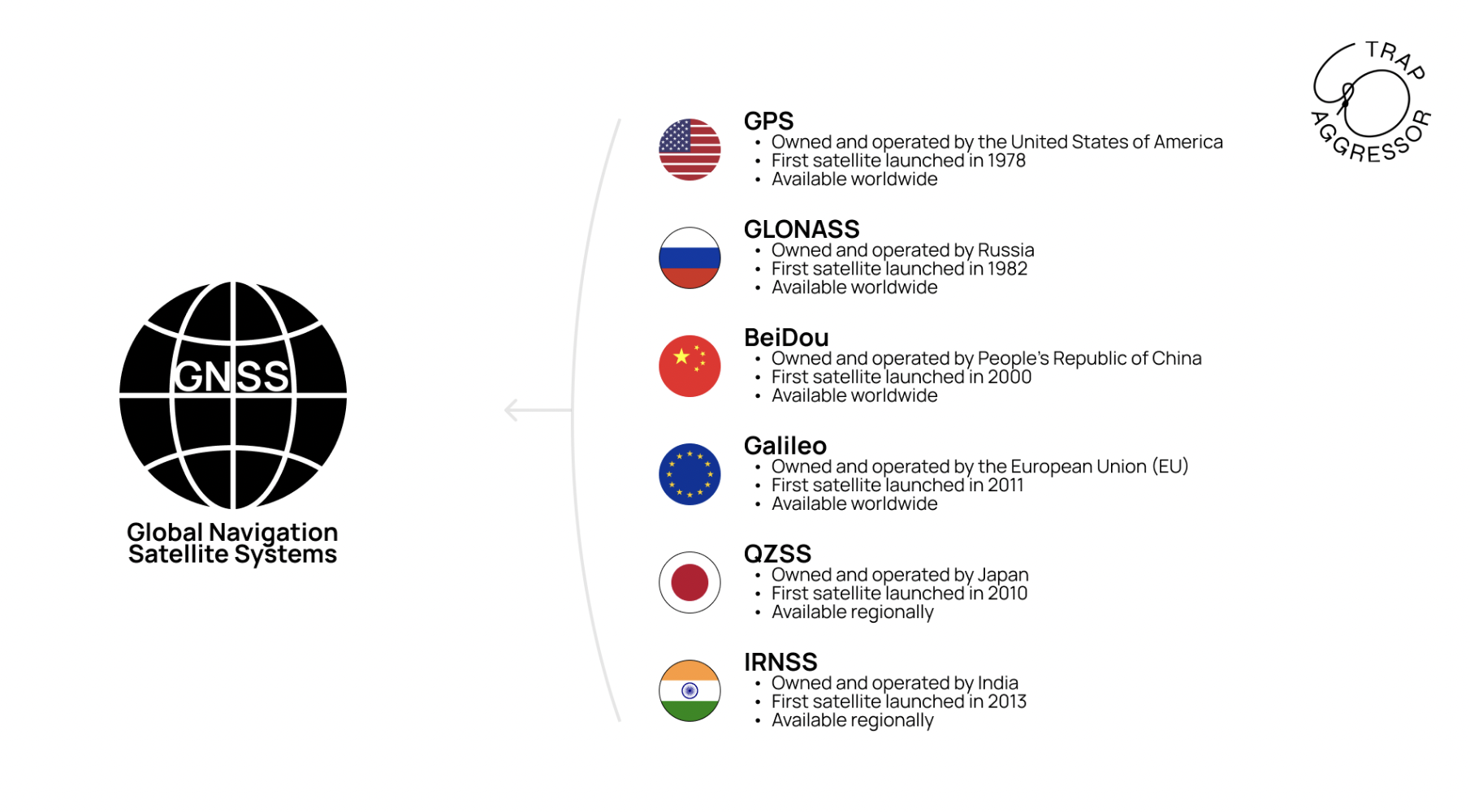
In March 2024, the Russians began installing DGPS, or differential GPS, navigational equipment on their Shahed-136s, which in theory could increase the accuracy of hitting these enemy kamikaze drones. Such systems are used for both civilian, such as agricultural equipment for precision tillage, and military equipment.
Shahed-238
In January 2024, the Ukrainian Armed Forces destroyed a new Iranian-made Shahed-238 (Geran-3), which Russia used during one of the UAV attacks on Ukraine. The Geran-3 is dark in color and silent. Almost all components of this drone are similar to the previous ones. However, a Chinese turbojet engine with a thrust of 250-300 kg is used in Shahed-238 instead of piston engines used in previous modifications.
“A jet engine is more complex and expensive to maintain and manufacture. It consumes more fuel, but the drone can develop a higher speed with it, meaning it’s more difficult to detect and shoot it down. However, its flight range is shorter,” says Andriy.
The engine is installed inside the fuselage of the Shahed-238, while most of the Shahed-136 piston engine is located outside. This kamikaze drone can speed up to 480 km/h and carries a 50 kg high-explosive fragmentation warhead. It has a range of about 2,000 km. This speed, combined with lower visibility and lower engine noise, theoretically makes the Shahed-238 less vulnerable to ground fire from Gepard or other heavy machine guns. On the other hand, the higher speed and likely higher thermal emission would make the Shahed-238 easier to detect by heat-seeking air defense missiles.
Still impossible to do without Western components
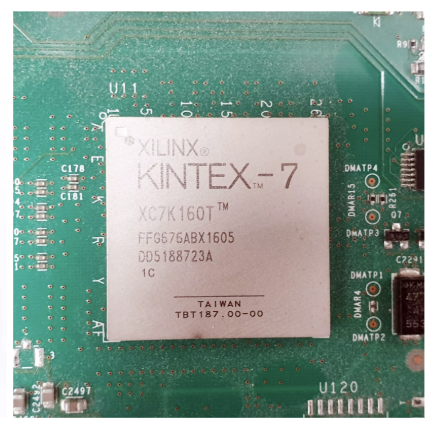
The satellite navigation signal processing of the new Shahed is implemented mainly on American products.
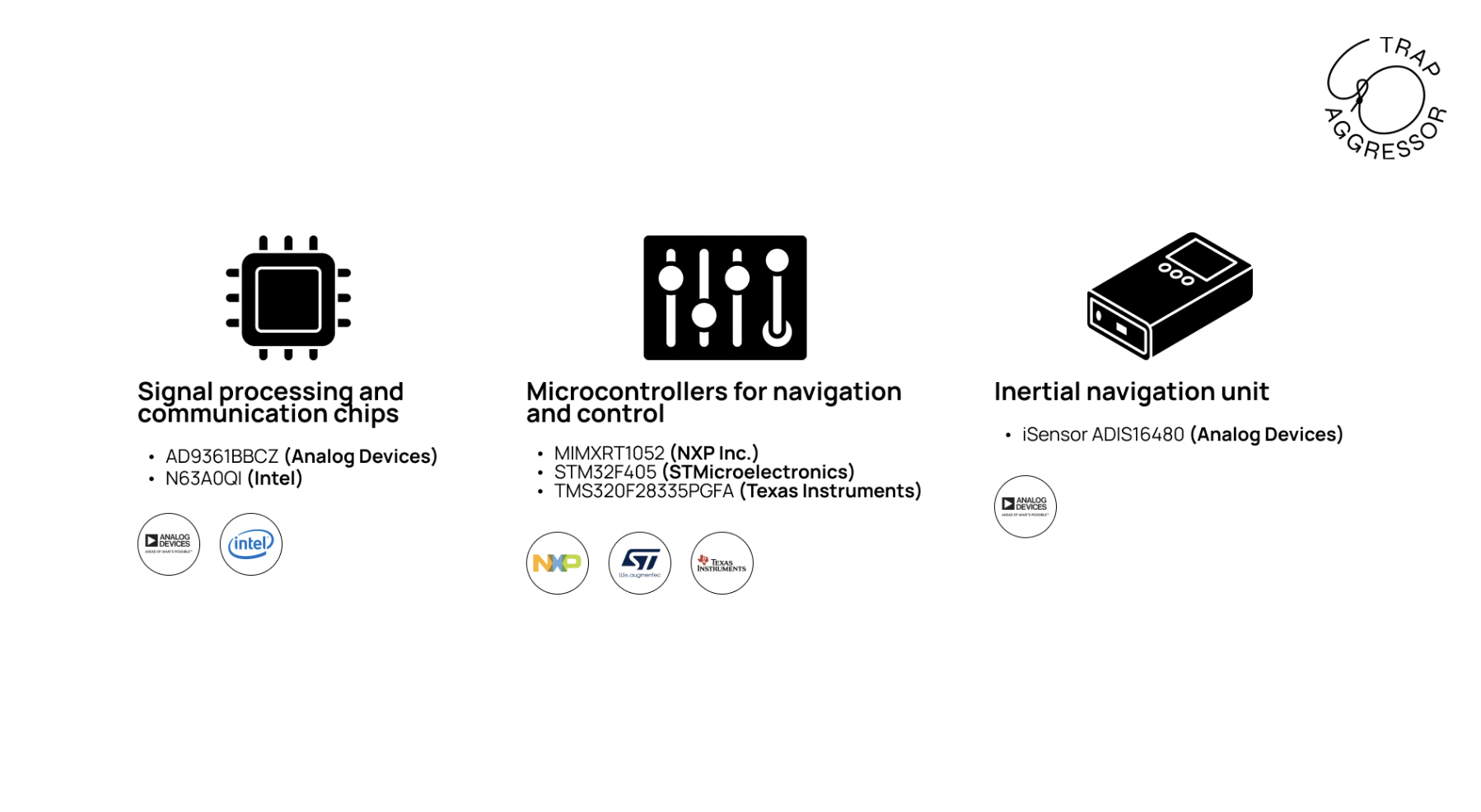
Andriy explains: “The use of electronic components from these companies may indicate that there are no Chinese or local Russian analogs, or they fail to meet the required specifications. As a result, proven solutions with reliable, predictable quality are preferred. This is exactly what these advanced American companies are known for.”
A more “advanced” Shahed-238 can cost as much as a Kalibr missile – from $200,000 to $300,000. This depends on the urgency, volume of the order, location of production, and many other factors.
There are three variants of the Shahed-238, all of which are equipped with the Iranian Toloue-10 896 microturbojet engine, but have different guidance systems. The standard model includes standard guidance systems based on GPS/GLONASS and inertial guidance systems used in the Shahed-136. The second version includes an infrared system to search for “hot” targets, such as military vehicles. The third version has a radar detection system designed to attack air defense systems and other radars.
Forced modifications: why is Russia changing the filling of the Shahed-136, and what is behind it?
Spoiler: It’s not just about sanctions—though they play a major role!
It may seem that the main motivation for changing the content of drones is the desire to improve their efficiency by selecting more stable or efficient components. For instance, upgrading navigation systems could help drones withstand Ukrainian electronic warfare better. However, in the realms of mechanical and aerospace engineering, there are a number of external and internal factors that affect the availability and selection of components.
- Sanctions and restrictions on access to the components
First of all, sanctions. Western trade restrictions and bans have seriously complicated the supply of electronics and high-tech parts used in the Shahed’s navigation systems, engines, and controls. They have been imposed both directly on Iranian and Russian manufacturers (including the Alabuga Special Economic Zone, a huge hub for Shahed production) and on intermediary companies supplying components. As a result, Russia is forced to look for analogs on the “gray” market, purchase components through shell companies, or even develop its own versions of some components, such as the Comet P8 adaptive antenna array, which can affect the quality and functionality of drones. Sanctions cannot completely stop all possible supply schemes through third countries, but they significantly increase the cost and slow down the production process.
- Suppliers’ refusal to cooperate with the Russian Federation
Some companies, even from countries that do not support sanctions, may deliberately refuse to sell parts to Russia to avoid reputational or legal problems. This forces Russian manufacturers to look for alternatives or use less efficient components.
- Financial factors or wholesale pricing
Shaheds are disposable and are mostly shot down by the Ukrainian Air Force. For example, the percentage of these drones shot down during May-July 2024 was about 94%. Therefore, Russia seeks to reduce the cost of drones in every possible way. Among other things, the purchase of parts often takes place on special platforms that resemble stock markets, such as DigiKey. Prices for the same product can change daily because if a company produces a large batch of a certain product, its prices can quickly fall, which buyers take advantage of. As in any other business, purchasing components in large batches is more financially profitable, even if the quality of such components is lower.
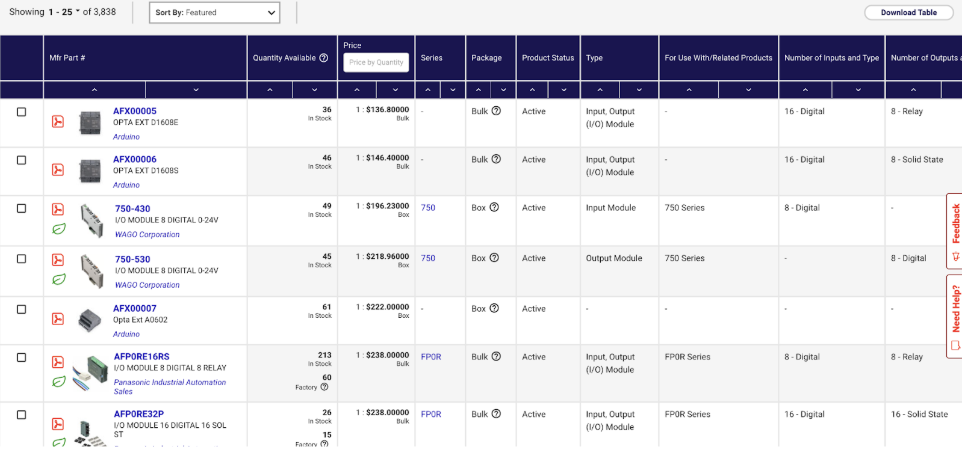
“One chip may cost $10, but if you order a bucket of these chips, it will cost 50 cents,” says a robotics engineer at one of the Ukrainian enterprises.
In addition, switching to cheaper analogs can allow you to increase production without a significant increase in costs.
“In volume, replacing a component is mainly an economic issue. That is, you can do R&D on one chip, and then abruptly switch to another if it is more profitable. Today, an STM-8 chip can cost 25 cents in bulk purchase, and the day after tomorrow – 10 cents. And the company can quickly choose a cheaper option if these components are interchangeable. Engineers calculate the cost of production in hours and in money. Then the management considers these proposals and decides what is more difficult for it: to continue buying these chips at double the price, or to replace them,” the specialist continues.
- The need for staff training
Operators and technicians who assemble and maintain drones at a particular production facility are limited in their knowledge and skills. If components change, employees have to spend additional time and effort learning to work with new parts. Therefore, each individual company purchases elements that are already familiar to its specialists or easier to maintain. Similarly, engineers who study which new components their company should purchase choose those they know how to work with. They often have to make decisions in a limited period of time, so this criterion should also be taken into account.
“For example, there are PLC controllers (programmable logic controllers), production controllers, etc. And a person in the development team knows how to work with only one type of controller. So, they purchase only that one,” the engineer explains.
- Adaptability to production capabilities
When changing the design of drones, any manufacturer focuses on the capabilities of its own production. Not all parts can be easily integrated into existing designs, and the creation of new technological processes requires time and resources. Therefore, the choice of components often depends on whether they can be easily produced on existing equipment. If the necessary parts are not found, the manufacturer can exclusively place orders for them by contacting the company directly.
“Switching to a mechanical bearing of a different diameter may require purchasing a completely different machine in order to work with it. If we talk about electronics, then the situation is similar, but deeper and more complex. When a manufacturer needs a specific transistor, its engineers can directly provide specifications for their production, and the factory will fulfill this order. The factory may not even publish them in its public catalogs. Because only one specific customer needs it,” says the specialist.
- Technical standards and compatibility
The Shahed contains components that must meet certain standards, including weight, power consumption, and resistance to external influences. If one element changes, it may require replacing other parts to maintain the overall efficiency of the drone.
“Engineers don’t make decisions off the top of their heads. There are certain technical requirements, and usually it’s about compatibility with something. Sometimes the technical task for an engineer sounds like this: we have such and such a PLC controller, and we need the same one, only under a license from the British company ARM Holding. This can happen for various reasons, and the engineer then has to look for this controller so that it is technically suitable for the already existing capacities and components and meets quality standards. When making changes to the board, for example, its complexity class can increase from 5 to 6. And it suddenly turns out that the entire plant has become unsuitable for this. Then we may be talking about building a new plant altogether. Therefore, in such cases, all the pros and cons of replacing certain components are weighed. Even models of the same drone can vary if they are manufactured in different factories due to a number of these factors,” the engineer explains.
The changes in Shaheds are a combination of economic, technical and political factors that affect both the quality and quantity of drones produced.
Which countries and companies provide components for Shaheds?
In November 2022, the British research organization Conflict Armament Research (CAR) documented about 500 components (including approximately 200 unique models) from four Shahed-131/136 UAVs shot down over the territory of Ukraine. These components were produced by more than 70 manufacturers from 13 different countries, with 82% of them manufactured by companies located in the United States.
A year later, in August 2023, CAR conducted a similar new study and analyzed more than 100 components (including 30 unique models) from two Shahed-136s shot down in Ukraine. They were produced by 22 different companies from 7 countries, including Russia. Most of the companies were headquartered in the People’s Republic of China, Switzerland, and the United States.
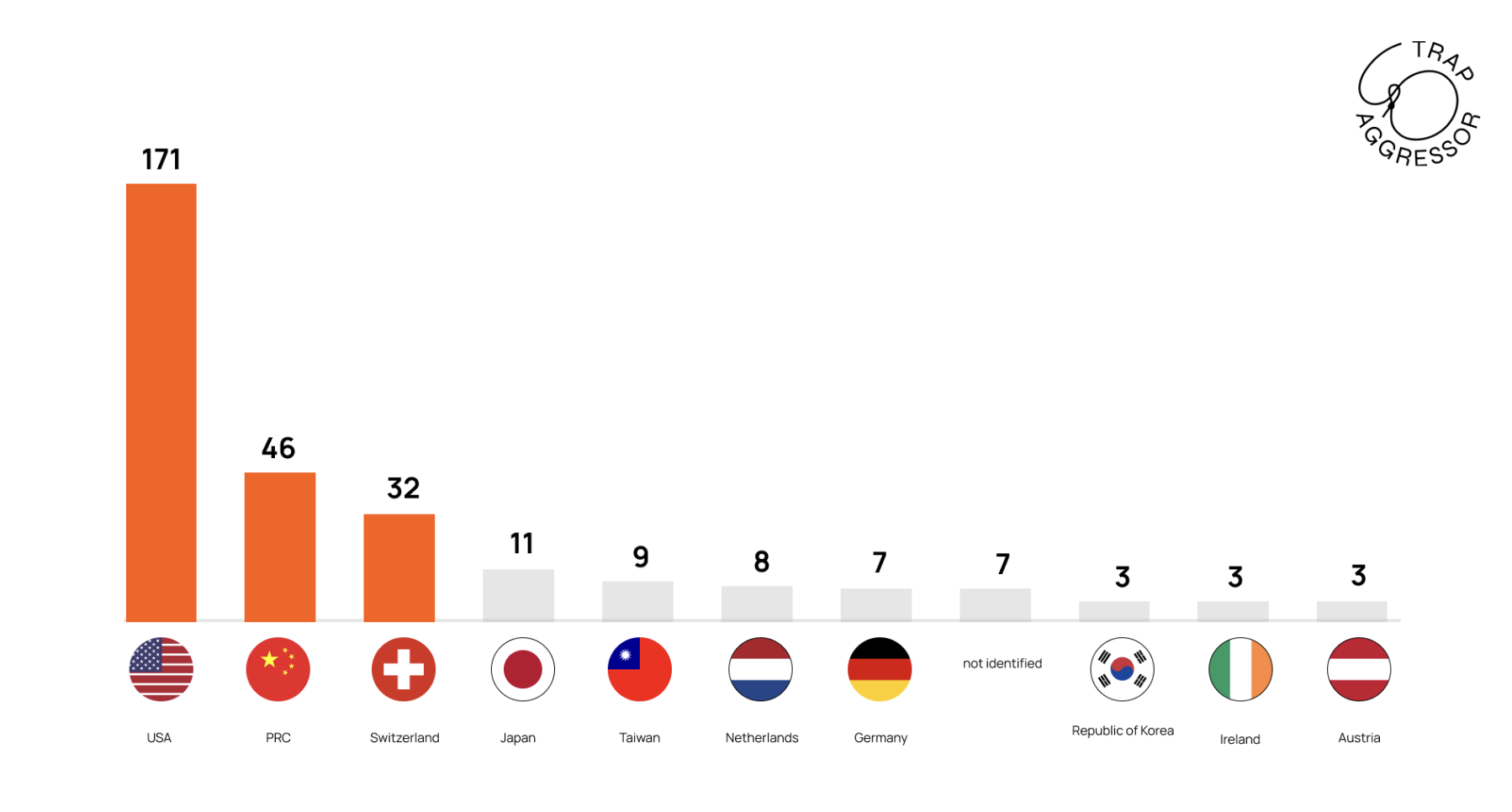
The “War and Sanctions” portal, created by the Defense Intelligence of Ukraine (DIU), contains data on Western components in Russian weapons, including the Shaheds. Analyzing the available data from the DIU website for the second half of 2024, we see that during this time the largest number of components found were from the USA (171), China (46), Switzerland (32), and Japan (11). Other manufacturing countries include Taiwan, the Netherlands, Germany, South Korea, Austria, and Ireland. Another 7 component manufacturers were not identified.
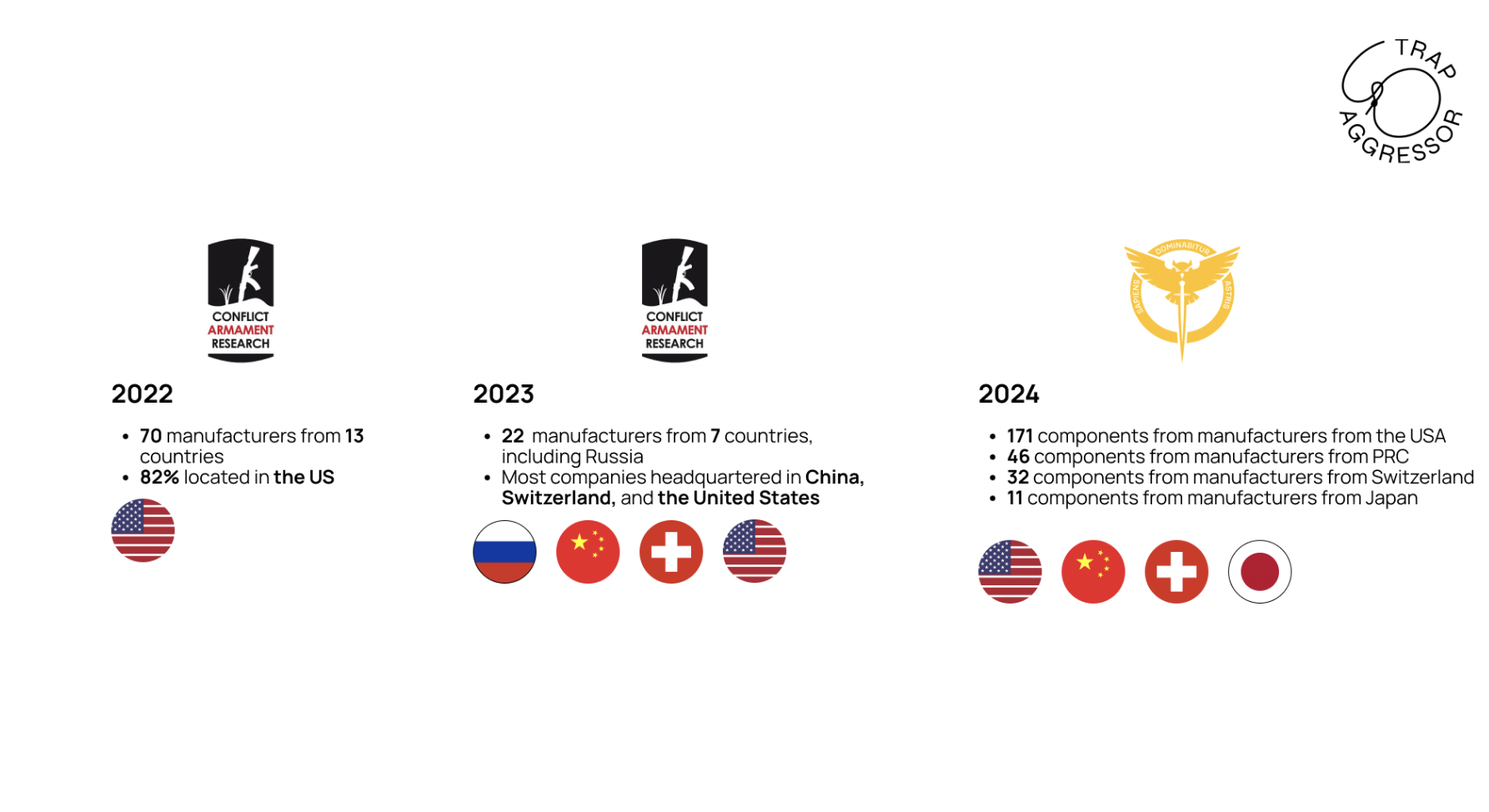
It is noticeable that after some decrease in the geography of imports of components for drones in 2023, in 2024 the number of exporting countries increased again (from 7 to 10 identified).
The share of the USA decreased to 57%, which still constitutes a significant part of all components in the found devices.