Roman Steblivskyi, Head of Sanctions Department at Trap Aggessor
On 10 April 2024, the Court of Justice of the EU issued a press release announcing the annulment of sanctions imposed on Russian oligarchs Mikhail Fridman and Piotr Aven. Various media reported this decision as if the General Court had lifted all sanctions against the oligarchs. However, this is not entirely true. Trap Aggressor analysed the General Court decision and discovered arguments that have not yet been disproved and are keeping Friedman under sanctions.
The document mentions that “the Court annuls the inclusion of Piotr Aven and Mikhail Fridman on the lists of persons subject to restrictive measures between February 2022 and March 2023.” This means that only some of the Council of the European Union decisions have been cancelled. In fact, Mikhail Fridman is still subjected to restrictive measures that bring him so much inconvenience.
At the same time, the court is convinced that the Council of the European Union had not presented evidence that would be strong enough to sanction the oligarchs. So what does this decision actually mean?
Mikhail Fridman was first placed on the EU sanctions list in February 2022. Unlike other countries that do not always justify the decision to sanction a particular individual, the European Union clearly explained its position. The summary of these reasons relating to Fridman is as follows:
- the oligarch had strong ties with the administration of Vladimir Putin, and has been his close supporter;
- acquired state assets through connections with the Russian political elite;
- lobbied for the lifting of international sanctions imposed on the Russian Federation.
Based on these arguments, the Council of the EU stated that Fridman’s business is a substantial source of revenue for Russia and that the oligarch himself benefits from Russia’s aggression against Ukraine and even threatens the sovereignty of Ukraine.
It would seem that there is nothing to disagree with. Fridman entered big Russian business back in the 1990s, during Boris Yeltsin’s second presidential term, as a member of the semibankirschina (also known as seven bankers), a group of oligarchs who were already influential enough to finance Yeltsin’s presidential campaign. The reason was pretty simple: the frail old Russian president had extremely low ratings and was losing at least 20–25% of the support of voters to the communist Gennady Zyuganov. Hence, the seven Russian oligarchs: Boris Berezovsky (LogoVaz), Mikhail Khodorkovsky (Menatep), Mikhail Fridman and Piotr Aven (Alfa Group), and Vladimir Gusinsky (Most Group), Alexander Smolensky (Stolichny Savings Bank), Vladimir Potanin (Oneximbank), boosted Boris Yeltsin’s rating before the election through the media they controlled. These oligarchs also provided financial support to Yeltsin’s election campaign. As a result, the communist Zyuganov lost to Yeltsin, who soon resigned from office in favour of then-Prime Minister Vladimir Putin.
In return for this support, Yeltsin transferred large state-owned enterprises in Russia to oligarchs through so-called “collateral auctions” before the presidential election. To be more precise, under these agreements through collateral auctions, in a consortium with the IFC, Fridman got ownership of the company Sidanko (Siberian-Far Eastern Oil Company), which later became a major Russian oil company TNK-BP.
But it turns out that kowtowing to Vladimir Putin, acquisition of various assets under his management, are not enough for the General Court to keep Mikhail Fridman under sanctions.
However, despite this General Court decision, the Russian oligarch still remains subject to European bans and restrictions. The court has only cancelled some of the old decisions, while there are newer sanctions — the Council of the European Union updates the anti-Russian sanctions list every six months. So what updates relating to Fridman were made in 2023, and what are the reasons that still keep the oligarch on the list?
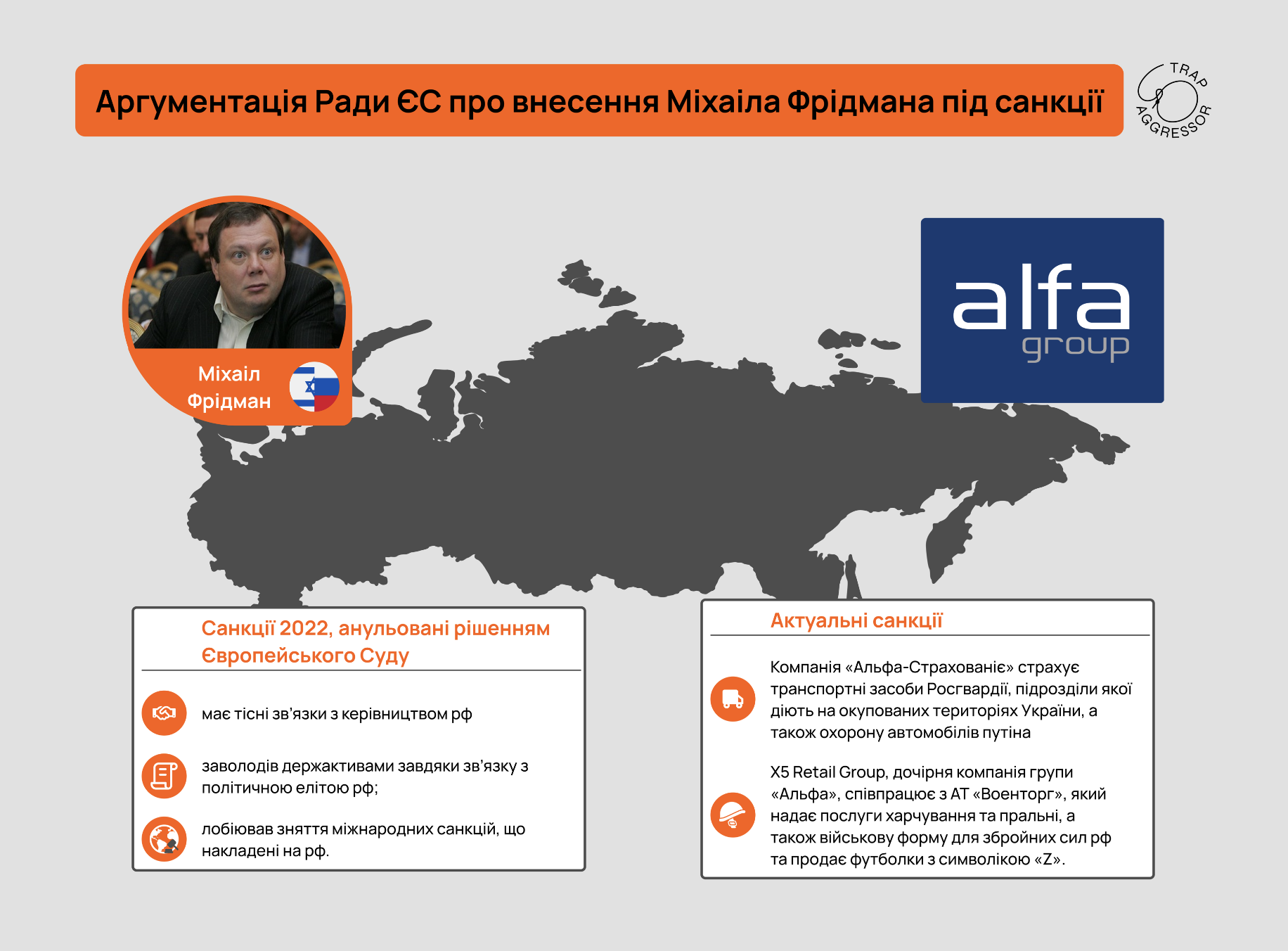
The Council of the EU decision of September 2023, in addition to the reasons from the previous cancelled documents, lists the following arguments: Alfa Insurance, a company of Fridman’s group, insured military vehicles of the Russian Guard, whose units were spotted in the occupied territory of Ukraine. Alfa also insured the armoured vehicles of Russian President Vladimir Putin. Another Alfa Group company, X5 Retail Group, cooperated with Voentorg, a company that supplied uniforms to the Russian army and sold T-shirts with the Z symbol. This story was previously reported by journalists of the Schemes investigative news project (Radio Liberty).
These facts are keeping Fridman under European sanctions for the time being. However, the oligarch will likely try to lift these restrictions as well. Meanwhile, Fridman’s lawyers have succeeded in disproving the well-known statements about his affiliation with a Russian oligarchic clan and his cooperation with the Russian political elite.
Therefore, the Council of the European Union should definitely update its evidence base after this decision. For example, in 2022, Trap Aggressor reported on how the Alfa Group financed the Russian manufacturers of tanks and engines for vehicles. Perhaps the EU should take a closer look at these reports.