
Key findings:
- The Russian company Marine Propulsion Systems (MPS) supplies western-made circuit boards, diesel engines, and components to the Russian Navy, which are used in the war against Ukraine.
- MPS CEO Sergei Sumkin remains a non-public figure and has not been subject to EU or US sanctions, despite the company’s significant role in military supplies.
- MPS has large contracts with key Russian military-industrial complex enterprises worth hundreds of billions of rubles, including Admiralty Shipyards and Zvezdochka.
- Dual-use goods get to Russia through Turkish and Hong Kong intermediaries.
March 2022. The Russian warship Veliky Ustyug is based in the Black Sea. The vessel belongs to the Caspian Fleet of the Russian Navy. The vessel is armed with eight Kalibr missiles, a 100-mm cannon, a 30-mm cannon, and two self-defense modules with Golka-S anti-aircraft missiles. The vessel is involved in hostilities against Ukraine. Just before the invasion, it was relocated to the Black Sea. But the war against Ukraine is not the first for Ustyug. Back in 2015, the same calibers were used to fire at Syria from the same ship.
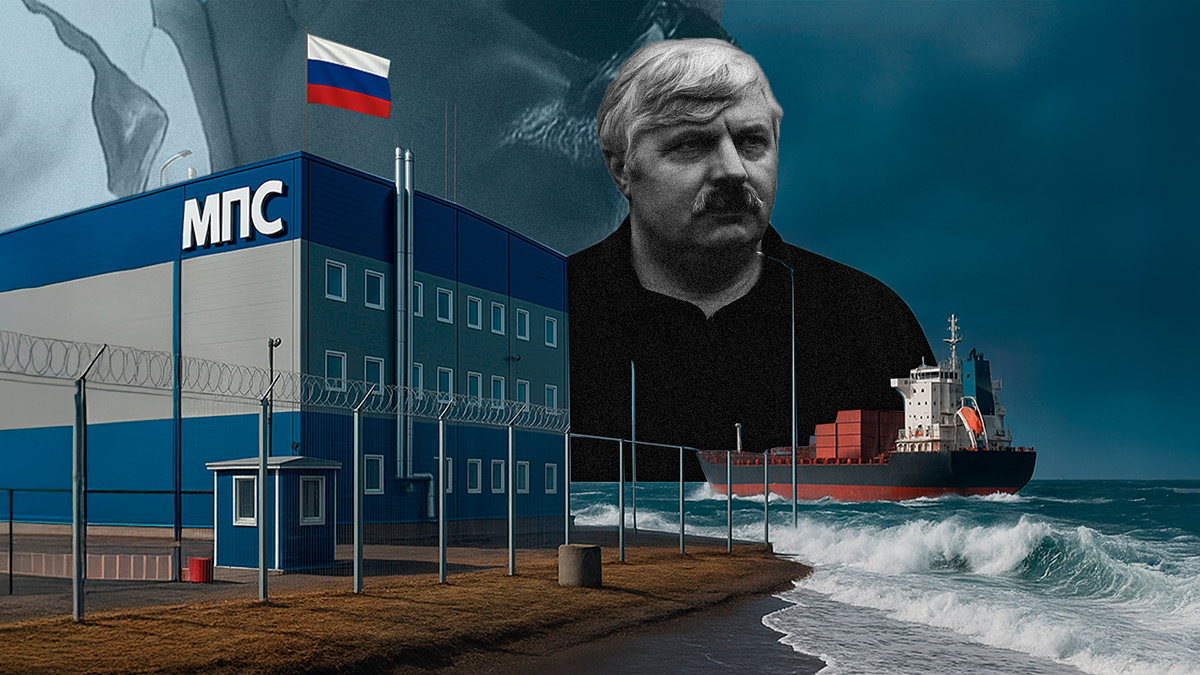
The engines for the Velikiy Ustyug ships are supplied by the Russian company Marine Propulsion Systems (MPS). From March 6, 2022, to May 2, 2024, this company imported spare parts for diesel engines, electronics for control systems, and components that power the Russian fleet.
Already in Russia, the company supplies its products to large enterprises of the military-industrial complex – factories that help in the war against Ukraine by providing the Russian army with machinery, equipment or components. The head and founder of MPS is Sergey Sumkin. And he is not a public figure, with no comments, no activity on social media, and no presence at specialized events.

Marine Propulsion Systems was founded in St. Petersburg. For 20 years in a row, it has been producing marine engines, diesel generators and control systems for ships of various purposes. In 2020, the company opened a new production facility in the Leningrad region, where it manufactures equipment for the Russian Navy. As of 2025, MPS is only on Ukraine’s sanctions lists.
Diesel generators from MPS are also installed in the Russian anti-submarine boat Grachonok. Vessels of this type are actively used by Russia in the war against Ukraine, performing tasks to protect waters, defend naval bases and counter underwater threats. Since the beginning of the full-scale invasion, the Russian army has been actively using Grachonoks in the port of Mariupol and Sevastopol.
According to the Russian service of the BBC, it was Marine Propulsion Systems that supplied boards from the Swedish manufacturer Jowa for the NE012 tugboat, which was built for the Russian Guard. The components were delivered in July 2023 at the request of the Ministry of Railways through Jowa’s subsidiary in Shanghai.
Billions of dollars in contracts for the Russian defense industry
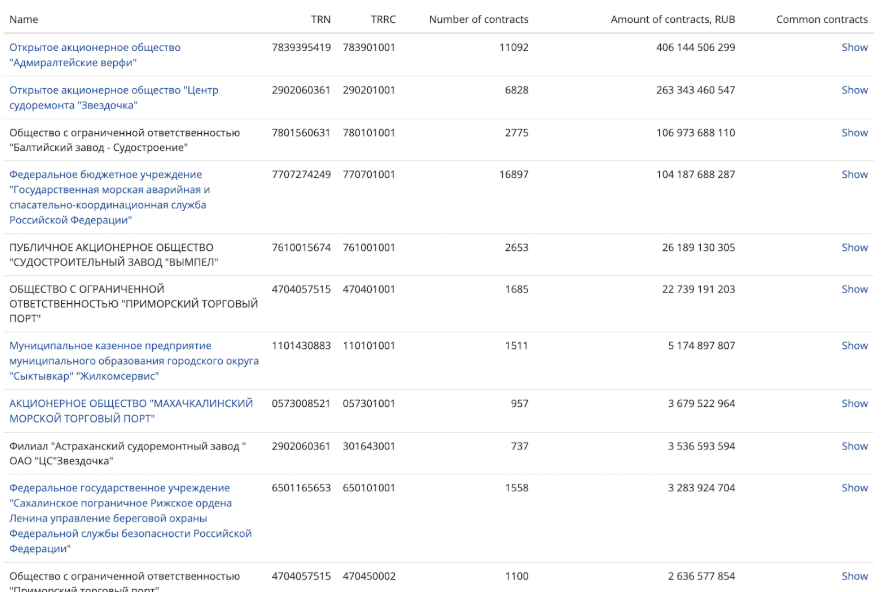
Since the beginning of the war (2014-2024), MPS, under Sumkin’s leadership, has signed contracts with Russian defense companies totaling 835.24 billion rubles. Among them are key players in the Russian military-industrial complex that have long been under Western sanctions. For example, the Admiralty Shipyards, the Zvezdochka Ship Repair Center, and the Baltic Shipbuilding Plant. With Admiralty Shipyards alone, the company has signed agreements worth more than 406 billion rubles, and with Zvezdochka another 263 billion.
Despite international sanctions
Trap Aggressor has gained access to customs documents confirming that Sumkin’s company continues to circumvent sanctions in various ways and purchase valuable equipment in Europe. According to these data, the MPS imported equipment for marine diesel engines to Russia through Asian countries for a total amount of almost $650 thousand.
Most of the goods came from Germany and Belgium. European companies include the world’s oldest engine manufacturer, Deutz AG. Controls for diesel engines at the railroad were supplied through intermediaries by German Aventics. Spare parts for wheeled loader repairs were also produced by the German company Officine Minelli SRL. The lion’s share of all deliveries were made through intermediary companies from Turkey. Also, deliveries were made through Hong Kong.
We sent official letters to all the companies we identified in the supply chain. Only the Belgian Anglo Belgian Corporation responded.
Anglo Belgian Corporation (ABC) is one of Europe’s leading manufacturers of medium-duty diesel and hybrid engines, founded in 1912 in Belgium. The company supplies engines for a wide range of applications, from NATO naval vessels (including patrol and support vessels) to civilian ships, locomotives and power plants in Europe, Africa and Asia.
The company told us that it was following the European Union’s directives and intended to “look into this situation.” In particular, they promised to contact the Turkish intermediary.

However, according to a study by the Kyiv School of Economics (KSE), these goods are critical to Russia’s military equipment. The total cost of such supplies alone has already reached more than $217,000 since the beginning of Russia’s full-scale invasion of Ukraine.
The bulk of the goods banned for export also comes from Germany and Belgium. The key suppliers include German Boning Automations technologies GmbH & Co. KG (electronic modules), Centa Antriebe Kirschey GmbH (steel couplings), Officine Minelli SRL (pneumatic cylinders, transmission shafts, hydraulic motors, electric motors/generators), DEUTZ AG (relays) and Belgian Anglo Belgian Corporation (steel couplings), and Spanish GALI GROUP (bearings). The main suppliers include TTSON LIMITED from Hong Kong ($241 thousand) and FELIT DIS TICARET LIMITED SIRKETI from Turkey.
Despite their official “civilian” designation, these components are used directly or indirectly in the military. Steel couplings are key elements of the propulsion systems of warships and armored vehicles. Pneumatic cylinders are used in a variety of military mechanisms, electric motors and generators are used in power units and power systems of military equipment, and bearings are indispensable components of any moving military equipment.
The connection between Marine Propulsion Systems and the Russian military-industrial complex is also confirmed by numerous court rulings in the Russian registers. The sanctioned Russian companies Pella, Vympel, and the Zelenodolsk plant, which build patrol boats, corvettes, and raid tugs, have been suing MPS since the beginning of the full-scale invasion for breach of contract and supply of faulty equipment. Even the FSB has filed a lawsuit against Sumkin’s company. The ruling refers to the supply of equipment for the FSB border department in Crimea. This is a direct proof of the work of Marine Propulsion Systems with the occupation administration in Crimea and Russian security forces, including the FSB.
Sanctions policy expert Bohdan Bernatskyi draws attention to the systemic problem of procurement of European dual-use goods:
“The issue of compliance with EU requirements for dual-use goods is extremely relevant. Engines, control modules, filters – all of these can be widely used, in particular in military or patrol vessels. Supplies are often arranged through companies from Turkey or Hong Kong, which makes it difficult to control.”
According to Bernatsky, the fight against such schemes should be based on two pillars:
“First, analytical and enforcement work needs to be centralized within the EU – for example, through FISMA, the European sanctions enforcement body. Such a structure could collect and analyze data, including from journalistic investigations, and pass it on to member states for prompt response. Secondly, to strengthen the compliance policy of the companies themselves. Particular attention should be paid to high-risk jurisdictions: Turkey, Hong Kong, Singapore, and the UAE. And even minor transactions should be subject to scrutiny if there is a risk of participation in the supply chain for the military needs of the Russian Federation.”
Between military orders and the Spanish sun: how the family of the MPS director lives
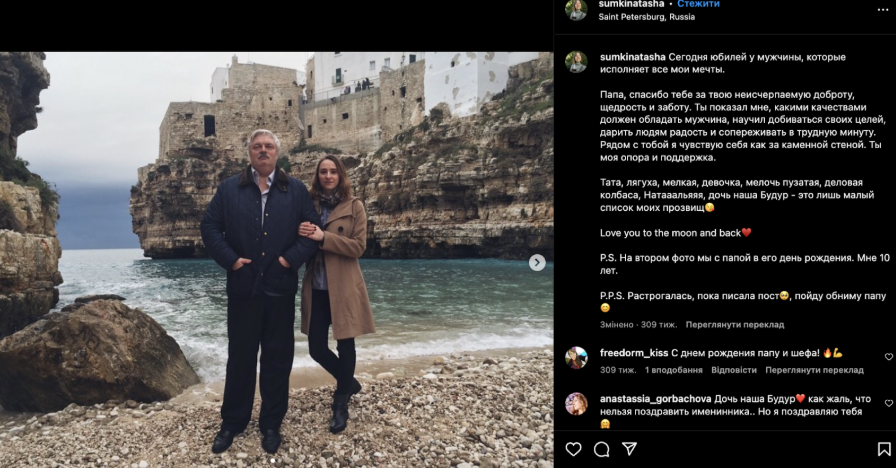
The director of the Marine Propulsion Systems company, Sergey Sumkin, is not a public figure. All that can be found in the public domain is his name in Russian registers. However, his daughter, Natalia Sumkina, does not limit herself to posting on social media. Despite the fact that her father’s company supplies components for the Russian navy, she left her homeland. Immediately after the full-scale invasion, she left Russia for Spain.