
Almost three years of Russia’s full-scale invasion of Ukraine and partial sanctions against the occupier cannot completely stop the Western world’s trade with this country. The whole world continues to buy Russian titanium products, while Russia imports raw materials for their production. Trap Aggressor analysts have found that in the first 7 months of 2024, Russian titanium exports amounted to more than $120 million, with one-third of the supplies going to France. At the same time, Russian imports of titanium raw materials reached almost $126 million, of which 52% came from China.
- Russia is dependent on foreign supplies of titanium raw materials, and Western countries are dependent on Russian supplies of processed titanium;
- Sanctions on titanium are not fully implemented due to Western countries’ dependence on Russian supplies;
- Titanium imports and exports have declined since 2022, but are far from zero;
- Ukrainian titanium can be supplied to Russia not directly but through foreign companies. Direct supplies were carried out in 2022, but as of July 2024, they have decreased to almost zero.
On July 8, 2024, Russia launched a massive missile attack on Kyiv, Dnipro, Kryvyi Rih, and other cities in Ukraine. It was the largest in terms of the number of victims and the second largest in terms of casualties since the beginning of the Russian-Ukrainian war. It killed 47 people. In the attack, the Russians used X-22, Kalibr, X-101, Zircon cruise missiles, Iskander-M ballistic missiles, X-59 guided missiles and 1 X-47M2 Kinzhal air-to-air missile. It was then that the largest children’s hospital in Europe, Okhmatdyt, suffered significant damage.

All of these weapons have something in common: their manufacture requires titanium. For example, missile warheads are made of titanium ingots. The body of the last compartment of the missile, which contains the solid fuel engine, is also made of this metal. In addition, Russia is continuing to research new titanium alloys for use in conditions of extreme heat at speed. Russians also talk about the development of new alloys in the context of plans to develop the Avangard intercontinental ballistic missile.
Its strength, resistance to corrosion from seawater and other chemicals, and the fact that it can be alloyed with various metals make it clear that titanium is an industrially important commodity around the world. It is an indispensable element in the production of weapons, in particular, it is used in aviation, body armor plates, parts for artillery systems, jet engines, etc. In 2023, China had the largest total reserves of titanium minerals in the world. Mozambique, South Africa, Australia, Canada, etc. are next in the list of top mining countries. Ukraine also produces large quantities of rutile and ilmenite concentrates from titanium ores.
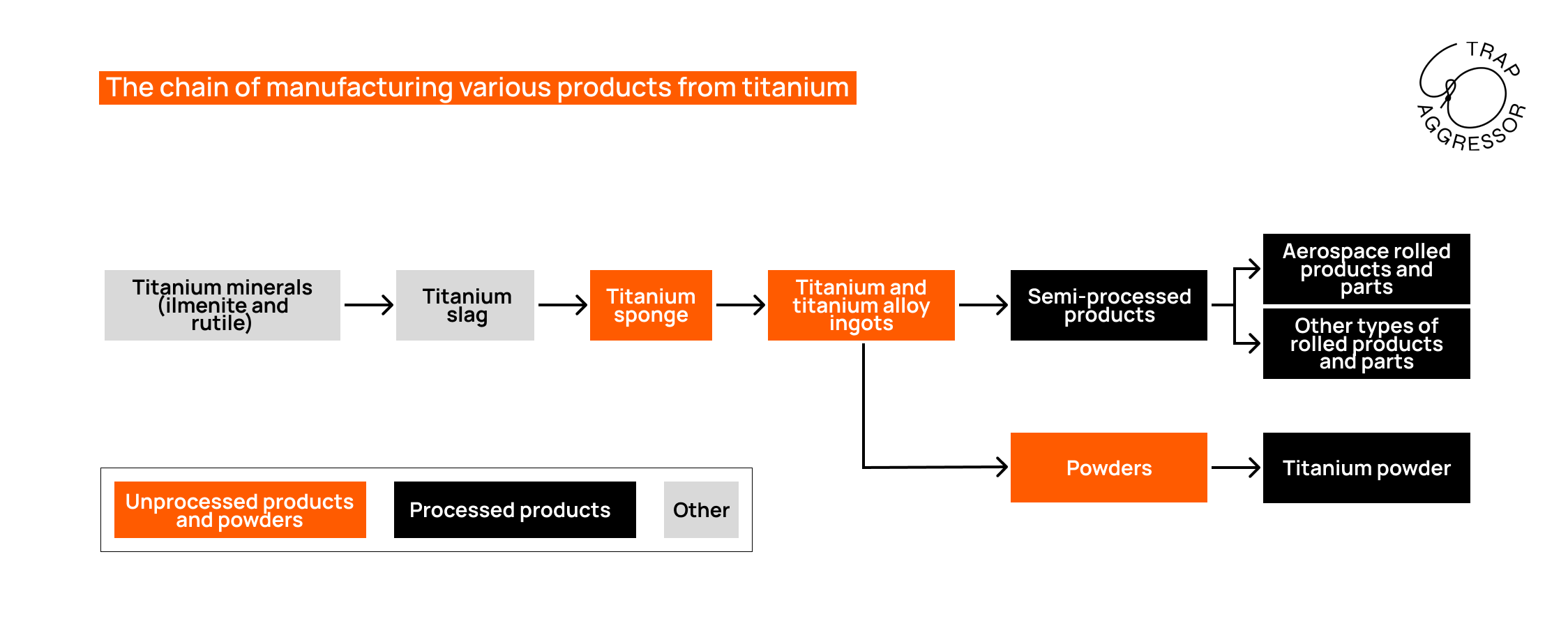
The process of mining and manufacturing titanium products is long and usually takes place at different enterprises/companies. Titanium ore (most commonly ilmenite or rutile concentrate) is first used to produce titanium slag, which is then converted into titanium sponge. Titanium sponge is the primary metal stage of titanium. The next stage of processing is the melting of the sponge and/or titanium scrap into titanium ingots and slabs and titanium powders. Ingots and slabs are used to make rolled metal products such as pipes, wires, sheets and plates, as well as finished titanium parts and components. The processing of titanium into finished products generates a large amount of scrap, which is also a valuable raw material for production.
Titanium and Russia
Russia has one of the world’s largest raw material bases for titanium. It accounts for 14.5% of the world’s titanium reserves. However, Russia’s contribution to global titanium concentrate production is only 0.03%. Despite the fact that Russia specializes in titanium production, it depends on imports of raw materials, as its own deposits are difficult to develop due to difficult geological conditions. Since 2022, Russia has been trying to solve this problem, as it realizes its dependence on the availability of critical material.
According to Rustitan Group, Russia’s current demand for titanium products is about 450 thousand tons per year. At the same time, the Ministry of Industry and Trade of the Russian Federation notes that the development of the domestic aircraft industry and chemical industry will require growth of the titanium market. In a few years, the required annual production will reach 800-850 thousand tons. Russia is actually committed to long-term arms production. Therefore, it wants to get rid of its dependence on Western imports of titanium ore.
In 2023, consumption in the Russian aerospace market accounted for 59% of all titanium. In particular, more than 40% of titanium products were used for engine production, and more than 19% for the construction of airplanes, helicopters and the space industry. General industrial use accounted for 35% of titanium, with the rest going to the energy sector, non-ferrous metallurgy and chemical engineering. This was announced by Dmitry Kurochkin, Head of Marketing at the Russian titanium giant VSMPO-AVISMA Corporation, at the Titan-2024 conference.
Today, VSMPO-AVISMA Corporation produces 96% of all titanium sponge in Russia. It is considered the main producer of aerospace-quality sponge titanium in Russia. It also supplied alloys to a third of the global aviation sector before the invasion of Ukraine in 2022. Of course, such dependence of Western countries on Russia does not allow them to impose sectoral sanctions against imports and exports of Russian titanium.
In September 2023, the U.S. Department of Commerce’s Bureau of Industry and Security did impose sanctions on Avisma. However, this ban means that goods manufactured in the United States and destined for Avisma now require a license from the Bureau of Industry and Security of the United States. In other words, there is no blocking of the company’s activities and no halt to the purchase of titanium, so the Russian company continues to make profits, just with control. Already in October 2024, the United States called on the G7 countries to impose restrictions on titanium, but as of November 2024, this has not yet happened.
Exports and imports of titanium
According to customs data, from January to July 2024, Russia exported $120,741,471 worth of titanium and its products to the following countries:
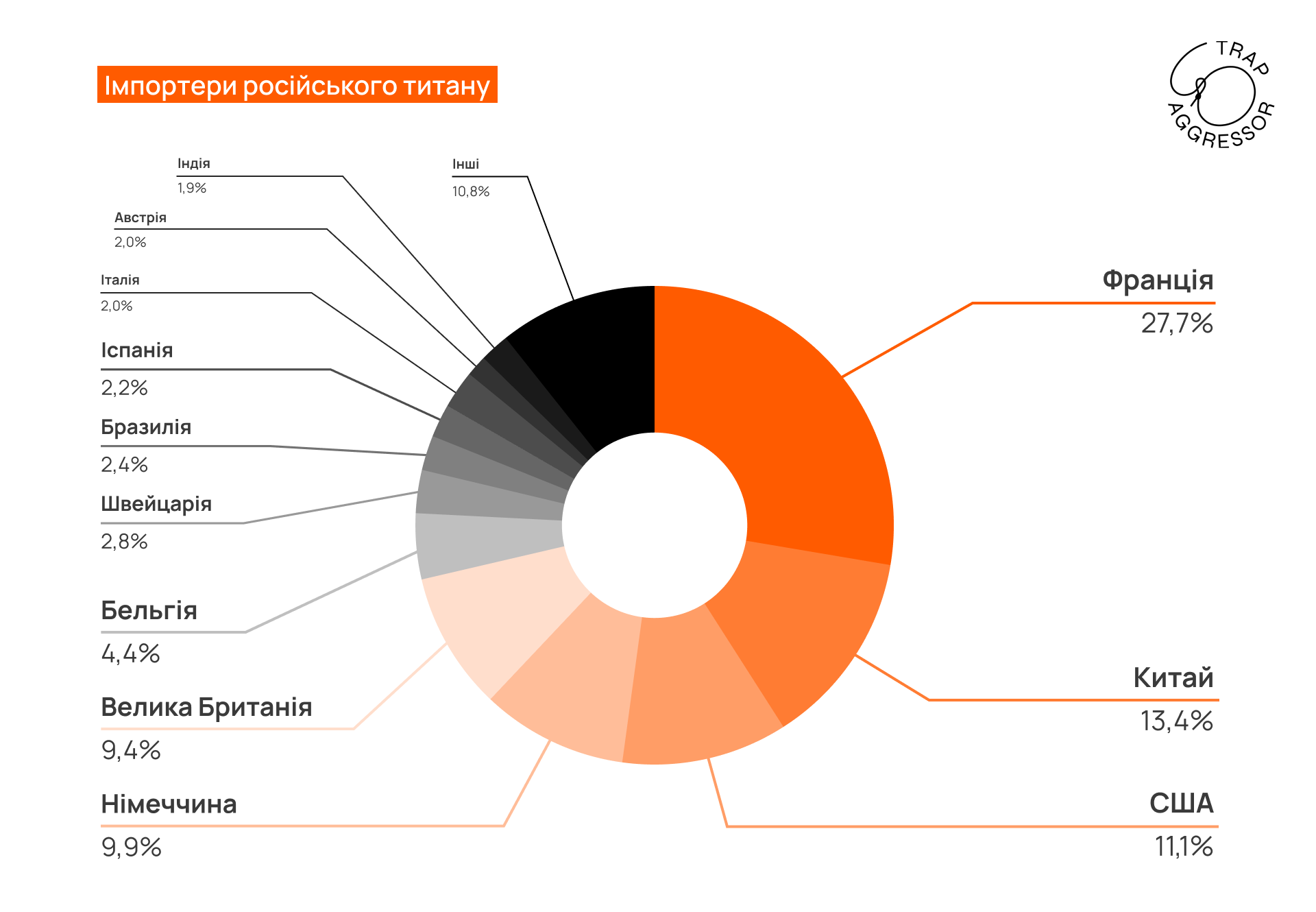
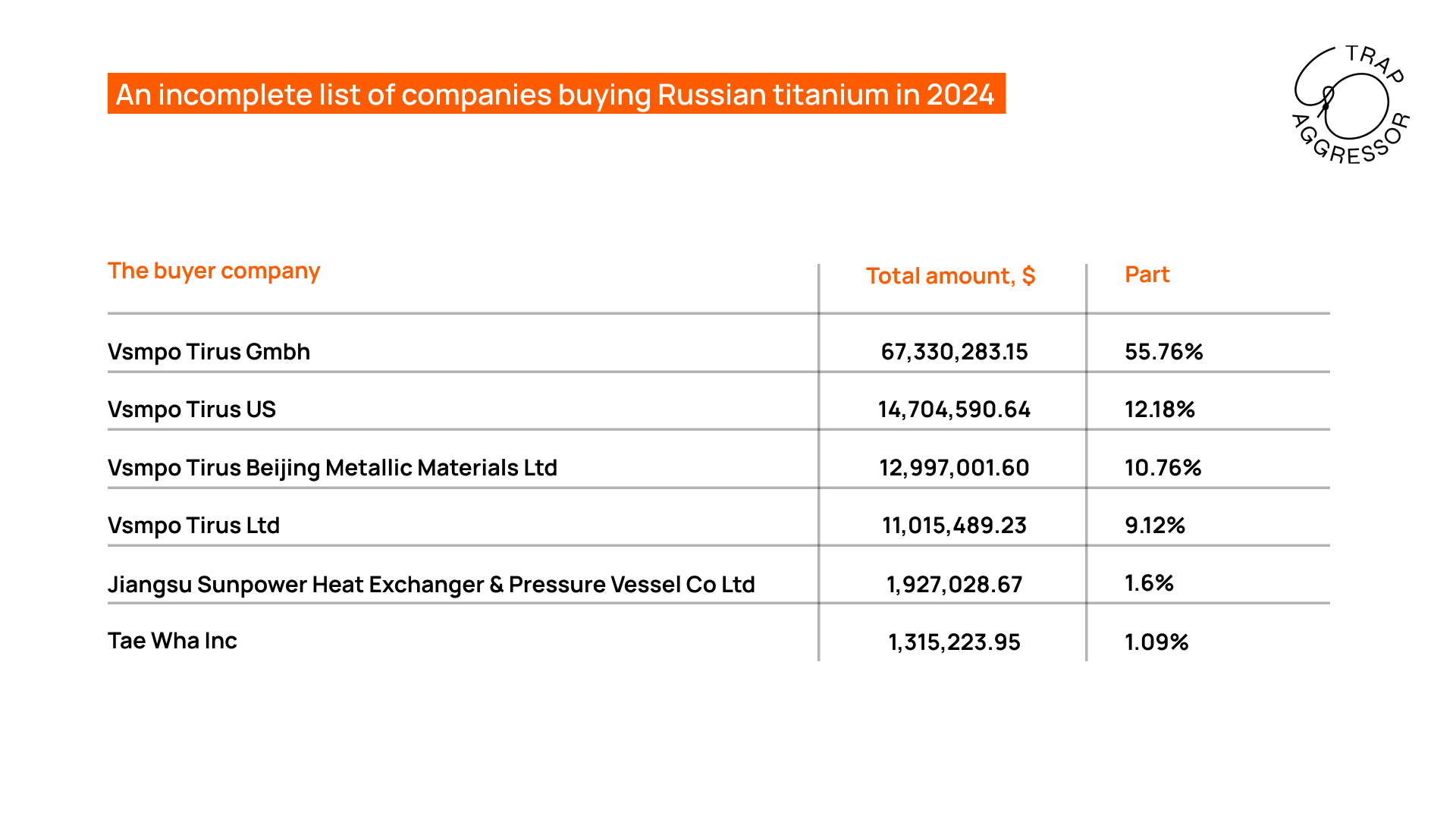
The Russian companies that exported titanium are, of course, VSMPO-AVISMA Corporation (94.55%), AT-SpetsTechnology LLC (1.2%), which, in particular, supplies ferrous and non-ferrous metallurgy products to the Russian military-industrial complex in the areas of aircraft engine construction, rocket and space industry, shipbuilding, production of weapons and military equipment for the ground forces under contracts with Rosoboronexport, and others. In 2023, exports of titanium products from the Russian Federation amounted to $362,722,019. The breakdown by country and export product has not changed much.
According to customs data, from January to July 2024, Russia imported titanium and its products for almost the same amount as it exported – $125,776,725 from the following countries:
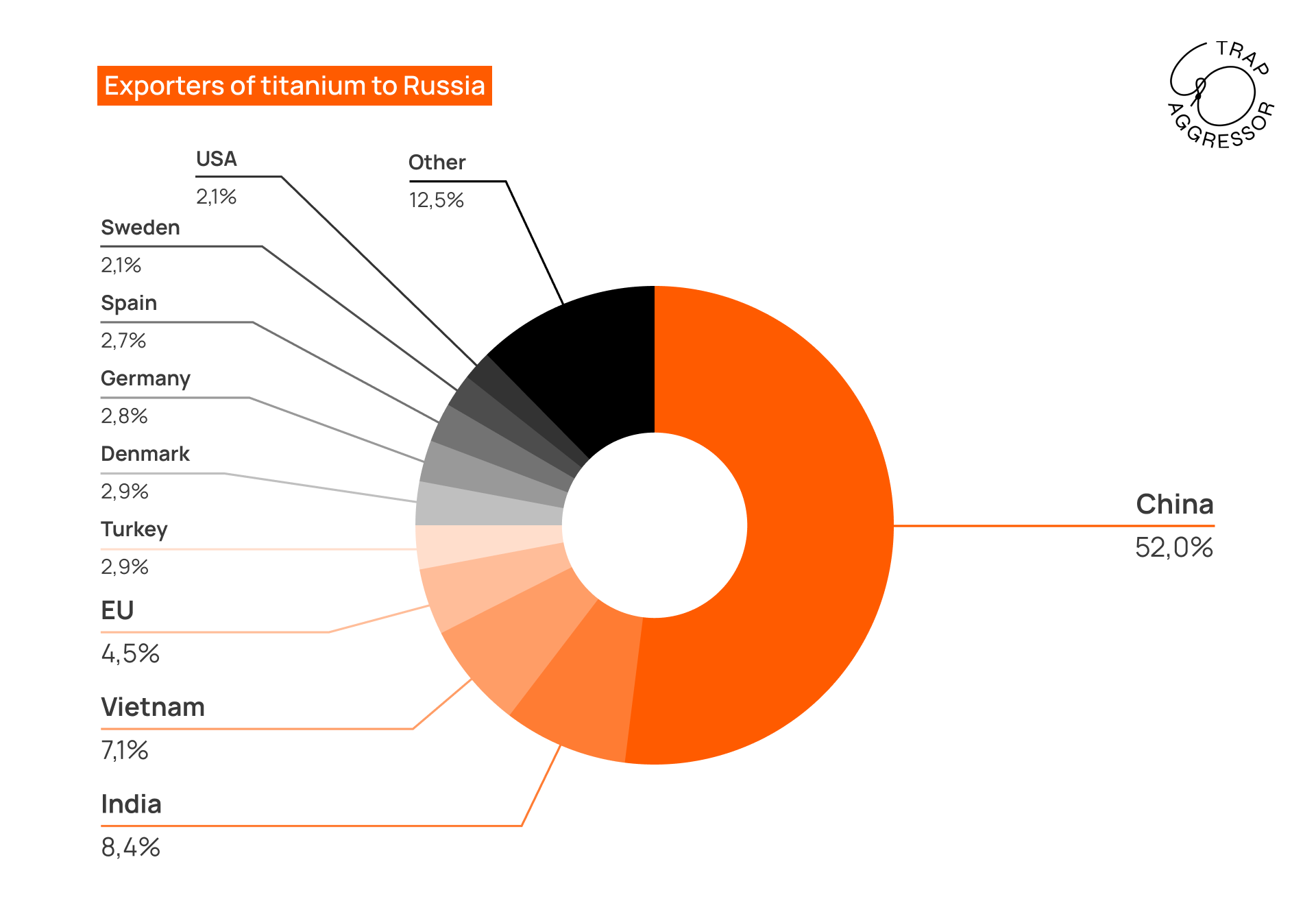
Russia mainly needed synthetic rutile (57.34%), titanium ore (15.53%), titanium slag (10.37%), and titanium plates (7.15%) from abroad. Among the Russian companies that imported titanium products were the aforementioned VSMPO-AVISMA Corporation, Uranium One (an international group of Rosatom companies engaged in uranium projects and more), Ural Mining and Metallurgical Company LLC, ZESKMI LLC (Plant Elektrosevkavmontazhindustriya), and others.
A year earlier, in 2023, Russia imported titanium products worth $436,556,195, and in 2022 – $522,154,239. Therefore, after Russia’s full-scale invasion of Ukraine, imports have decreased to some extent. As for the supply map, Turkey dropped in the ranking of suppliers to Russia from 2023 to 2024, Sri Lanka disappeared from the top ten, and India, on the contrary, increased trade.
Export of Ukrainian titanium to Russia

The company is now headed by a Russian, Sergey Ivanovich Krasiukov, who is associated with the Makiivka Cable Plant industrial group, which has opened additional enterprises in Rostov and other Russian cities. Makiivka Cable Plant LLC is headed by Vitaliy Stoyan, a native of Donetsk.
Neo Cable LLC was supplied with products, namely a metal corrosion inhibitor, by the Kyrgyz company OOO Tumar ComTrade. In fact, this was not done directly by Ukraine. However, the Ukrainian company Technokhimreagent LLC, based in Zaporizhzhia, is listed as the manufacturer. Trap Aggressor sent a request to this company. They explained that in 2024 they did not export their products anywhere. In addition, according to the company, the weight of the product is 48 tons, which is 2 full trucks of 24 tons each. And the company did not export products of this weight at all in 2022-2024. The cost of one kilogram of product is about UAH 24 per kg, which is too low; this company has the lowest price – about UAH 82. Therefore, it is possible that the inhibitor was purchased earlier and through a number of countries or companies got to a Kyrgyz company and eventually to the Russian Federation.
The second delivery – titanium ingots – worth $94,272 was made to Russia’s Dvina Splavresurs LLC, which specializes in non-ferrous metals. The supplier was the Estonian logistics company Alus Grupp Ou on behalf of Farotex DWC-LLC, which is registered in Dubai, UAE. According to the company’s website, Farotex has an office in Ukraine at 40u Hlybochytska Street, Kyiv, office 19, and its partners are Antares and Motor Sich. The company offers for supply titanium slabs, ingots, universal multipurpose furnaces designed for the production of titanium ingots and slabs weighing up to 20 tons, gas discharge electron beam guns, etc. The manufacturer of the products is the Ukrainian company Antares MC LLC. The company ignored Trap Aggressor’s request.
Farotex’s contact numbers list a contact person named Dobri Dobrev, a Bulgarian citizen of Ukraine. He previously founded a company of the same name in the UK, but liquidated it in 2020. Instead, Dimitrov is among the founders of NIVKI CENTER LLC in Kyiv, along with former assistants to MPs Serhiy Kunitsyn and Serhiy Trigubenko. Previously, he was a member and beneficiary of the scandalous OPT MINUS TRADE 126, which was featured in journalistic investigations into embezzlement schemes at recreational areas in the Dnipro River and is linked to the Klitschko brothers.