Monitoring information is up to date as of 1 February 2025.
In January 2025, the State Logistics Operator (DOT) announced tenders worth 7.5 billion UAH. In turn, the agency signed contracts worth 9.4 billion UAH based on procurement processes announced both in January and earlier. Tenders worth 667 million UAH did not proceed, mainly due to a lack of bids. StateWatch analysts examined the effectiveness of DOT’s January procurement activities and developed recommendations for improving non-lethal procurement processes.
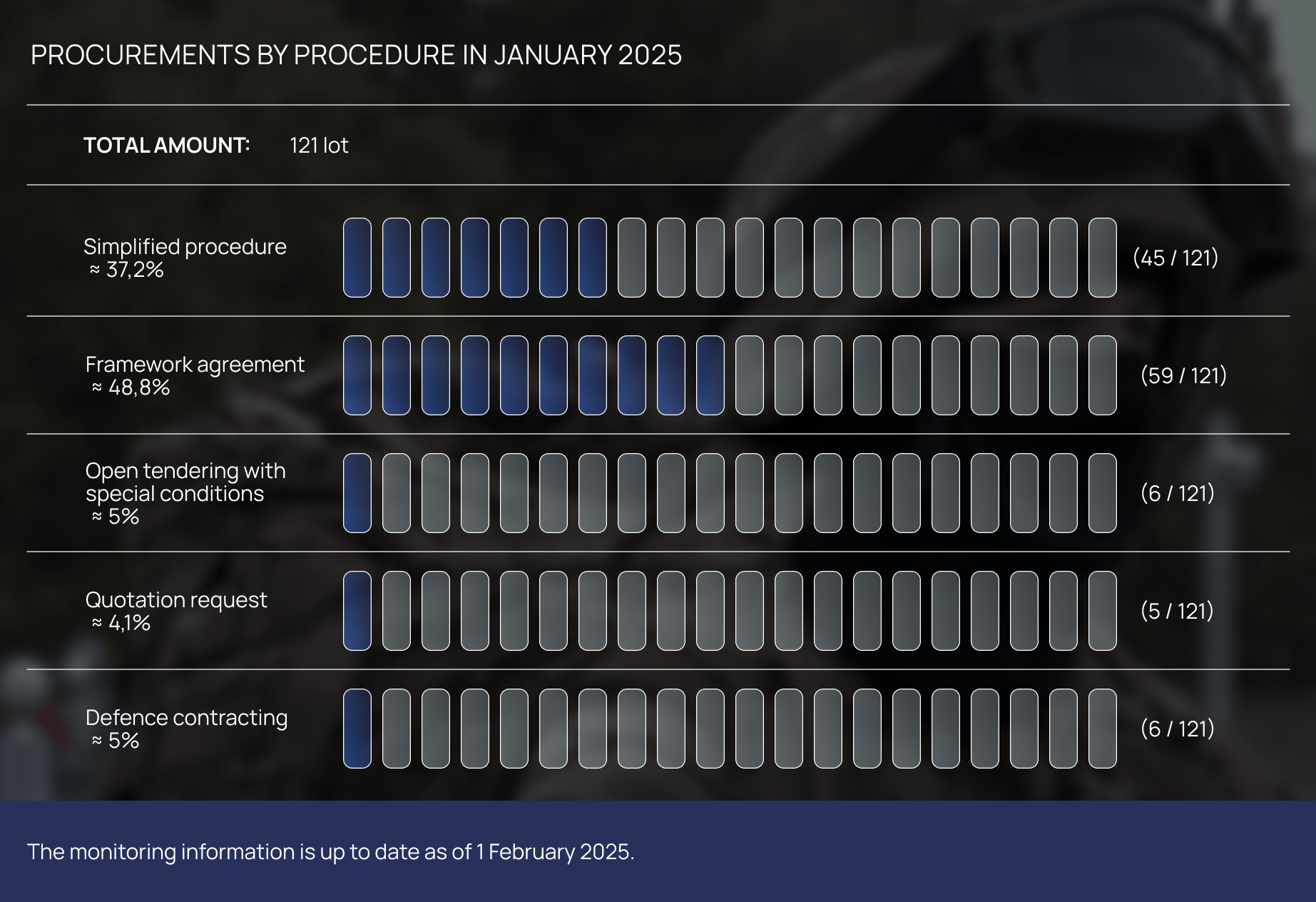
Overall, in January the agency announced 53 tenders (121 lots) with an expected value of 7.5 billion UAH. The majority of procurement processes – 45 lots worth 7.35 billion UAH – were conducted using simplified procedures. A total of 86 companies participated in the bidding throughout the month; however, participant activity was relatively low – with an average of 2.39 proposals per tender.
In turn, the agency signed 127 contracts worth 9.4 billion UAH. DOT spent 45.24% of the contracted funds (4.09 billion UAH) on equipment. Contracts for food products account for 34.43% (3.25 billion UAH), approximately 19% (1.75 billion UAH) went towards fuel, whilst the remaining amount was spent on other goods and services (0.36 billion UAH).
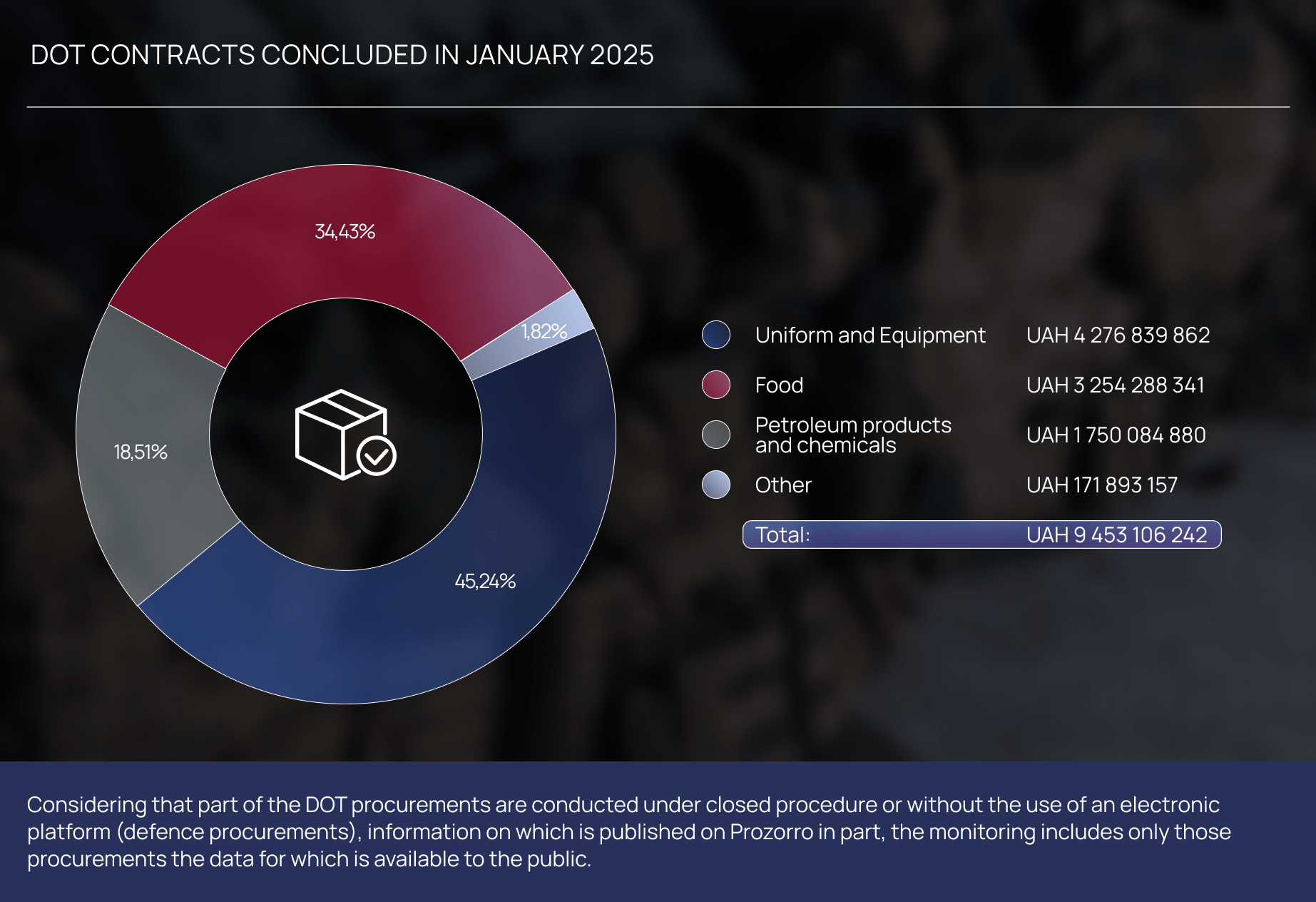
Given that some DOT procurements are classified or conducted without using the electronic platform (defence procurement), with limited information published on Prozorro, the monitoring only included procurements with publicly available data.
Food Products and Catering Services Procurements
In January 2025, food procurement tenders totalling 144.794 million UAH were announced. Of this, 8.12 million UAH was allocated to the simplified procedure, whilst 136.7 million UAH went to the pilot model, which was used to determine current prices for various food categories.
The total number of lots announced under the pilot model was 59, of which 20 are still ongoing. However, a significant portion of these procedures did not proceed. In total, 39 lots were unsuccessful or cancelled.
It was not possible to determine current prices for the following food categories:
Most of the cancelled procurements related to preserved and fresh products, whilst unsuccessful lots were primarily associated with basic ingredients and specific types of vegetables and fruits.
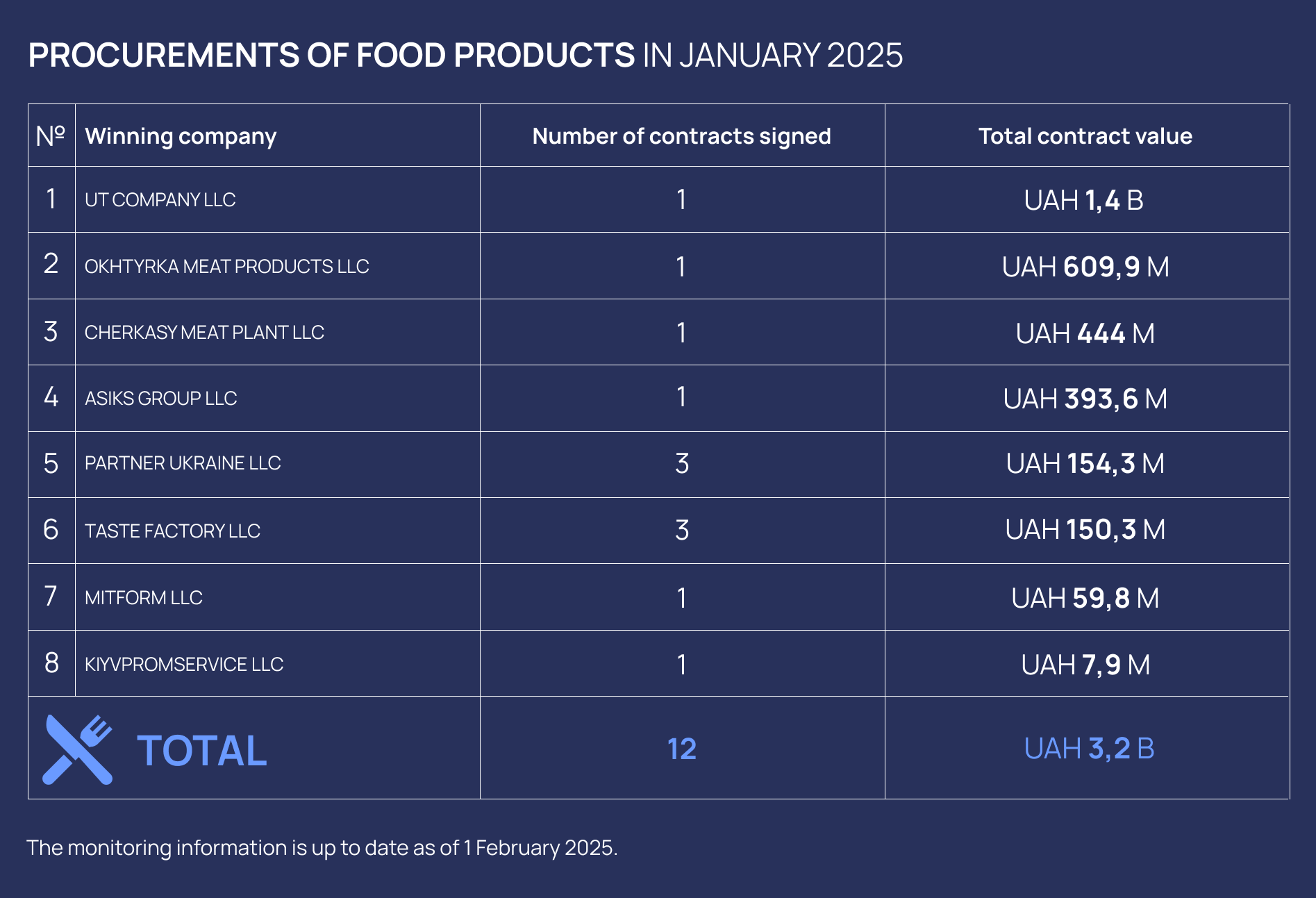
Meanwhile, as a result of procurements announced both in January and earlier, food contracts worth 3,254,288,341.92 UAH were concluded, accounting for 34.5% of the total budget. Of this, 364.576 million UAH was spent on daily ration packs, and 2.881 billion UAH on food products procured via catalogue. Catering services were contracted for the remaining amount, but the contract was ultimately terminated. The largest contract signed in January, worth 1.43 billion UAH, was with UT COMPANY LLC under the pilot model, providing for the supply of 9.3 million сatalogue sets at a price of 154.20 UAH per unit. January’s top food suppliers also included OKHTYRKA MEAT PRODUCT LLC and CHERKASY MEAT PROCESSING PLANT LLC.
Equipment Procurements
For the procurement of equipment and supplies, DOT concluded 69 contracts totalling 4.276 billion UAH. In particular, the agency purchased outerwear worth 2.104 billion UAH, including wind and waterproof winter jackets of various types amounting to 710,207,352 UAH, as well as trousers of the same category totalling 401,686,800 UAH. Among other uniform items were summer special suits costing 168,475,800 UAH. Furthermore, a significant portion of expenditure was on footwear, specifically winter boots with high uppers. Two procurement processes contracted 350,000 pairs at a cost of 762,690,000 UAH. Notably, the volumes in the two procurements were distributed unevenly (300,000 and 50,000 pairs), yet TALANLEGPROM LLC was the sole bidder and was ultimately contracted at an average price of approximately 2,179 UAH per pair. An additional 706.7 million UAH was spent on equipment and accessories: belts, backpacks, bags, eyewear, holsters, etc. Moreover, 215 million UAH was spent on underwear and socks, including thermal underwear and trekking socks. Winter and fire-resistant gloves cost 77.6 million UAH, while headgear – comprising caps, panama hats, balaclava helmets and helmet covers – amounted to 76.2 million UAH. Contract amounts are indicated taking into account adjustments approved in supplementary agreements.
Fuel and Lubricants Procurements
A total of 1.744 billion UAH has been allocated for the procurement of fuel and lubricants. The largest share of the budget (817.8 million UAH) is for diesel fuel, which is being purchased for all regions of the country: the largest amount for the Central region (361.7 million UAH), followed by the Eastern (175.7 million UAH), Southern (173.8 million UAH) and Western (106.4 million UAH) regions. The second largest category is petrol of various grades (575.2 million UAH), with the main expenditures being on A-80 petrol (387 million UAH), A-92 (134.4 million UAH) and A-95 (49.3 million UAH). For aviation fuel (jet fuel), 300.5 million UAH has been allocated. Smaller procurement volumes include lubricants: motor oils (40 million UAH), hydraulic fluids (10.2 million UAH), transmission oils (2.6 million UAH) and special technical fluids (3.9 million UAH). The vast majority of supplies are provided by UKRNAFTA PJSC (1.689 billion UAH).
Cancelled and Unsuccessful Procurements
During January, 12 tenders with a total value of 667 million UAH were deemed unsuccessful. In particular, DOT was unable to procure combat helmets with a total expected value of 541.3 million UAH (8,327 UAH per unit). The procurement did not proceed due to errors in the qualification requirements.
DOT made errors when preparing the announcement for the simplified procedure, specifically by failing to indicate the requirement for a licence to sell personal protective equipment. Given the impossibility of making changes within the announced procurement, it was decided to cancel the tender.
Separately, a significant portion of procurements within the pilot model for determining current prices for various product categories did not proceed. In total, 39 lots proved unsuccessful or were cancelled.
Challenges
DOT faced a series of operational challenges during procurement processes. In January, the procurement of combat helmets worth 541.3 million UAH failed due to an issue in the tender documentation – specifically, the absence of a requirement for a licence to sell personal protective equipment. Due to the impossibility of amending already announced conditions, the procedure had to be cancelled and re-announced.
Separately, within these procedures, a foreign participant raised questions about product certification and recognition of international standards, particularly certificates of conformity from international organisations (SGS, TUV, Bureau Veritas). However, the tender documentation requirements stipulated a certificate of conformity issued by the UMOD’s Central Logistics Development Directorate. This issue requires a comprehensive solution to align product certification with international standards.
Furthermore, the implementation of the pilot model for food procurement also experienced unsuccessful procedures. To determine current prices for food products, 39 out of 59 lots did not proceed or were cancelled. The most significant problems occurred with lots for long-shelf-life products, fresh vegetables and fruits. These results indicate the need for further improvement of mechanisms for working with suppliers.
Recommendations for DOT:
DOT, which has been responsible for the procurement of fuel, uniforms and food supplies for military personnel since December 2023, was established as part of the anti-corruption reform of the Ministry of Defence procurement system. The agency’s total annual budget amounts to approximately 67.4 billion UAH, with goods worth 26.5 billion for 2025 requirements already contracted last year. Procurements are conducted through the Prozorro electronic system.
DOT procurement monitoring has been supported by the Office of the United Kingdom’s Special Defence Advisor and delivered by EDGE Foundation and StateWatch Think Tank.