Information current as of 16 April 2025
– During March, 41 contracts were concluded totalling UAH 3.42 billion.
– Nearly 40% (UAH 1.31 billion) of the total contract value was allocated to diesel fuel for April delivery. Despite competition in these tenders increasing by more than 40% compared to the procurement of arctic fuel for March, Ukrnafta PJSC once again secured all tender wins.
– One contract was signed for drinking water procurement, whilst none were concluded for food supplies due to pre-existing contracts established in previous months.
– For the third consecutive month, a portion of the lots intended to establish food pricing within the pilot nutrition model has failed to attract successful bids.
– The procurement of body armour covers worth UAH 203.13 million was cancelled after the declared winner, a representative of a non-resident firm, submitted fraudulent tender documentation.
StateWatch analysts have examined the efficiency of March procurement activities and put forward recommendations for procedural improvements.
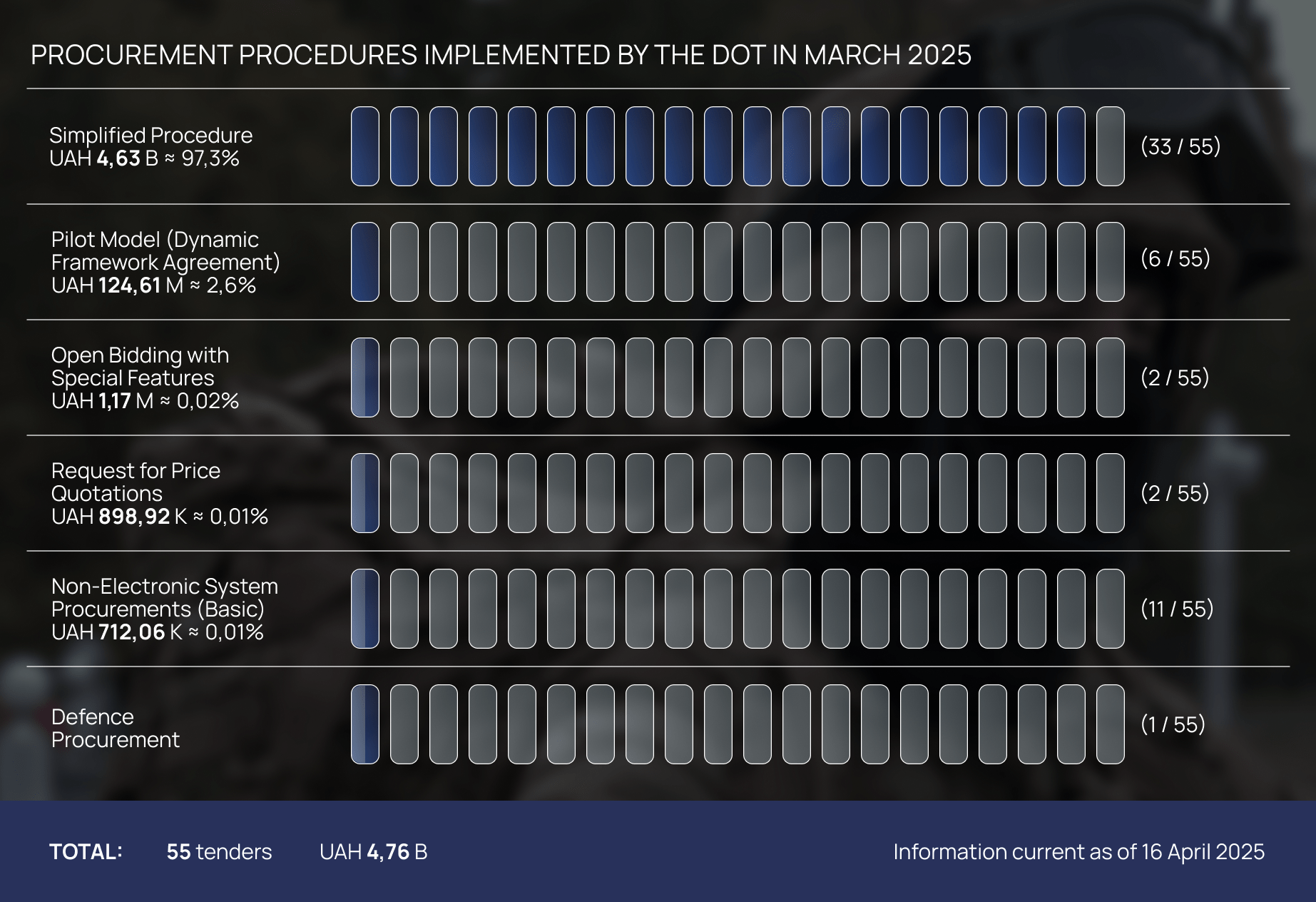
In March 2025, the DOT issued 55 tenders (comprising 106 lots) with an expected value of UAH 4.76 billion. The vast majority of these procurement activities, valued at UAH 4.63 billion, are proceeding under the simplified procedure. Throughout the month, bidding participation involved 44 distinct companies, with tenders attracting an average of just 2 proposals each.
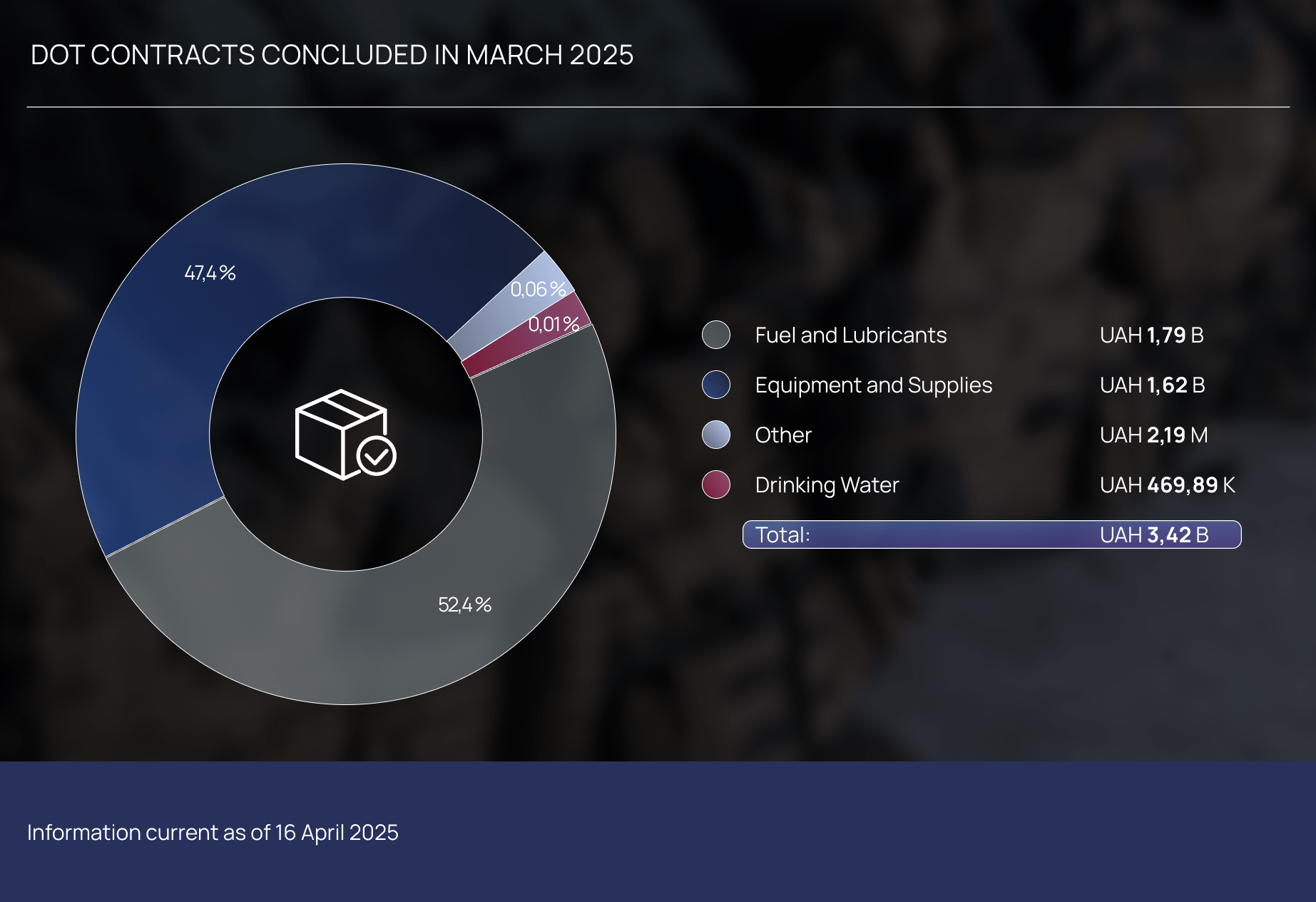
During March, the agency concluded 41 contracts totalling UAH 3.42 billion. The largest proportion of funds was directed towards fuel and lubricants procurement, accounting for UAH 1.79 billion (52.44%). Expenditure on equipment and supplies amounted to UAH 1.62 billion (47.48%), whilst UAH 2.2 million (0.06%) was allocated to miscellaneous goods and services. No contracts were established for food products or catering services, as the necessary volumes had already been secured through previous procurement arrangements. The agency did, however, purchase drinking water to the value of UAH 469,900 (0.01%).
Fuel and Lubricants
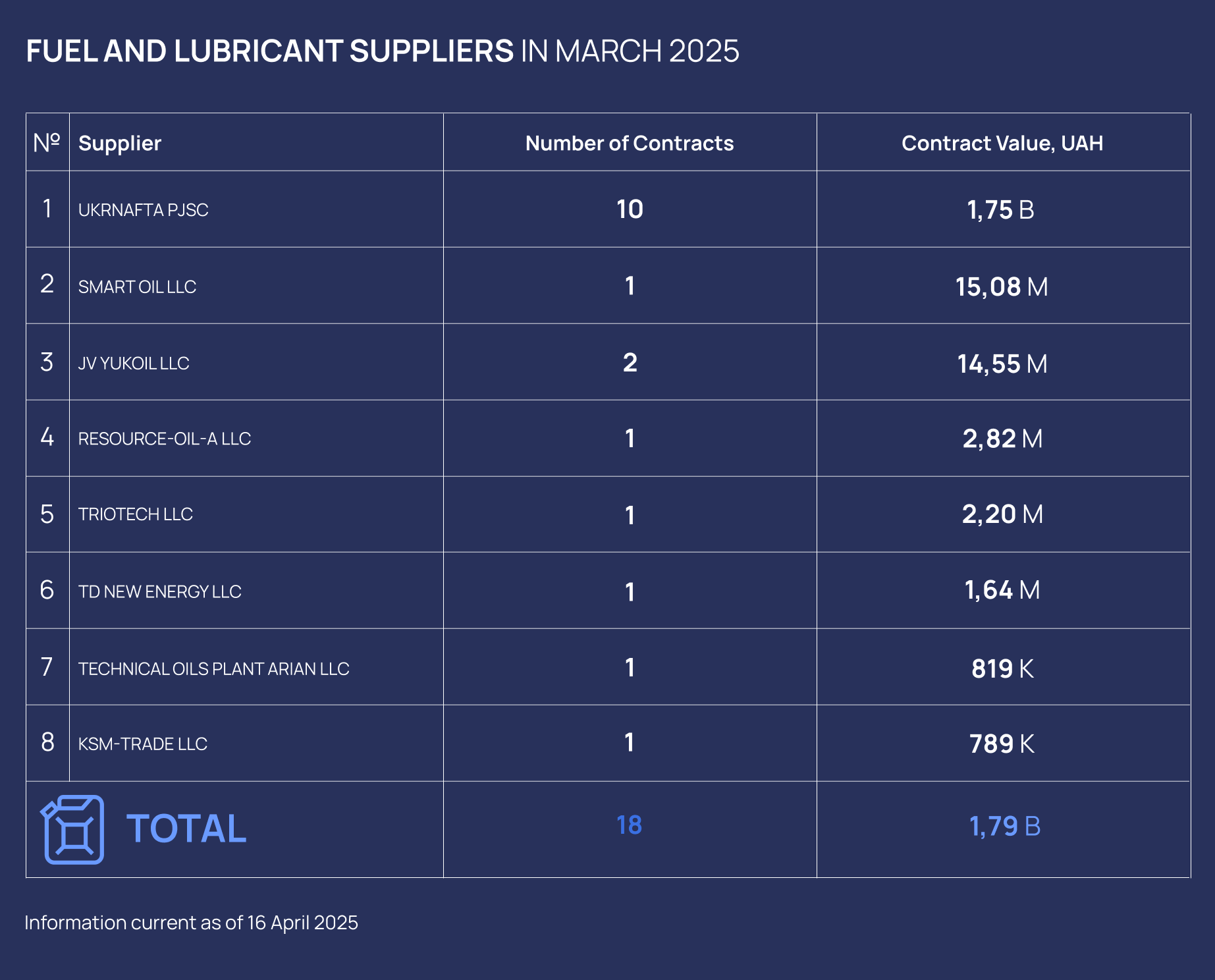
In March, the agency concluded 18 contracts for the supply of fuel and lubricants totalling UAH 1.79 billion. These procurement activities generated overall savings of UAH 629.87 million.
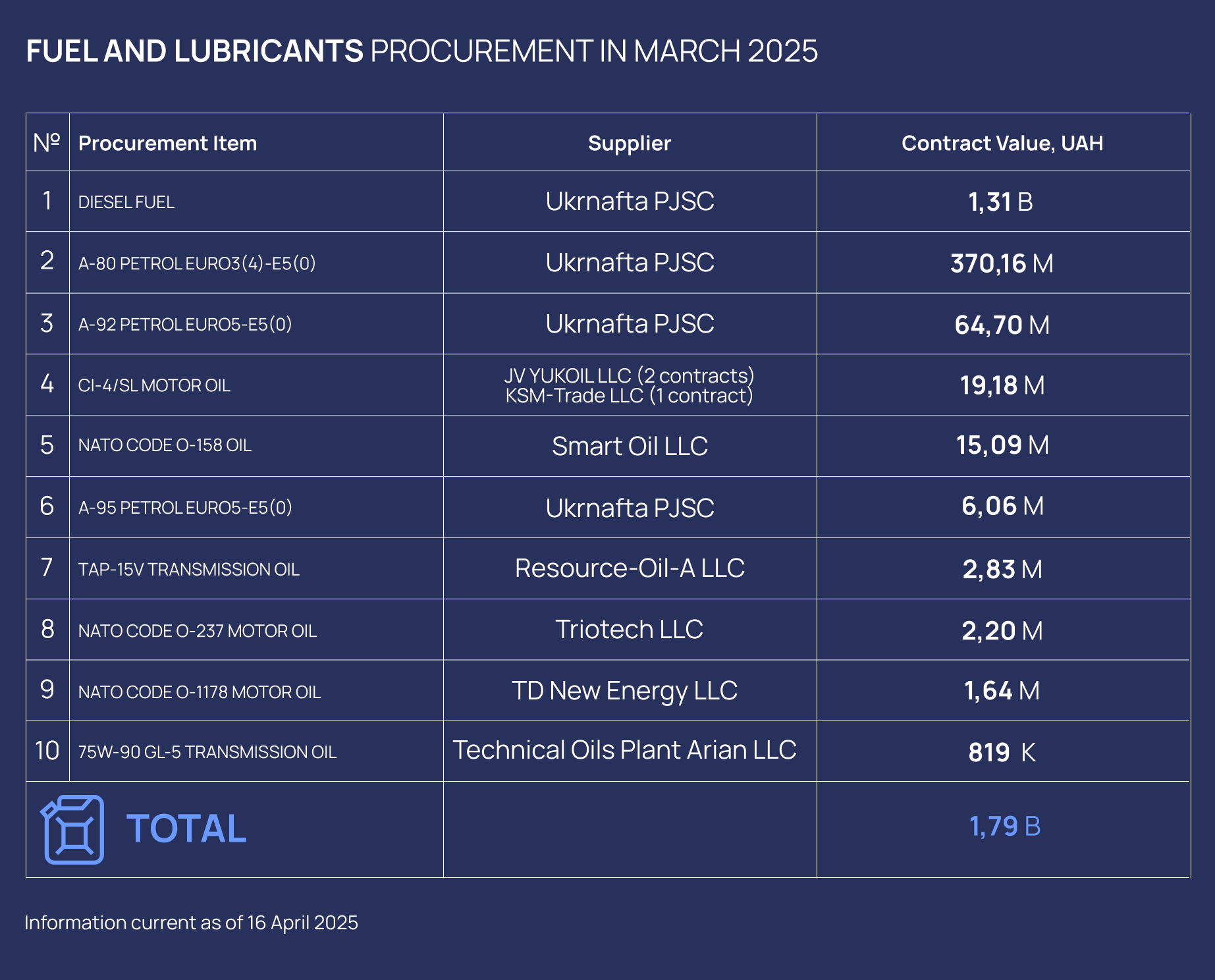
Diesel fuel for April delivery comprised the majority of the contracted sum at UAH 1.31 billion. The highest volumes were allocated to the Central region (UAH 598.8 million), followed by the Western (UAH 342.9 million), Eastern (UAH 238.9 million) and Southern regions (UAH 133.1 million). Ukrnafta PJSC secured all contracts across these regions.
The DOT reported that April’s diesel procurement achieved savings of UAH 242 million, with bidding competition increasing by over 40% compared to the previous month’s tenders for arctic diesel fuel. The Central region lots attracted two participants each, while the Southern region drew three bidders, and the Western region secured three and four participants for two lots respectively. The Eastern region continues to present the greatest logistical challenge, attracting only a single bidder. Across all tenders, the average number of proposals stood at 2.5.
The agency also procured petrol worth UAH 440.9 million, primarily consisting of grade A-80 (UAH 370.2 million), with additional purchases of A-92 (UAH 64.7 million) and A-95 (UAH 6.1 million). As with the diesel contracts, all petrol supply agreements were secured with Ukrnafta PJSC.
Expenditure on lubricants, including motor and transmission oils, totalled approximately UAH 37 million. The procurement comprised NATO-coded oils O-158 (UAH 15.09 million), O-237 (UAH 2.20 million), and O-1178 (UAH 1.64 million), alongside various grades of motor and transmission oils valued at UAH 3.64 million.
Ukrnafta PJSC continues to dominate as the primary supplier of diesel fuel and petrol. Whilst the DOT has established contracts with seven additional companies, these arrangements involve substantially smaller quantities.
Equipment and Supplies
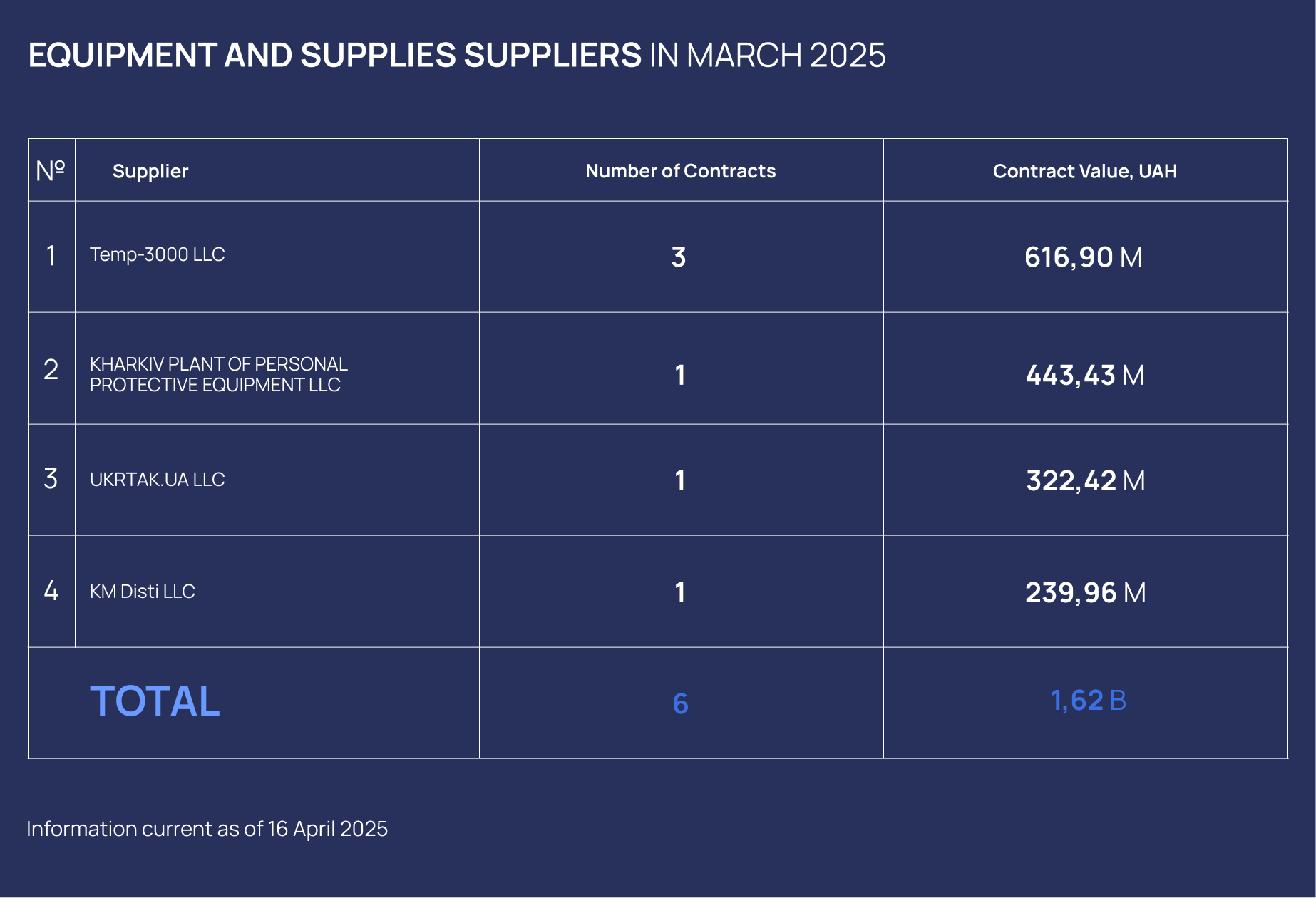
In March, the DOT signed six contracts for uniforms and equipment worth UAH 1.62 billion. These procurement activities generated savings of UAH 35.21 million.
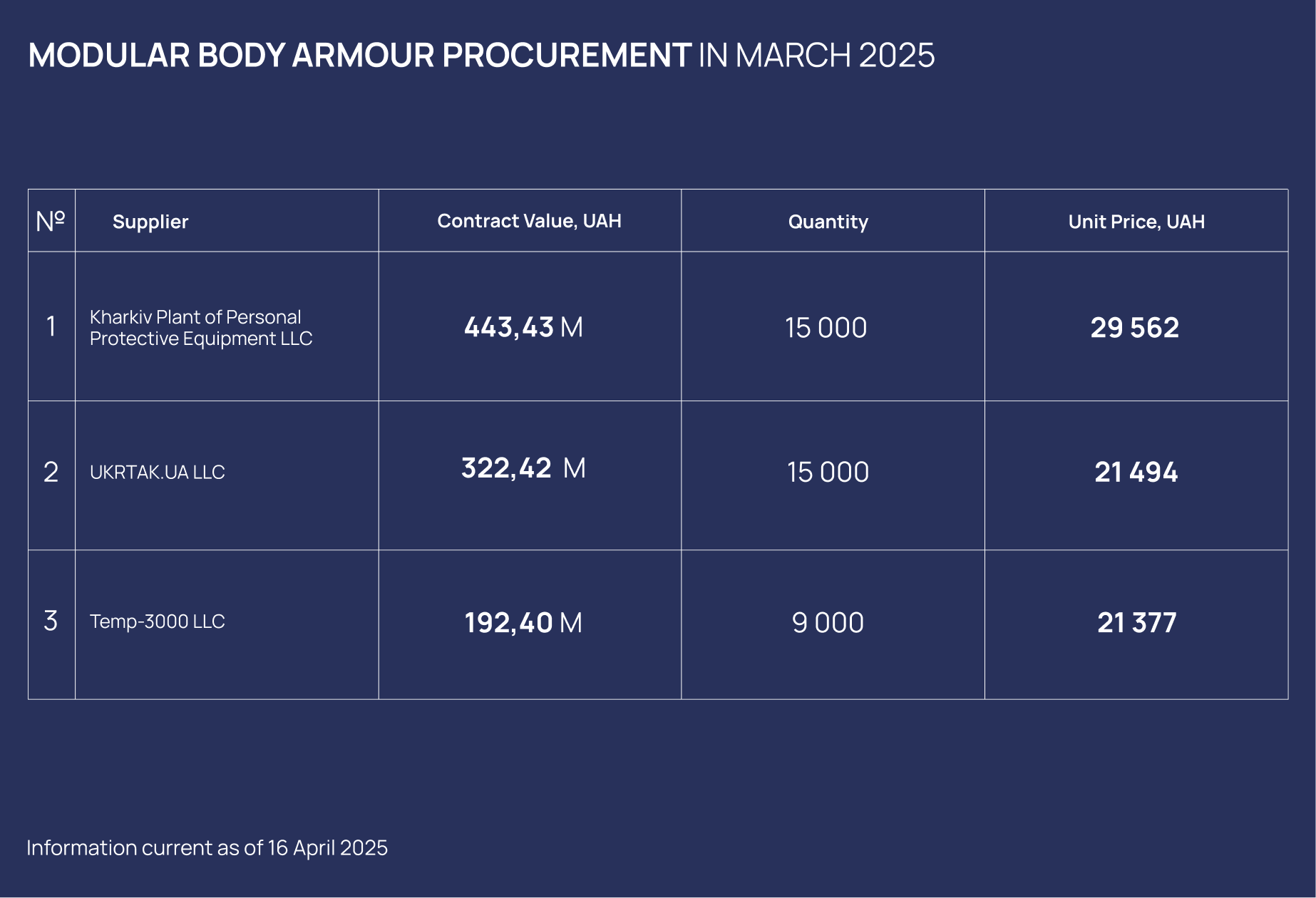
The highest expenditure was allocated to modular body armour (Types 1-5). Contracts were awarded to Kharkiv Plant of Personal Protective Equipment LLC (UAH 443.43 million), UKRTAK.UA LLC (UAH 322.42 million), and Temp-3000 LLC (UAH 192.40 million). This allocation reflects a shift towards greater market competition and indicates a decline in the previously dominant position held by Temp-3000 LLC in the body armour procurement sector.
Furthermore, the agency entered into an agreement with KM Disti LLC for the supply of 28,000 high-cut combat helmets, valued at UAH 239.96 million. Concurrently, Temp-3000 LLC was awarded two distinct contracts: one for the provision of 15,000 full-size helmets at UAH 127.35 million, and another for 35,000 units at UAH 297.15 million.
For the March reporting period, procurement contracts in the equipment category were distributed amongst four suppliers. Of these, Temp-3000 LLC emerged as the recipient of the highest contract value overall.
Food Products and Drinking Water
In March, the DOT signed a contract with IDS Aqua Service LLC for the supply of bottled water, valued at UAH 469.9 thousand.
During the month, the agency continued to implement its pilot model within the Kyiv region, announcing 47 procurement lots, with 20 of these proving unsuccessful.
The agency failed to establish viable market prices for several food categories:
– Long-shelf-life products (pâtés, cured pork fat, pickled products) – UAH 2.67 million
Fruit and vegetables (including apples, pears, tomatoes, celery, radishes, peppers, cucumbers, carrots, potatoes, onions) – UAH 2.35 million
– Fresh herbs (dill, parsley, mint, sorrel) – UAH 1.85 million
– Meat products – UAH 510.6 thousand
No new contracts were awarded under the pilot model during this reporting period.
Cancelled and Unsuccessful Procurements
In March 2025, nine tenders (comprising 24 lots) with a combined value of UAH 293.38 million failed to proceed. Most significantly, an attempt to purchase 20 tonnes of motor oil under NATO code O-1180, valued at UAH 3.88 million, was unsuccessful as all submitted bids were rejected for failing to meet technical specifications.
Under the simplified procurement procedure, two further tenders received no bids whatsoever: one for 1,080 tonnes of A-95 petrol (UAH 52.75 million) and another for 3,405 bottles of drinking water (UAH 429 thousand).
A particularly noteworthy case involved the cancellation of a UAH 203.13 million tender for 15,000 body armour covers. This procurement was terminated after the successful bidder, Nextgen Ltd LLC, was found to have submitted misleading information. The company had claimed that the British firm Tradingscape Limited was the manufacturer, whereas public records indicate that Tradingscape operates solely in agency and wholesale trading without manufacturing capabilities. The procurement was subsequently cancelled as these violations of public procurement legislation could not be remedied.
The pilot model for establishing current food prices continued to face challenges, with a substantial number of lots failing to progress. In total, 20 lots were declared unsuccessful due to a complete absence of bids.
Challenges
March marked the third consecutive month in which portions of the pilot food procurement model failed to establish current market prices. Twenty lots across fresh herbs, fruit and vegetables, meat products, and long-shelf-life foodstuffs yielded no successful outcomes. This persistent pattern points to fundamental difficulties in the market-testing approach. The DOT has now recognised the need to revise specific aspects of the model, with particular focus on logistics and supplier relationships.
A further issue arose in the UAH 203.13 million procurement of body armour covers, where Nextgen Ltd LLC secured the contract by submitting false manufacturer information. This reflects a recurring problem with insufficient verification procedures during the tender evaluation process. Previous instances include the December 2024 procurement involving Fortress of Protection LLC and the February 2025 contract with Milikon UA LLC – both distributors of Israeli manufacturer Masada Armor Ltd. The former submitted documentation without proper authorisation credentials, whilst the latter failed to provide the mandatory sales licence.
Recommendations for the DOT Based on March 2025 Challenges Analysis:
1. Establish clear criteria for documentary evidence required from tender participants.
2. Apply consistent legislative standards when verifying and approving tender documentation across all bidders.
3. Develop a rapid response mechanism to address identified violations before contracts are finalised.
4. Implement continuous internal compliance monitoring of tender documentation against legislative requirements.
5. Create procedural guidelines addressing the participation of foreign entities and their representatives in procurement tenders.
6. Conduct additional stakeholder consultations with potential suppliers to improve participation rates in the pilot food procurement model.
DOT procurement monitoring has been supported by the Office of the United Kingdom’s Special Defence Advisor and delivered by EDGE Foundation and StateWatch Think Tank.