
The digitisation of food procurement procedures through the DOT-Chain IT platform, coupled with enhanced goods quality control systems, demonstrated tangible progress in logistics procurement management. Nevertheless, the agency also encountered numerous challenges that hindered the modernisation of approaches and the expansion of competition.
The StateWatch team analysed DOT contracts concluded between 1 January and 31 December 2024, which were published on Prozorro. The report information is current as of the date of uploading from the BI Prozorro system, with further details provided in the complete version of the document.
These figures exclude contracts concluded as a result of defence procurement procedures. However, when analysing tenders for food products and material supplies, analysts separately examined direct contracts available on Prozorro.
The specified contracts encompass provision for 2024 requirements and partially for 2025. This represents the first instance in the Armed Forces of Ukraine’s history where an agency concluded a substantial portion of contracts in advance at the end of the preceding year to ensure supply continuity.
Collectively throughout the year, 424 companies participated in tenders, with an average of 4.02 proposals submitted per tender. In turn, 199 companies became DOT suppliers, demonstrating an extensive contractor network. The data on participants and suppliers excludes classified procurement activities.
Challenges in State Logistics Operator Procurement during 2024
The risks arising during logistics procurement processes were largely attributable to historical deficiencies in management and technical product requirements. However, one of the primary issues remains the orientation towards specific suppliers, which has resulted in certain companies achieving dominant market positions.
Among the challenges encountered by DOT, analysts highlight the following:
1. Competition limitations due to inadequate technical specifications (TS). Previous discriminatory manufacturing requirements for military footwear facilitated the dominant position of “TALANLEGPROM” company. Although TS restrictions were removed in September 2023, the consequences continue to impact competition levels. In 2024, “TALANLEGPROM” secured contracts representing 99.34% of the total value for summer boots and 100% for winter boots.
2. Unsuccessful body armour procurement due to reliance on a single manufacturer’s price proposal. When planning 2024 procurement, the U-MOD considered only “TEMP-3000” company’s price proposal to determine the indicative price ceiling above which tenders could not be announced. Consequently, during the first four months of 2024, some potential suppliers did not participate in tenders. Ultimately, the total value of unsuccessful and cancelled body armour procurement tenders announced in 2024 amounted to approximately UAH 9 B, whilst contracts worth approximately UAH 5 B were actually signed.
3. Competition limitations through failure to divide large product volumes into sufficient lots. Concentrating substantial product volumes within a single lot creates risks of supplier market monopolisation. For instance, in December 2024, DOT published a procurement for 487,000 pairs of summer boots worth UAH 1.06 B in just one lot. According to the organiser’s conditions, this consignment was to be supplied by a single supplier only. In response to a StateWatch inquiry, the agency explained that according to market analysis, “TALANLEGPROM” LLC was the sole company capable of delivering the required quantity at a lower price.
4. Framework agreements with limited information access. In 2024, the agency initiated the practice of framework agreements with limited information access for food procurement. Although such procedures aimed to ensure supply stability and timeliness, certain information, particularly regarding tender winners, remains concealed. This complicates public oversight and procurement transparency.
Further details regarding DOT’s challenges and responsive measures are described in the complete monitoring version.
Food Procurement
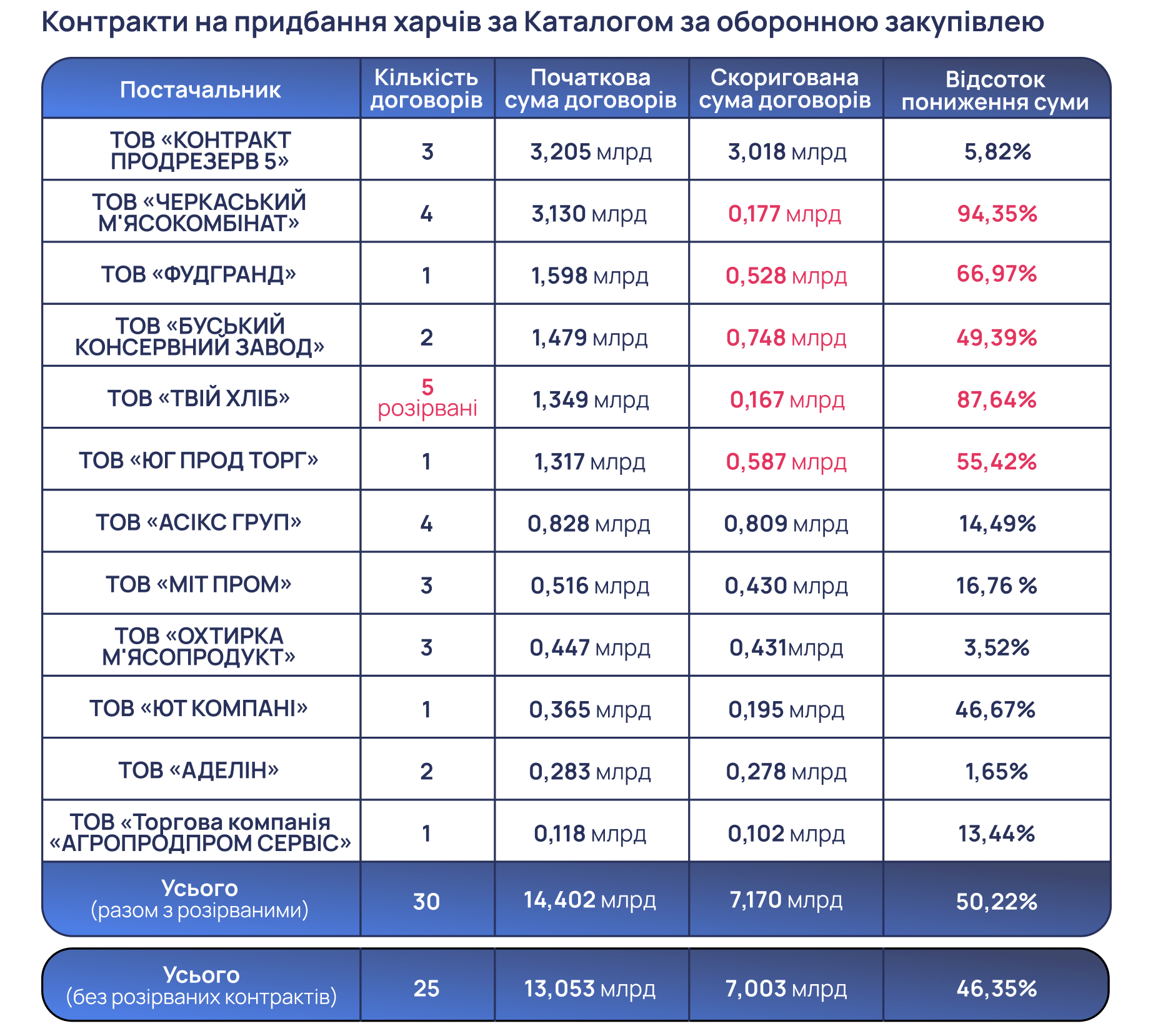
Thus, from March to June 2024, DOT concluded 30 direct contracts for purchasing food sets according to the Catalogue under the “defence procurement” procedure, totalling approximately UAH 14.4 B.
However, StateWatch analysts recorded significant reductions in contract values and product volumes following the signing of additional agreements – the total sum decreased from UAH 14.4 B to approximately UAH 7 B. Consequently, nearly half the product volumes required re-contracting, as suppliers were unable to fulfil contractual obligations.
Collectively throughout 2024, the State Logistics Operator concluded 86 food procurement contracts. Specifically, food sets according to the Catalogue were contracted for approximately UAH 43 B, daily ration packs for UAH 168.9 M, and catering services for UAH 261.78 M. Simultaneously, 9 of the 86 agreements, including 5 concluded under defence procedures, were ultimately terminated.
Overall, 77 participants took part in food tenders, 30 of whom signed contracts (excluding concealed suppliers). Among DOT’s food contractors, 7 companies had previously supplied products commissioned by the U-MOD’s State Procurement Department, which was responsible for non-lethal procurement prior to the DOT’s launch.
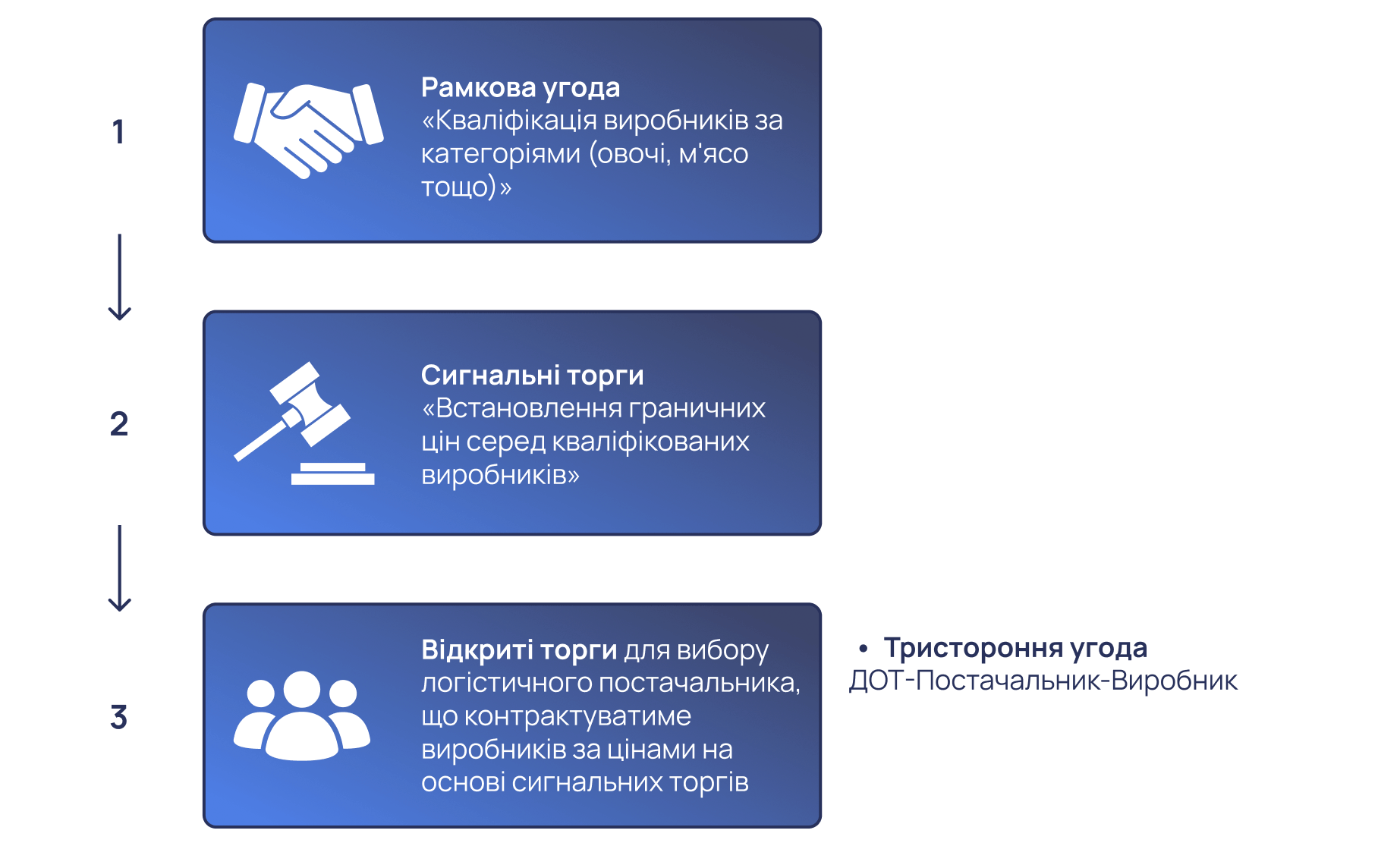
Throughout 2024, the State Logistics Operator developed and refined a model for military food provision, particularly seeking mechanisms to separate product procurement from logistics. To achieve this, the agency developed a multi-stage model which, following adjustments, operates as follows:
DOT announced the first procurement under the pilot model on 27 December 2024, worth UAH 3.192 B for supplying 20.6 M food kits and 4,050 animal feed sets. The initial model was to cover 6 regions (Kyiv, Kyiv Oblast, Vinnytsia, Zhytomyr, Cherkasy, and Kirovohrad oblasts).
Procurement of equipment and uniform
Modular Body Armour
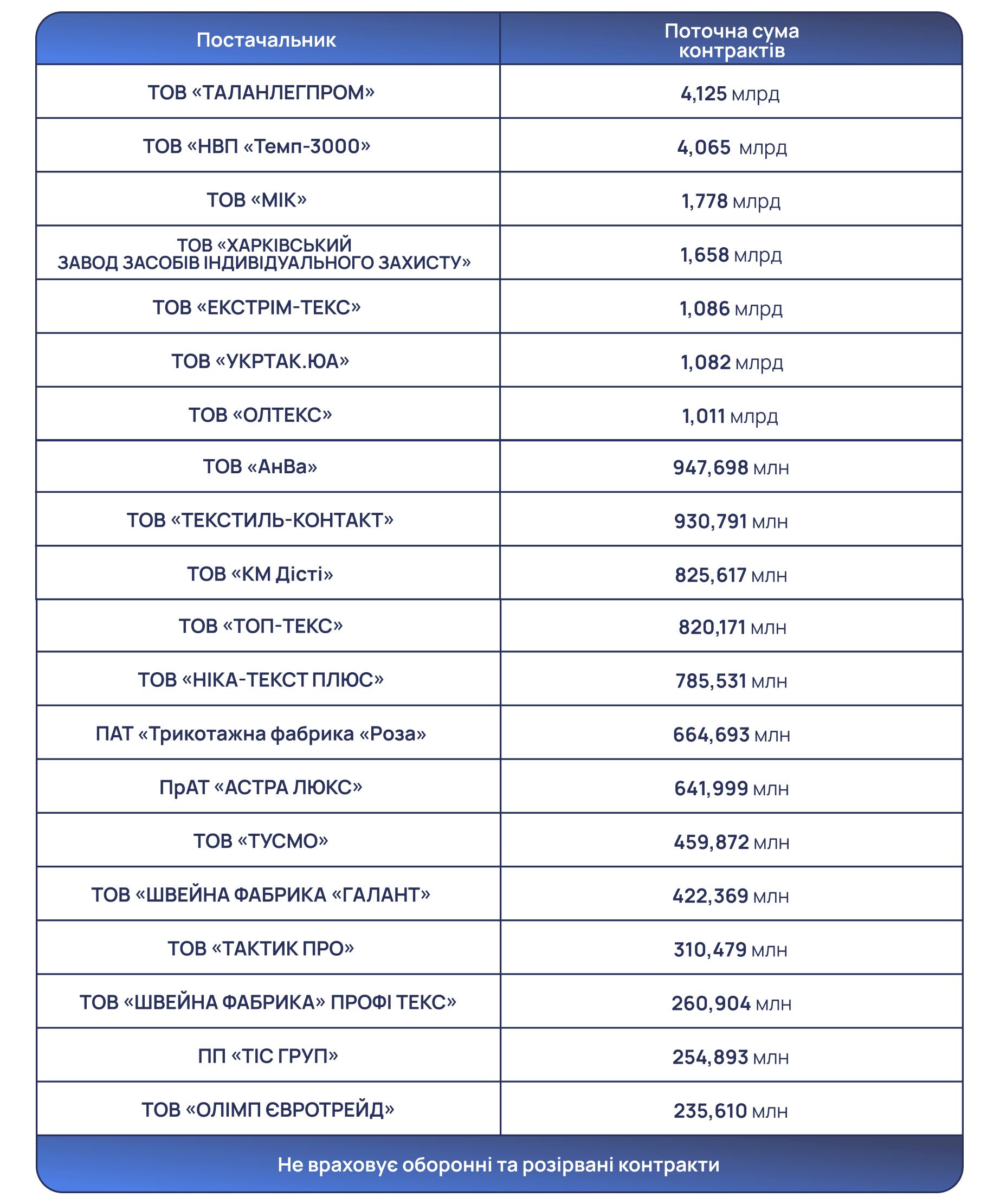
Concurrently, tenders for purchasing modular and lightweight body armour worth approximately UAH 9.4 B failed to materialise. Of this amount, UAH 2.5 B comprised lots cancelled by the ordering entity where 3 to 5 participants had shown interest, whilst UAH 6.9 B represented unsuccessful tenders due to absence of proposals.
The primary reason for the lack of proposals during the first four months of 2024 was the mismatch between indicative and expected costs with market proposals from most Ministry of Defence-certified suppliers. Throughout nearly the entire year, there were 6 such suppliers.
Significant changes in armour procurement occurred in August when authority to determine indicative price was transferred from the U-MOD to DOT. This enabled the agency to independently formulate both indicative and expected costs whilst considering market conditions.
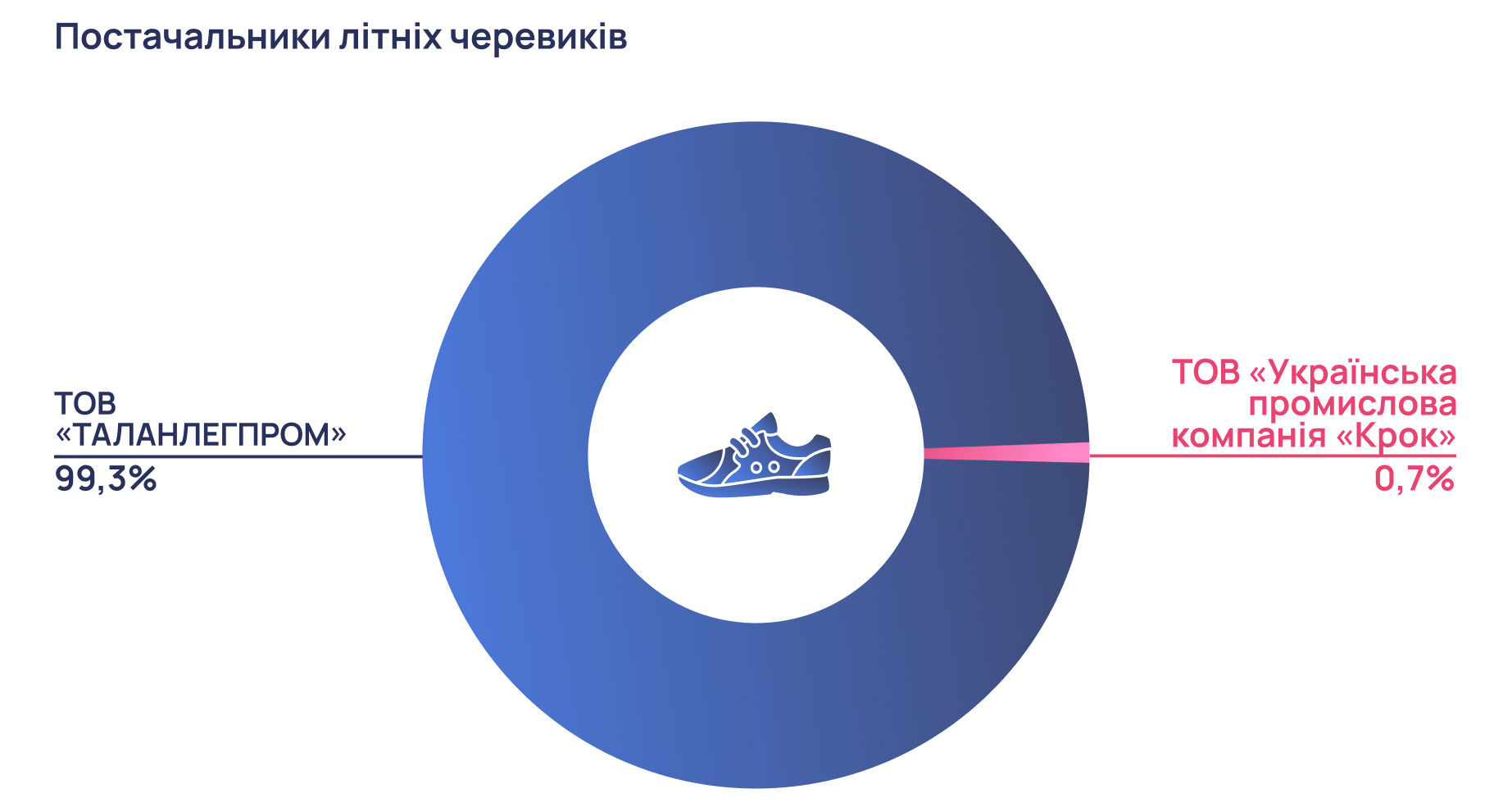
To purchase 1,100,660 pairs of summer boots, the agency signed 7 contracts worth UAH 2.5 B. Specifically, 650,600 pairs were purchased to meet 2024 requirements, with the remainder for 2025. The average price per pair was UAH 2,330.
Three companies participated in tenders: “TALANLEGPROM” LLC, “Ukrainian Industrial Company ‘Krok'” LLC, and “TOP-TEX” LLC. The latter enterprise won no tenders – ultimately contracts were concluded with two manufacturers. “TALANLEGPROM” remained the largest supplier with a 99.34% market share.
Prior to 2024, U-MOD technical specifications effectively restricted other manufacturers’ participation, as requirements stipulated mandatory presence of the “Talan” group logo on boot soles.
Following removal of this restriction, competition formally increased, but “TALANLEGPROM” maintained its dominant position through substantial production capacity and lower pricing compared to competitors.
Fuel and Lubricants Procurement
According to Prozorro data, in 2024 the State Logistics Operator purchased fuel and lubricants worth UAH 22 B, concluding 187 contracts. However, DOT’s annual report indicates that throughout the year the agency concluded contracts for fuel and lubricant procurement totalling UAH 28.2 B, inclusive of classified defence procurements.
The principal supplier was nationalised “UKRNAFTA” PJSC, which won the majority of contracts for petrol, diesel, and jet fuel throughout the year. The distribution of contracts amongst suppliers based on procurement results is demonstrated using diesel fuel as an example in the graph below.
Suppliers of diesel fuel
Characteristics of fuel and lubricant supplies:
1. Petrol and diesel procurement, beyond the commodity itself, also included purchasing fuel vouchers. Potential voucher suppliers were required to meet the following criteria: 15 filling stations in Kyiv and 1 in each oblast (excluding Crimea and Donetsk, Luhansk, and Kherson oblasts).
2. Supply volumes were adjusted through supplementary agreements due to volume deviations (up to 3%) and delays.
3. Supplementary agreements were concluded with delays, sometimes six months after the deadline, indicating deviations from delivery schedules specified in contracts.
Recommendations for Minimising Risks in the Defence Procurement System
1. Conduct an expert analysis of technical specifications through a working group comprising representatives from the Central Logistics Development Directorate, Logistics Forces Command, U-MOD Procurement Policy Department, Central Quality Control Directorate and research institutions to identify outdated and discriminatory standards.
2. Harmonise national technical specifications with NATO standards and include precise references to corresponding Alliance documents.
3. Ensure internal U-MOD auditing of contracts concluded under framework agreements with limited information access.
To the DOT:
1. Gradually expand the use of DOT-Chain to other categories of non-lethal goods and implement a delivery timeframe monitoring system.
2. Implement a mandatory mechanism for dividing large procurement volumes into lots to encourage participation from diverse suppliers.
3. Minimise the use of framework agreements with limited access, favouring instead procurement methods that enable public oversight.
4. Apply advance payment practices only when suppliers provide documentation guaranteeing fulfilment of contractual obligations.