Information current as of 9 February 2026.
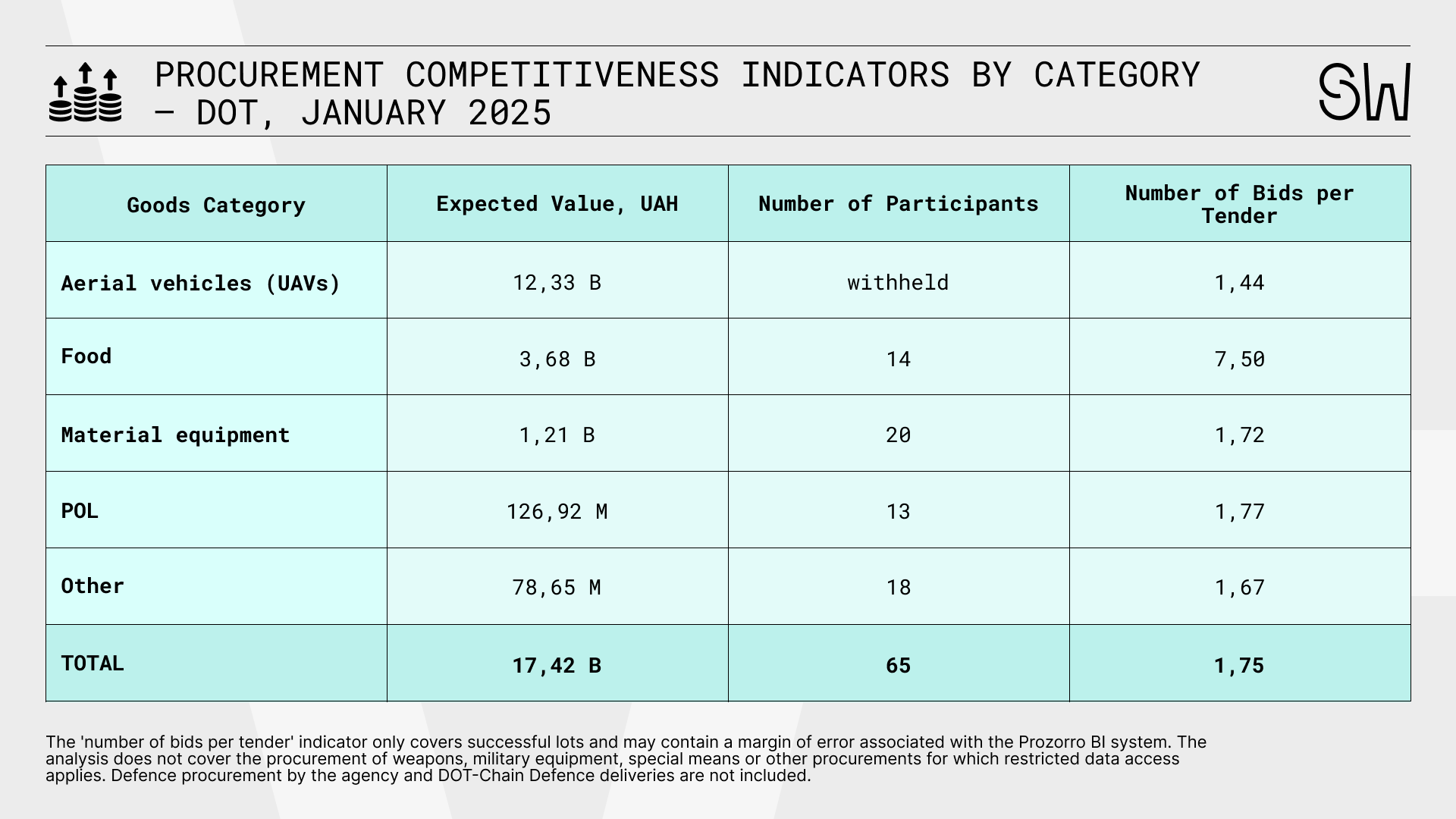
– In January, DOT Defence Procurement Agency announced 69 tenders totalling UAH 17.42 billion.
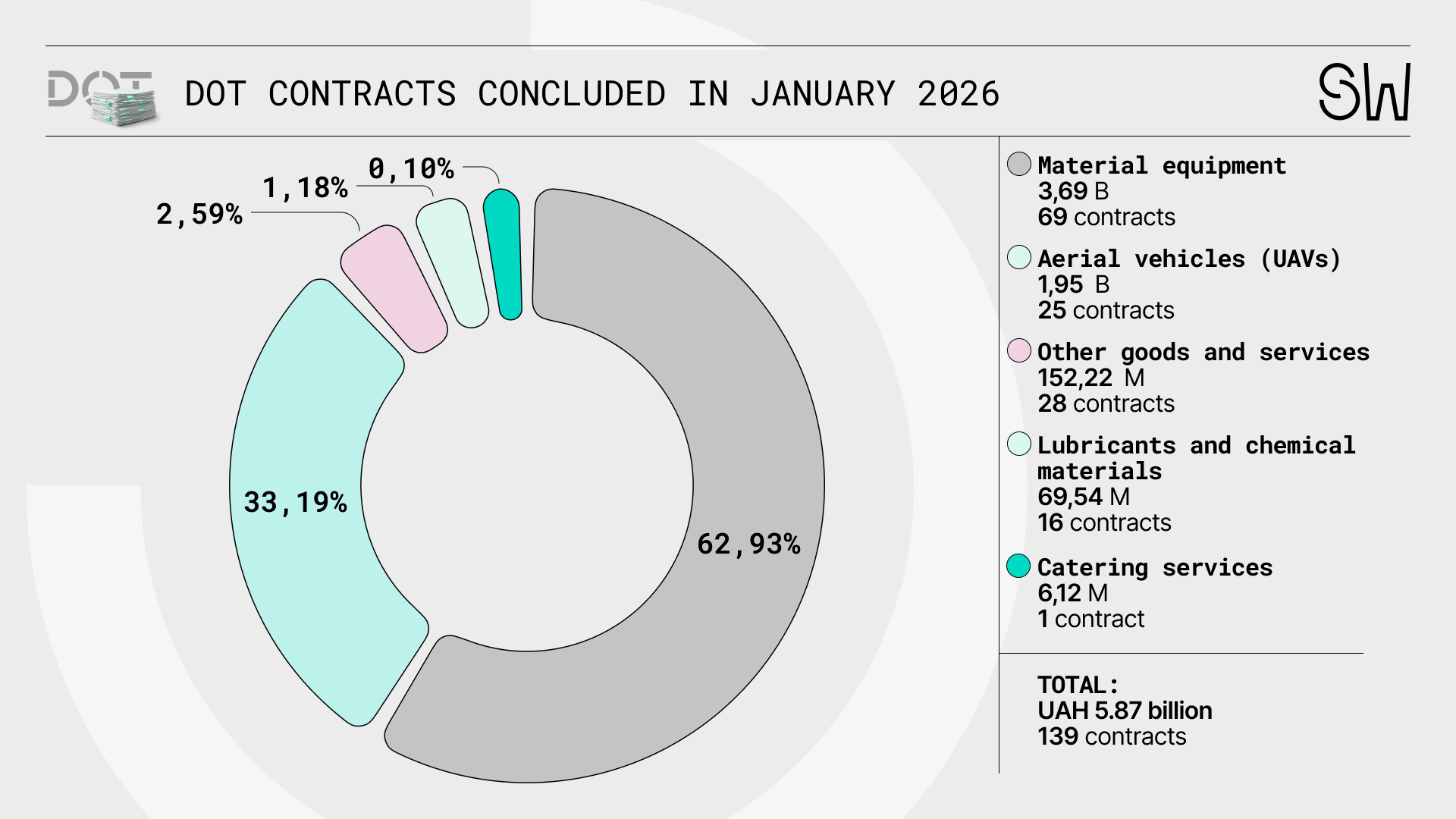
– During the same period, 139 contracts were concluded, totalling UAH 5.87 billion. Over 62% of this sum was earmarked for material equipment.
– The DOT is now procuring non-lethal goods on behalf of the State Special Transport Service (DSST).
– PRIVATE REAR OPERATOR LLC failed to deliver chemical hand warmers. As of early February, only 24,000 of the contracted 300,000 sets had been delivered. The company and the goods manufacturer, IMEX MAX LLC, are the subjects of criminal proceedings concerning bid rigging in State Border Guard Service tenders and the supply of substandard heating products.
– Following the Antimonopoly Committee’s finding that MIK LLC had engaged in anti-competitive conduct in DOT tenders, EKVIPTORG LLC – a company owned by the son of MIK LLC’s proprietor – began to win a number of material equipment contracts.
– Although food ration packs had already been contracted for the entirety of 2026, in January the agency announced a dynamic framework agreement worth UAH 54.06 billion. The DOT maintains that this serves as a contingency mechanism in the event of a critical shortage of food ration packs before January 2027.
StateWatch’s monitoring covers procurements published exclusively in the Prozorro electronic system. Therefore, the sample excludes direct contracts and other procurements, including those for weapons and military equipment, where the information constitutes a state secret and/or has not been published in the system. Accordingly, the number of contracts and their total value presented in this monitoring reflect only a portion of the actual contracting volume.
From January 2026, all procurement for the Armed Forces of Ukraine (AFU) – including weapons, military and material equipment, food, petroleum, oil and lubricants – will be centralized under the Defence Procurement Agency (DPA). The agency is responsible for organising supply and implementing a comprehensive procurement strategy.
From 2026 onwards, the agency will also provide the DSST with logistics nomenclature for food products, material equipment and petroleum, oil and lubricants (POL). The DSST will establish lists and determine the volumes of goods and services required, while the agency will manage the full procurement cycle. Procurement is funded within the DSST’s current budget, which stands at approximately UAH 2.9 billion for 2026.
In total, the DOT announced 69 tenders (135 lots) in January, with an expected value of UAH 17.42 billion. The largest share of the announced tenders (UAH 12.33 billion) was for the open procurement of unmanned aerial vehicles (UAVs). Over 70% of procurements were initiated under framework agreements. A total of 65 companies participated in the tenders during the month. The average number of bids per tender was 1.75.
In January, the DOT concluded 139 contracts totalling UAH 5.87 billion, resulting from tenders announced in January and the preceding months. Over 62% of the total value (UAH 3.69 billion) was spent on material equipment. Expenditure on aerial vehicles (UAVs) totalled UAH 1.95 billion (33.19%), excluding direct agency contracts and DOT-Chain Defence. POL accounted for UAH 69.54 million (1.18%), while one catering services contract was concluded for UAH 6.12 million (0.10%). Expenditure on other goods and services totalled UAH 152.22 million (2.59%).
By the beginning of the year, the Defence Procurement Agency had already finalised defence contracts totalling 40% of the budget for 2026. This figure includes all agency contracts, even those not published on Prozorro.
Aerial Vehicles (UAVs)
In December, the agency commenced the procurement process for the following year, marking the first instance of contracting beginning within the current year. The agency also holds contracts for the scheduled delivery of weapons and military equipment in 2026. Previously signed three-year contracts for weapons and equipment, covering deliveries in 2026, also remain in force.
It should be noted that the DOT procures UAVs through three methods:
1. Direct contracts: a contract is concluded with a specific manufacturer for a defined UAV model without competitive procedures. Further detail is provided in the StateWatch publication ‘Comparative Analysis of the UAV Procurement Procedure Under Direct Contracts’.
2. A framework agreement on the Prozorro platform involves a two-stage competitive procedure: first, a list of approved manufacturers is established, and then specific procurements are conducted among them. Unlike direct contracts, the contracting authority specifies key technical performance characteristics rather than a specific product model.
3. The DOT-Chain Defence IT system functions as a ‘drone marketplace’. Units can select UAV types and quantities independently, ‘paying’ with virtual funds allocated by the agency. Based on this data, the agency concludes contracts directly with manufacturers and suppliers.
The subsequent StateWatch analysis focuses on transparent, competitive procedures conducted through Prozorro.
In January 2026, the DOT signed 25 contracts for the supply of UAVs, totalling UAH 1.95 billion, which were recorded in the electronic system. Savings amounted to UAH 113.32 million.
The UAVs procured included 5,200 DJI Matrice 4E MATRICE 4 THERMAL units at an average price of UAH 146,216.15 and 6,175 DJI Matrice 4E MATRICE 4 ENTERPRISE units at UAH 192,690.06 each.
Separately, the agency reported that, since the launch of the DOT-Chain Defence system five months earlier, the military had received 225,000 drones valued at over UAH 10 billion.
Material supply
In January 2026, the DOT concluded 69 contracts for the supply of material equipment totalling UAH 3.69 billion. Total savings amounted to UAH 155.93 million. Details of selected key procurements are presented in the table below.
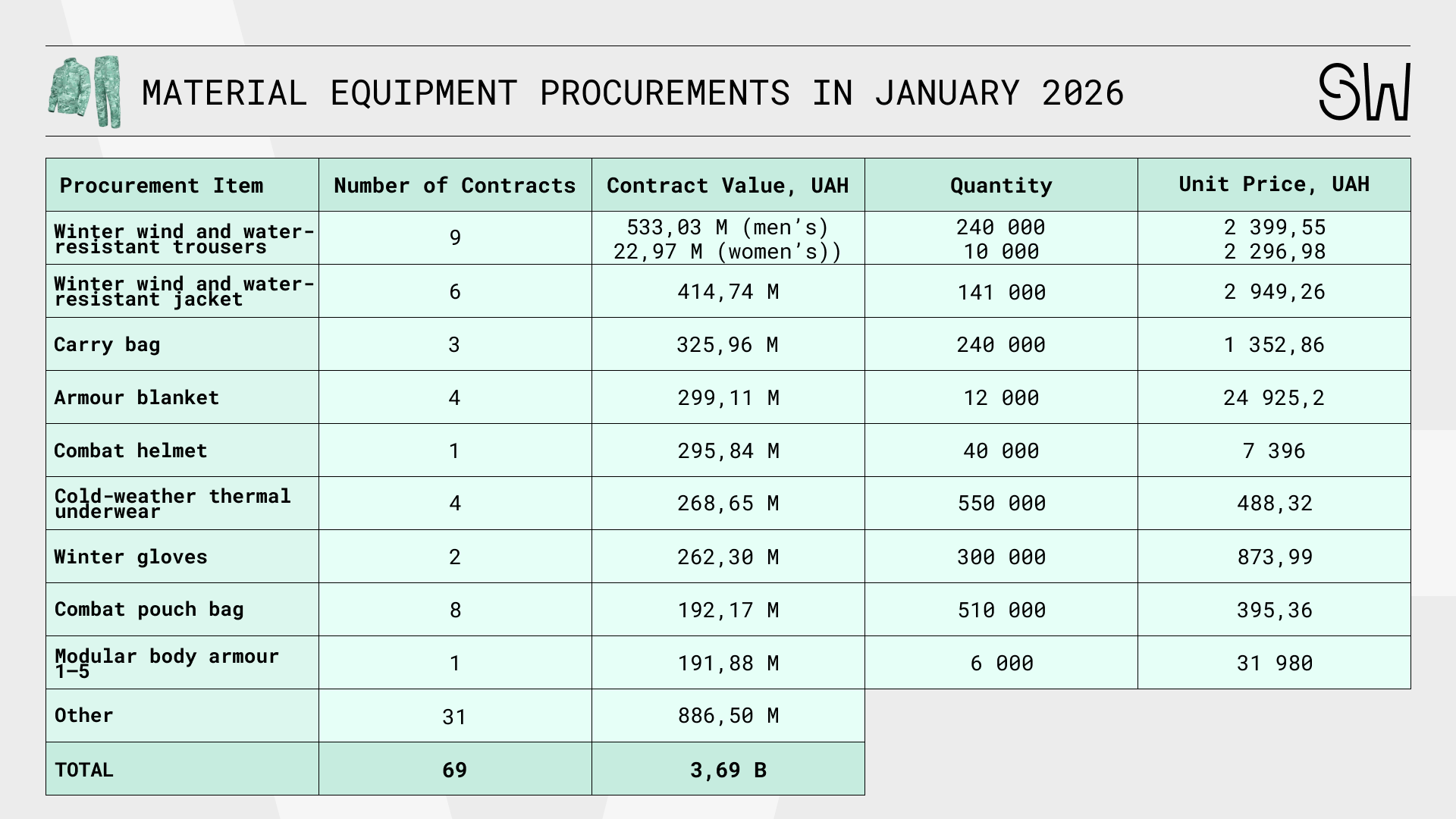
ANVA LLC offered the lowest price – UAH 2,160 per a pair of men’s trousers (35,000 pairs for UAH 75.6 million). Meanwhile, TRADE DIM KHARKIV LLC was contracted to supply 10,000 pairs of women’s trousers at UAH 2,297 per pair (UAH 22.97 million). This marks the first time that the DOT has procured winter trousers with an anatomical cut suitable for women. However, this represents only 18.5% of female servicemembers in the Armed Forces of Ukraine.
DOT also procured 141,000 winter, wind- and water-resistant jackets at a cost of UAH 414.74 million. The average unit price was UAH 2,949.26.
It should be noted that a significant number of tenders for winter uniforms failed in 2025 due to a lack of bids. This was due to a sharp reduction in the expected value in April, which was 2–21% lower than the 2024 contract prices. Further details are available in the StateWatch May monitoring report.
In January, 6,000 modular body armour sets (configuration 1–5) were procured from UKRTAK.UA LLC at a cost of UAH 31,980 per unit. The tender proceeded without competition, with delivery scheduled by the end of September.
For comparison: in December, DOT purchased 42,000 modular body armour sets (configuration 1–5) at a record low expected value of UAH 21,804.13. One of these contracts was signed with UKRTAK.UA LLC for 18,000 units at UAH 17,849.90 each. However, one month earlier, the same supplier had been contracted to provide 4,500 sets at UAH 31,980. Small-volume deliveries at higher prices may indicate supplementary batches, which are economically inefficient and undermine pricing stability.
In January, the agency procured a further 12,000 armour blankets at an average price of UAH 24,925.20 per unit, totalling over UAH 299 million. The lowest bid was awarded to EKVIPTORG LLC for the supply of 3,000 armour blankets at UAH 24,915 per unit.
EKVIPTORG LLC was registered in August 2024 and is owned by Artem Mitrokhin, the son of Oleh Mitrokhin, the proprietor of MIK LLC. At the end of last year, the Antimonopoly Committee found that MIK LLC and PAKOPTTORG LLC had engaged in anti-competitive conduct in DOT tenders. The companies were fined UAH 36.3 million and were entered into the register of violators, which provides grounds for rejecting a participant’s bid in public procurement for a period of three years.
EKVIPTORG LLC first participated in DOT tenders in June 2025, receiving contracts worth over UAH 1 billion by December. In January, the company signed four contracts with the agency totalling over UAH 280 million.
For the purposes of participating in tenders, EKVIPTORG LLC primarily submitted documentation relating to goods manufactured by MIK LLC.
In January, DOT separately contracted 40,000 combat helmets (Type 1) from LEADER STP LLC for UAH 295.84 million (UAH 7,396 per unit). The procurement proceeded without competition. Type 1 helmets provide extended protection, covering not only the crown of the head, but also the ears.
The agency’s last procurement of such helmets was in July 2025, when the unit price from TEMP-3000 LLC was UAH 8,160. LEADER STP LLC belongs to the TEMP-3000 corporate group owned by Yurii Yevtushenko and is managed by his son, Hlib Yevtushenko.
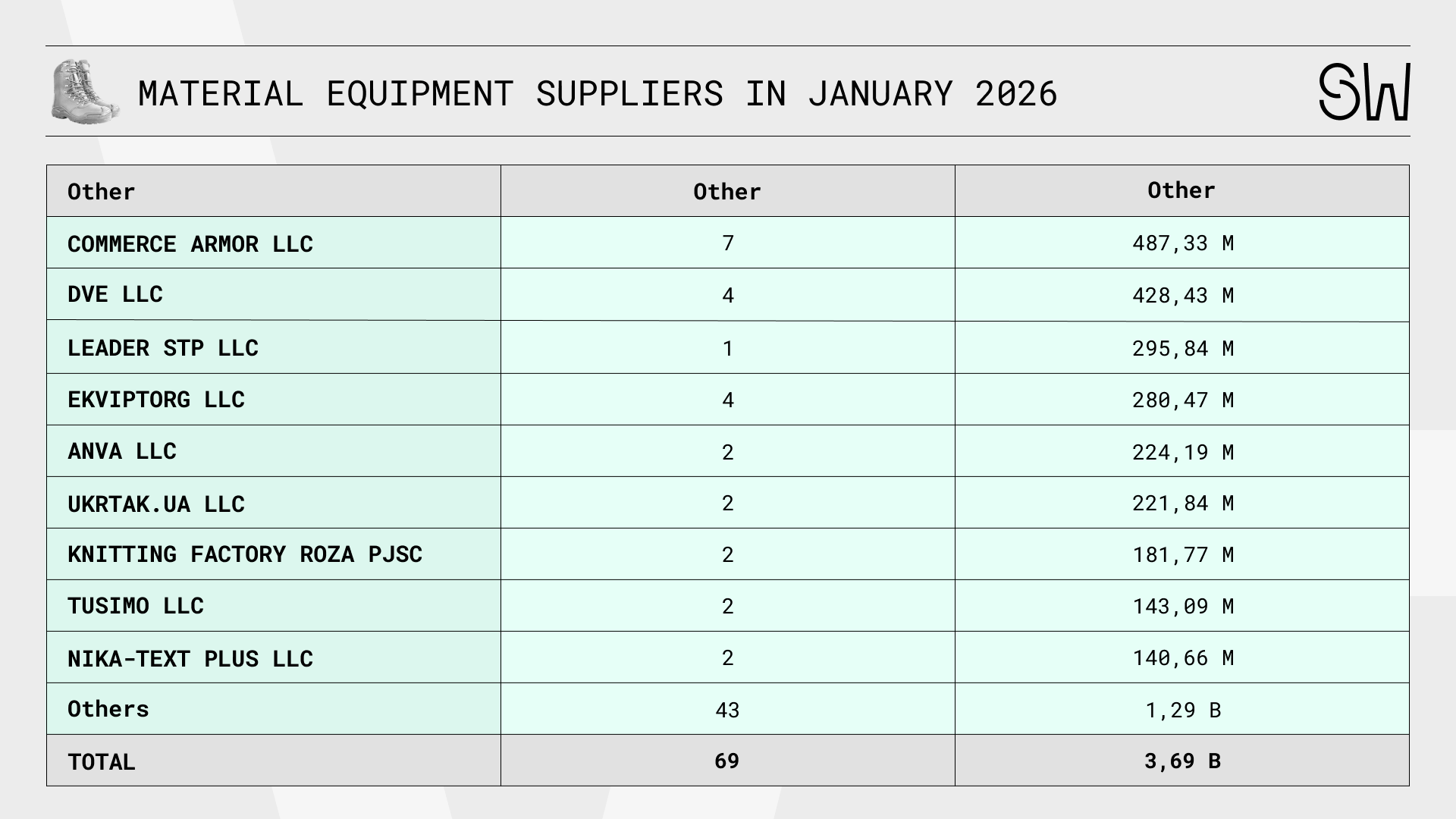
The largest contracted amount in January – UAH 487.33 million – was awarded to COMMERCE ARMOR LLC. This company does not manufacture products itself, but supplies them from other companies. In particular, contracts were signed for:
– 300,000 pairs of winter gloves at an average price of UAH 874, manufactured by ANVA LLC and SKVIRATEKS LLC;
– 350,000 bags at UAH 379.60, manufactured by TOP-TEX LLC;
– 41,000 pairs of winter, wind- and water-resistant trousers at UAH 2,294.34, manufactured by SKVIRATEKS LLC.
The agency also contracted SENSSMART LLC in January for 125,000 pixel-patterned field caps and 100,000 MultiCam field caps, totalling UAH 48.13 million. Kharkiv-based SENSSMART LLC, which is owned by Volodymyr Yevheniiovych Kriuchkov, first signed contracts with DOT in November. Meanwhile, Volodymyr Kriuchkov, a sole trader, had previously concluded material equipment contracts with the agency worth UAH 252.89 million.
In addition to SENSSMART LLC and the sole trader Volodymyr Kriuchkov, other participants associated with him also take part in DOT tenders, namely the sole traders Iryna Serhiivna Kriuchkova and Bohdan Volodymyrovych Kriuchkov, who are linked to his wife and son respectively. Notably, all of these business entities declare SENSSMART LLC as the manufacturer of the goods in their tender submissions. Their participation is discussed in detail in the StateWatch monitoring report for November.
For instance, in January, Volodymyr Kriuchkov (sole trader) and SENSSMART LLC – of which he is the ultimate beneficial owner – submitted simultaneous bids for the procurement of ponchos. The lowest bid was that of the sole trader (UAH 495 per unit), followed by SENSSMART LLC (UAH 500). However, both bids were rejected. As the sole trader’s letter of guarantee stated that there were no connections between the participants, the contracting authority rejected both bids on the grounds of an apparent conflict of interest involving SENSSMART LLC. On previous occasions, however, the participation of related parties in similar procurements had not resulted in bid rejection.
In total, 36 companies were awarded contracts for material equipment in January.
By the end of 2025, the DOT had finalized major food service procurements for the AFU for the whole of 2026, signing 16 contracts totalling UAH 27.5 billion. At that time, the catalogue prices of products increased by 8% relative to the May procurements. Consequently, the expected value per set also increased to UAH 171.50. Contract prices averaged UAH 128 per set, which was approximately 25% below the expected value.
However, in January, the DOT initiated a dynamic framework agreement with restricted access for the procurement of 315.29 million food ration packs via the catalogue at a cost of UAH 54.06 billion (UAH 171.50 per unit).
According to Nashi Hroshi’s reporting, the Defence Procurement Agency of the DOT stated that the framework agreement is intended for use exclusively in the event of a critical shortage. It is conceived as a contingency instrument enabling the rapid conclusion of contracts in the event of an emergency or threat of supply disruption to existing contracts.
The procedure operates in two stages: first, a list of qualified companies is established; then, requests for proposals are issued to them. Applications have been submitted by: KONTRAKT PRODREZERV 5 LLC, TORH SITI PRODUKT LLC, ADELIN LLC, OKHTYRKA MEAT PRODUCTS LLC, FLAVACOR LLC, GRAND-CONSULT LLC, BUSKY CANNERY LLC, and TRADE GRANITE INVEST LLC.
Risks of food supply disruptions under current contracts cannot be ruled out. In particular, according to information from Tetiana Nikolaienko, BUSKY CANNERY LLC – one of DOT’s largest suppliers – is implicated in a State Bureau of Investigations case concerning under-delivery and the supply of substandard food products to combat units of the AFU in Dnipropetrovsk Oblast.
According to investigative findings, officials signed acceptance certificates for the full volume of goods, whilst in practice only a portion was delivered to military personnel – the remainder was written off through controlled intermediaries. Furthermore, substandard products were supplied to servicemembers, including rotten fruit and vegetables. The head of the brigade’s food service received kickbacks of up to 50% of the value of deliveries. During searches, assets worth over UAH 10 million were discovered, including real estate, vehicles, and an expensive clothing collection.
In December, the DOT concluded two contracts with BUSKY CANNERY LLC for the supply of 25.1 million food ration pack sets by catalogue for the AFU for the entirety of 2026, totalling UAH 3.21 billion. The company’s involvement in criminal proceedings alongside the conclusion of large contracts underscores the risk of supply disruption.
Separately, the agency announced new tenders with an expected value of UAH 3.67 billion (UAH 171.50 per unit) for 21.39 million food ration packs for personnel and 2,160 animal feed packs.
In January, the DOT also concluded a catering services contract worth UAH 6.12 million (UAH 138.75 per service). Under this contract, 44,144 services will be provided to the military training department of the National Aviation University.
Lubricants and Chemical Materials
Although DOT did not procure any diesel in January, it signed 16 contracts totalling UAH 69.54 million for the supply of lubricants and chemical fluids. The agency achieved savings of UAH 13.09 million.
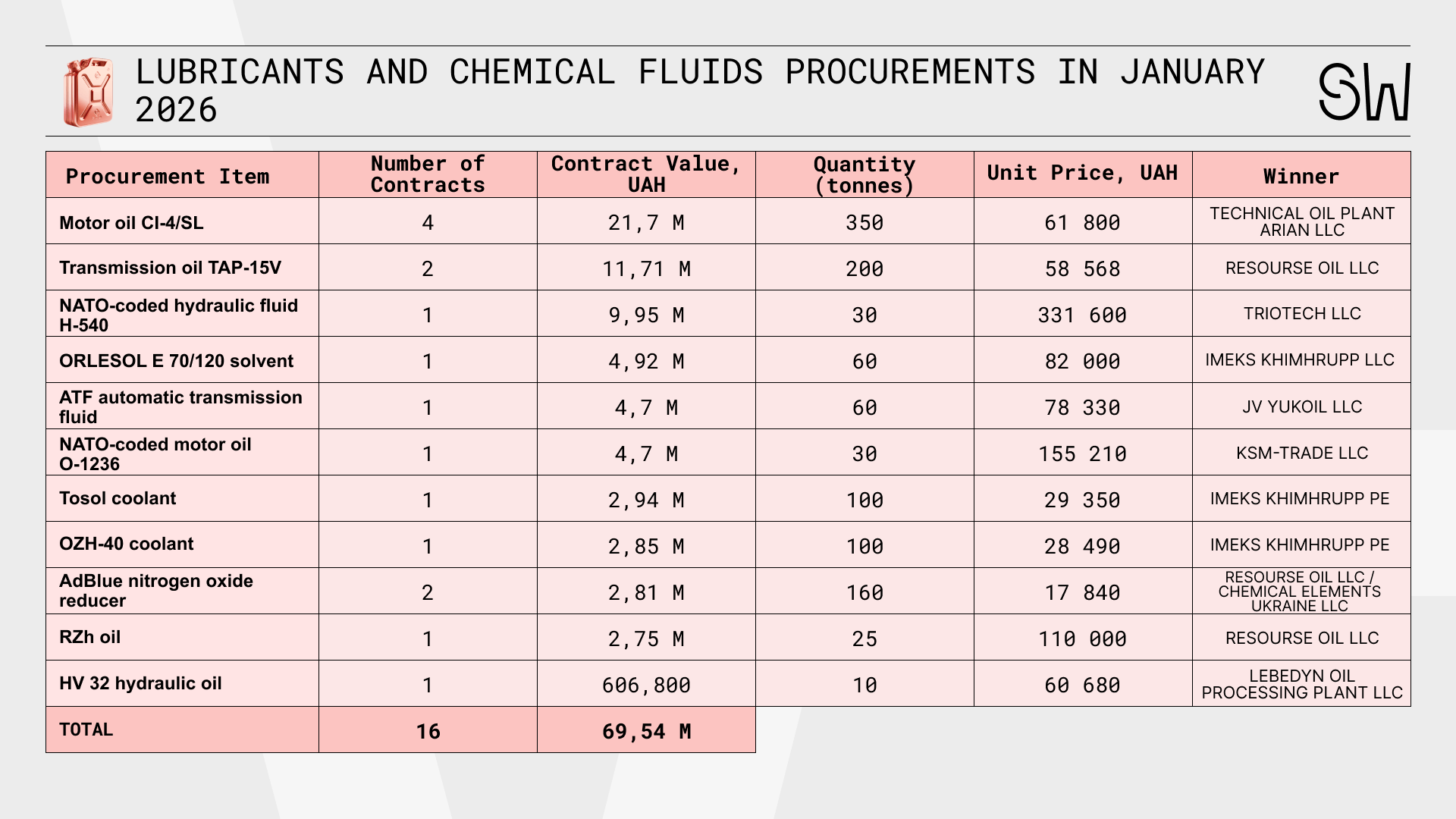
In January, contracts for lubricants, oils, and other fluids were concluded with 8 companies.
The absence of diesel fuel from January contracts is explained by the fact that the procurement cycle for the following year commenced ahead of schedule: the relevant contracts were concluded in late 2025. It will be recalled that in December, the agency procured 93,200 tonnes of arctic diesel for UAH 3.92 billion (average price per tonne: UAH 42,106). DOT also separately purchased 22,500 tonnes of A-80 petrol for UAH 1.21 billion (average price: UAH 53,843.78 per tonne).
Challenges in January Procurements
Unsuccessful and Cancelled Tenders
Of all the procurements announced in January, 46 lots totalling over UAH 3.86 billion were unsuccessful.
In the aerial vehicles (UAVs) category, three tenders (37 lots) worth UAH 1.43 billion were unsuccessful in January due to a lack of bids. Specifically, the agency was unable to procure 5,400 multi-rotor reconnaissance unmanned aerial systems at an expected cost of UAH 219,799.80 per unit and 2,000 unmanned aerial systems at UAH 123,433.33 per unit.
Procurement also failed due to the absence of bids for 111,000 short-sleeved T-shirts, including 30,000 adaptive units at UAH 405.24 per unit and 81,000 standard units at UAH 210 per unit.
Additionally, three lots from the catalogue food ration pack tenders announced in January were cancelled due to no longer being required. These tenders had envisaged procuring 14 million sets for personnel and 1,420 sets for animal feed, with an expected value of UAH 2.4 billion.
Failed Deliveries of Hand Warmers
A significant challenge arose from the failed delivery of chemical hand warmers. Kharkiv-based PRIVATE REAR OPERATOR LLC was contracted to deliver 300,000 sets by 9 December 2025, yet as of early February had in practice delivered only approximately 24,000. Meanwhile, on 25 December, reports confirming the full performance of both contracts were published in the Prozorro system.
In early December, DOT announced a new large-scale procurement for over 500,000 sets, and the tender proceeded in the absence of competition. PRIVATE REAR OPERATOR LLC was selected as the winner again, at a price of UAH 20.88 per set. The contract was signed on 26 December 2025 – by which time the agency was already aware of the company’s previous unmet obligations.
PRIVATE REAR OPERATOR LLC supplies products manufactured by IMEX MAX LLC, also based in Kharkiv. Notably, IMEX MAX LLC is associated with Anatolii Rodzymskyi, a deputy from the Kharkiv branch of the Opposition Platform – For Life party. According to Rodzymskyi, the supply failure was due in part to delays in signing the contract by the DOT and to power outages affecting production.
At the time the contract was signed, both companies were implicated in criminal proceedings initiated in April 2025 concerning the supply of heating products to the State Border Guard Service that did not meet technical requirements (violations of the temperature regime, labelling and packaging).
The investigation established that under the first contract with IMEX MAX LLC, that same company manufactured the products, whilst PRIVATE REAR OPERATOR LLC received payment and supplied the hand warmers as its authorised representative. Under the second contract, ANDRUSHIRE SPIRIT PLANT LLC – which subsequently changed its name to PRIVATE REAR OPERATOR LLC – participated alongside IMEX MAX LLC to create the appearance of competition in procurement procedures. Investigators consider these two companies to have acted in collusion.
The agency has attributed the supply shortfall to the fact that the established 2025 requirement of 600,000 sets should have been tens or even hundreds of times greater – given that chemical hand warmers are single-use items designed for use by a single servicemember over 6–8 hours.
In early February, the agency announced that PRIVATE REAR OPERATOR LLC had been fined UAH 1.1 million for breach of contract terms. In addition, DOT representatives, together with the Security Service of Ukraine and the State Quality Guarantee Authority, are monitoring production and dispatch of batches at the manufacturing site.
Following a wave of public criticism, the DOT announced its intention to procure and transfer 150,000 hand warmers at its own expense by the end of February. The issue is examined in detail in the StateWatch analysis “Will the ‘Mamo’ Hand Warmers Keep Servicemembers Warm: An Analysis of the Failure to Supply the AFU with Chemical Hand Warmers.”
Legal Proceedings
The agency has faced legal challenges regarding the outcome of the tenders for body armour configurations 1–11, which were expected to be worth UAH 37,386. UKRTAK.UA LLC was selected as the winner in two lots. The company was to supply 34,000 sets at UAH 25,499.99 and a further 16,000 sets at UAH 26,299.90. However, KHARKIV PLANT OF PERSONAL PROTECTIVE EQUIPMENT LLC (KPPPE) contested the results because the bid did not meet the requirements.
KPPPE drew particular attention to the absence of a certificate confirming experience in performing similar contracts at a level of no less than 30% of the expected value. Furthermore, the letter from the Central Directorate for the Development of Material Support (CDDMS) provided by UKRTAK.UA LLC concerned the approval of the reference sample for configurations 1–8, with separate approval for elements 9–11.
The court upheld KPPPE’s claim, resulting in UKRTAK.UA LLC’s bid being rejected. The next-lowest bidder, AKROPOLIS PVTP LLC, was also rejected because it had submitted a certificate of conformity for configuration 1–8 only, rather than for configurations 1–11 as required by the tender documentation.
Following the designation of KPPPE as the winner, TEMP-3000 LLC filed a claim. The company argued that the competitor’s “Price Offer” document did not enable identification of the procurement subject. Additionally, TEMP-3000 LLC cited discriminatory conditions and an unequal approach to the assessment of certificates.
Some participants had received conformity certificates for a ‘reconfiguration of the reference sample’ of configurations 1–8, with separate approval for elements 9–11. KPPPE, however, held a document covering configurations 1–11, and sought to exploit this distinction to their advantage.
The court found that KPPPE’s documents did not meet the tender documentation requirements, and that assessing the legitimacy of CDDMS documents was beyond the scope of the dispute.
Consequently, in February, the agency concluded two contracts with TEMP-3000 LLC totalling UAH 1.48 billion (an average price of UAH 29 659 per unit).
Terminated Contracts
At the end of 2025, the DOT terminated 9 contracts with PYRIATYNSKIY DELIKATES LLC for the supply of 441,028 combat rations for the AFU totalling UAH 171.43 million.
These were for 180,012 enhanced and 261,016 standard daily field rations ordered in the summer of 2025. Despite the established delivery deadlines (30 September and 25 December 2025), the company failed to fulfil its obligations.
During 2024–2025, the DOT terminated contracts for the supply of over 1.5 million combat rations (approximately 30% of the contracted volume). One factor contributing to the terminations was the low production capacity of suppliers. Only 25% of contracts were with companies that independently manufacture a portion of ration components, whilst the majority of suppliers purchased components from numerous third-party manufacturers.
For instance, contracts totalling UAH 201 million with FABRYKA SMAKU LLC and YUH PROD TORH LLC, concluded in 2024, ended in termination after the companies delivered only 2% and 58% of their contracted volumes, respectively. Suppliers with their own production cycle, such as PREMIUM SERVICES LLC, MITFORM LLC and PYRYATINSKY DELIKATES LLC, also failed to deliver 794,269 rations due to non-compliance with dispatch deadlines, non-delivery or goods failing to meet technical requirements.
The tight timeframes for contract performance (1.5–2.5 months) posed an additional challenge, particularly when combined with the late communication of the 2024 requirements, leading to a series of unsuccessful procurements. During 2024–2025, a further 4.5 million sets could not be procured.
Despite the aforementioned challenges, the DOT succeeded in contracting approximately 3 million rations following a two-year hiatus in individual ration procurement (from late 2022 to October 2024). A total of 12 participants were involved in the tenders, nine of whom ultimately became suppliers.
Further detail on the challenges of combat ration procurement is provided in the StateWatch research paper “Combat Ration Procurement for the Armed Forces of Ukraine: Causes of Supply Failures and Market Assessment – StateWatch Analysis.”
Recommendations Based on the Analysis of January 2026 Challenges
For the DOT Defence Procurement Agency:
1. Strengthen the verification of counterparties’ production, financial and organisational capacity before concluding a contract, with a view to preventing supply failures.
2. Minimise the use of restricted-access framework agreements for non-lethal procurements and give preference to those subject to public oversight instead.
3. Specify whether the conformity of a procurement item can be determined based on an act that only covers its individual components if the item was procured as a complete set.
For the Ministry of Defence of Ukraine:
1. Require the Defence Procurement Agency to introduce mandatory lot division for large-volume procurements to increase competition and expand the pool of potential suppliers.
For the Logistics Forces Command of the Armed Forces of Ukraine:
1. Carefully and in advance, plan the annual requirement for chemical hand warmers, considering potential savings and forecasting different temperature scenarios.
2. Establish strategic reserves of items associated with service members’ exposure to extreme conditions.
3. Increase the requirement for winter material equipment and personal armour protection for female service members, considering the actual number of women in the AFU.
DOT procurement monitoring is part of a support programme funded by the Special Defence Adviser of the British Embassy in Ukraine, implemented by the EDGE Foundation and StateWatch.