
Information current as of 8 June 2026.
Key Findings
- The Verkhovna Rada ratified the EU credit package agreement worth EUR 90 billion, which enabled an increase in security and defence expenditure to a record UAH 4.4 trillion in 2026. Of this amount, EUR 60 billion will be allocated to defence spending.
- In May, the supply of unmanned ground vehicles (UGV) was exempted from VAT – following the Verkhovna Rada’s decision at the end of 2025 to abolish the VAT exemption for electric vehicles, which had also applied to GRS. As of May, units had received 1,000 UGV units worth over UAH 487 million through DOT-Chain Defence.
- The government extended the DOT-Chain Defence to 24 October 2027 and expanded platform access to the State Border Guard Service (SBGS) and the National Police. As of end-May, the military had received 485,000 items of equipment worth UAH 31.4 billion through the system. The platform features products from over 200 Ukrainian manufacturers.
- In May, DOT concluded 153 contracts totalling UAH 14.1 billion. The largest share – UAH 7 billion – comprised petroleum, oil and lubricants (POL) procurements. The price of diesel reached its highest level since 2024, at UAH 64,923 per tonne.
- Following a sharp rise in global oil quotations, new POL contracts are gradually transitioning to formula-based pricing indexed to the international Platts benchmark – although contracts for A-80 petrol and lubricants do not yet provide for this mechanism.
- For the first time, 2,000 women’s modular body armour vests were procured for the Armed Forces of Ukraine (AFU). Despite this positive development, the quantity is far from sufficient: as of March 2026, the AFU comprised over 55,000 female service personnel.
In May, the DOT Defence Procurement Agency (DOT) announced 71 tenders (94 lots) with an expected value of UAH 15.4 billion. The majority (UAH 6.2 billion) comprised tenders for the procurement of vehicles. 60% of all Prozorro procurements were initiated under the simplified procedure, with a further 39% conducted under a framework agreement for the procurement of vehicles. A further 0.2% each were open tenders with special conditions and procurements conducted without the electronic system – to support the Agency’s operational requirements. In total, 94 companies participated in the tenders, excluding Unmanned Aerial Vehicle (UAV) procurements. The average number of bids per tender stood at 2.02. The most competitive category was vehicles, attracting 6.25 bids per tender. No UAV tenders were announced in May.
Competition Indicators in DOT-Announced Procurements, May 2026
| Procurement Category | Expected Value, UAH | No. of participants | No. of bids per tender |
|---|---|---|---|
| Vehicles | 6.2 billion | 7 | 6.25 |
| Food | 3.8 billion | 10 | 5 |
| POL | 3.7 billion | 7 | 1.23 |
| Materiel | 572.1 million | 31 | 1.76 |
| Other | 1 billion | 39 | 1.4 |
| TOTAL | 15.4 billion | 94 | 2.02 |
In May, DOT concluded 153 contracts totalling UAH 14.1 billion – resulting from tenders announced both in May and previously.
The largest share – 49.7% (UAH 7 billion) – comprised petroleum, oil and lubricants (POL) procurements (71 contracts). Food expenditure totalled UAH 4.5 billion (32%), with materiel accounting for UAH 1.4 billion (10%). UAV procurement accounted for UAH 872.5 million (6.2%); however, this figure does not include the Agency’s direct contracts or procurements through DOT-Chain Defence. Motorcycles were contracted separately – UAH 92.4 mn (0.7%).
DOT Contracts Concluded in May 2026
| Procurement Category | No. of contracts | Contract Value, UAH | Share |
|---|---|---|---|
| POL | 71 | 7 billion | 49.65% |
| Food | 6 | 4.5 billion | 31.88% |
| Materiel | 33 | 1.4 billion | 10.11% |
| UAV | 18 | 872.5 million | 6.18% |
| Other goods and services | 24 | 215.9 million | 1.53% |
| Motorcycles | 1 | 92.4 million | 0.65% |
| TOTAL | 153 | 14.1 billion | 100% |
Institutional Changes
International Financial Assistance and Amendments to the State Budget
The Verkhovna Rada ratified the Memorandum of Understanding on macro-financial assistance under the Ukraine Support Loan and the corresponding credit agreement with the EU.
This concerns a credit package worth EUR 90 billion for 2026-2027, which had long been blocked by Hungary. Following the victory of the opposition Tisza party in the parliamentary elections, the country changed its position, and at the end of April the Council of the EU unblocked the programme. The European Parliament officially adopted the relevant package of decisions. For further detail, see the March monitoring report by StateWatch.
It was on the strength of these funds that, at the start of June, the Verkhovna Rada adopted the bill amending the State Budget for 2026 in respect of the financing of the security and defence sector using to EUR 90 billion in funding from the EU for 2026–2027. In 2026, the state budget will receive a first tranche of EUR 45 billion (UAH 2,221 billion), of which EUR 31.8 billion is earmarked to support defence and security capability. The bill provides for an increase in expenditure of UAH 1.56 trillion, of which over UAH 1.5 trillion is allocated to the Ministry of Defence (MoD) – for the pay of military personnel and the procurement and modernisation of weaponry.
Total security and defence expenditure in 2026 is set to rise to a record UAH 4.4 trillion. Of this, UAH 2.3 trillion is earmarked for the procurement of weapons and military equipment, and over UAH 1.45 trillion for the monetary allowances of service personnel.
In a separate decision at the end of May, the Cabinet of Ministers allocated UAH 10.84 billion to strengthen defence capability – the remaining balance of the state budget’s special fund, accumulated from personal income tax revenue, gambling licence fees, and lottery proceeds. The fund was established in 2025 after the MoD assumed the functions of the now-defunct Ministry of Strategic Industries. The funds were allocated across two areas: UAH 9.05 billion for the procurement, modernisation, and repair of weapons and military equipment, and UAH 1.79 billion for the development of the defence-industrial complex, including the introduction of new technologies and the expansion of production capacity.
Ground Robotic Systems Exempted from VAT
In May, the Verkhovna Rada adopted amendments to the Tax Code exempting the supply of UGVs for the Defence Forces from VAT. The exemption will remain in force until the end of martial law and applies to procurements under state contracts.
UGVs are critical for logistics, evacuation, and the supply of frontline units. From January to March 2026, the front line experienced an acute shortage of such systems. The cause was a tax loophole that arose at the end of 2025, when the Verkhovna Rada repealed the VAT exemption for electric vehicles; since UGVs units are classified as electric vehicles, the exemption ceased to apply to them as well. Manufacturers began demanding additional funding to cover the resulting tax burden, which effectively blocked the fulfilment of contracts. This occurred despite the General Staff having submitted the Requirement for UGVs units back in January, with some units already manufactured and held in storage. Units were forced to cover their requirement for robotic systems by their own means or through volunteers.
In response, Mykhailo Fedorov stated that contracts would be unblocked through additional funding from the MoD. At the start of February, an interagency meeting was already held, at which the need for amendments to the Tax Code was supported, and the agreed amendments were submitted to parliament.
As of May 2026, Defence Forces units had received 1,000 UGV units worth over UAH 487 million through DOT-Chain Defence. In the H1 of 2026, the MoD plans to contract 25,000 UGV units under various programmes – twice the volume contracted during the whole of 2025.
Vehicles
Motorcycles
In May, DOT concluded a contract for the supply of 1,500 motorcycles for the AFU – three times more than the previous year. The procurement was conducted under the simplified procedure. 6 companies participated in the tender, which made it possible to save approximately UAH 12 million. The savings will be directed towards the additional provisioning of the Defence Forces.
The contract was concluded with STANFORM LLC at a price of UAH 61,596 per unit. By December, the company is to supply motorcycles manufactured in China by Chongqing Keweis Machinery Manufacturing Co., Ltd.
The lowest price bid was submitted by BUDPOSTACH LLC – UAH 58,630 per unit, which would have secured savings of over UAH 12 million. However, the bid was rejected for non-compliance with the technical requirements: the load capacity of the motorcycle was 150 kg rather than the required 160 kg. The company appealed the decision to the DOT appeals body, citing a technical error.
Pickup Trucks
In May, DOT announced 6 lots for the procurement of 4,200 pickup trucks without a winch, and one lot for 400 – with a winch (a device for extracting stuck vehicles). The procurements are conducted under a framework agreement: the Agency first selects suppliers, and then holds tenders for individual lots amongst the approved companies. This procedure speeds up procurement and ensures the protection of suppliers’ commercial information, but it significantly limits the scope for public oversight of the procurement.
As of 8 June, 37 companies had passed the selection process. According to data from Nashi Hroshi, the first to apply and pass selection was the Kyiv-based company NEU LLC, registered in 2019. Its owner and director, Borys Tkalenko, previously held a stake in BOR-AVTO LLC, which was part of the Ukrprominvest group, linked to the son of Petro Poroshenko. Another approved company belonging to the same group is PROTECT ENGINEERING LLC.
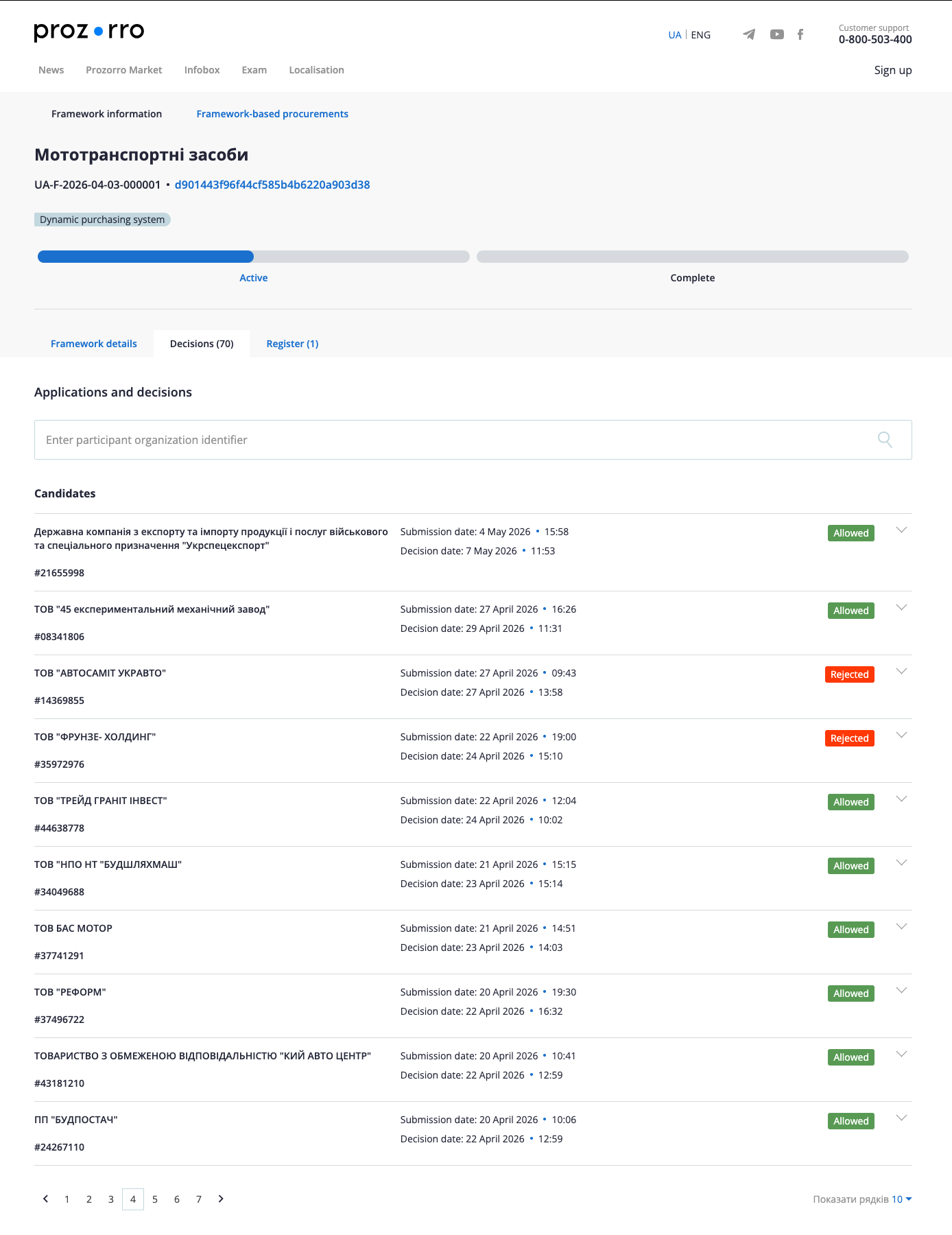
The list of selected suppliers also includes TRADE GRANITE INVEST LLC, which had previously supplied only food products for the AFU. The company was placed under DOT restrictive measures for one year for using an annulled canned goods testing protocol; however, a court overturned this decision, allowing the firm to resume participation in tenders.
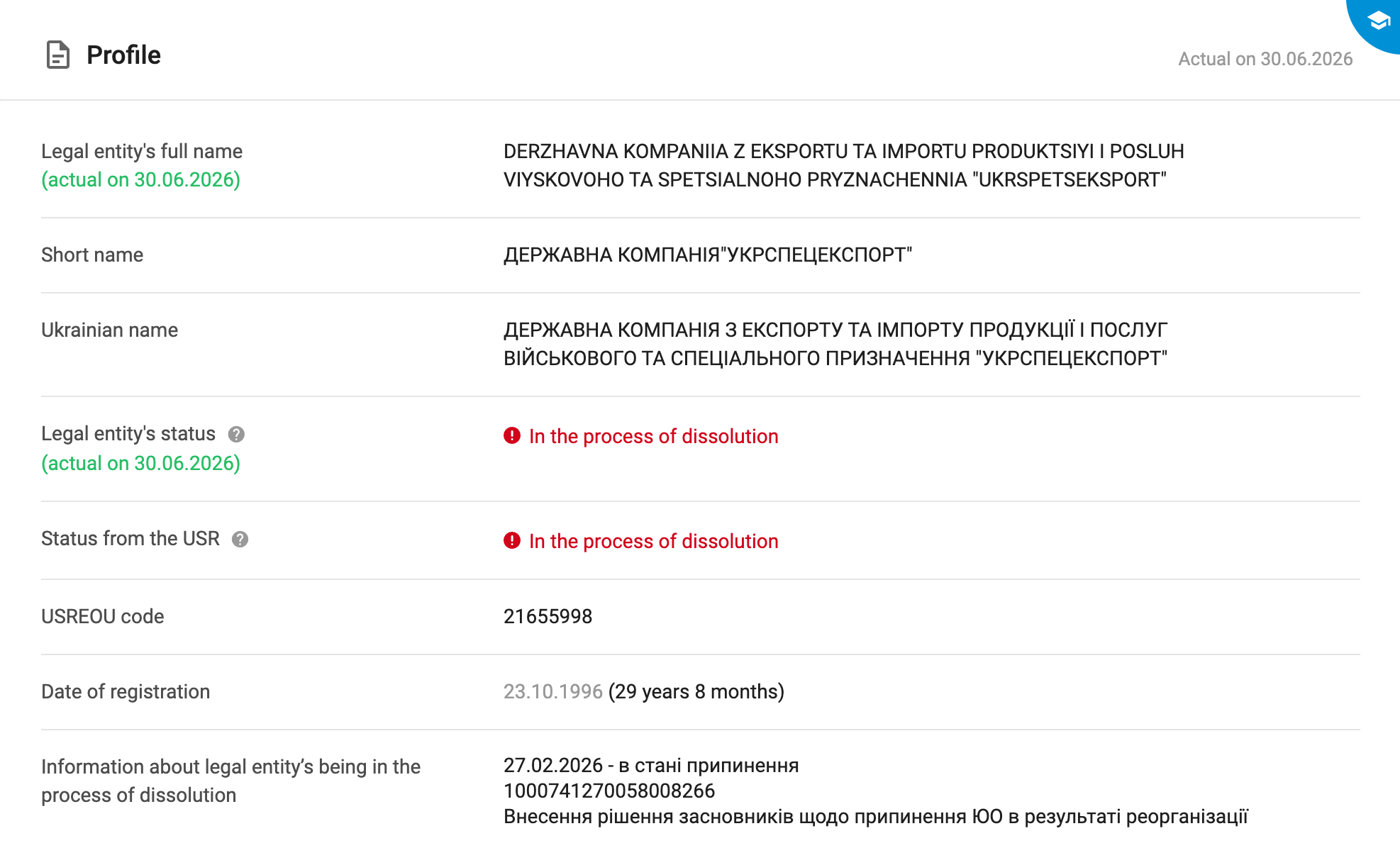
The list of selected firms also includes UKRSPECEXPORT, the State Company for export and import of military and special-purpose products and services, which has featured in scandals, including over the failed delivery of mines, and is currently undergoing dissolution.
UAV
In May, the government extended the experimental defence procurement project conducted through the DOT-Chain Defence system until 24 October 2027. The platform, which has already proven effective in meeting the needs of the Armed Forces and the National Guard, has been expanded: it is now also used by units of the State Border Guard Service and the National Police.
As of end-May, the military had received 485,000 units of UAVs and other equipment worth UAH 31.4 billion through DOT-Chain Defence in 2026. The platform offers almost 800 items from over 200 Ukrainian manufacturers. At the end of May, at the request of military personnel, warheads and munitions for unmanned systems were added to the marketplace. These are munitions for bombers, GRS units, and other platforms. This enables units to meet a wider range of drone-related requirements through the system. The time from order to delivery is 6 days, and the first deliveries have already been successfully made.
Separately in May, 18 contracts were concluded through Prozorro for the procurement of DJI Matrice-series reconnaissance UAVs, worth a total of UAH 872.5 million. In particular, 3,000 Matrice 4E drones were contracted at a price of UAH 146,738 per unit, and 2,375 units of the Matrice 4T model at UAH 183,195.
Also, according to MoD data, five times more medium-range middle-strike attack UAVs were contracted in the first months of 2026 than over the whole of the previous year. UAVs of this class are designed to strike targets at a distance of 30 to 200 km.
Having confirmed the combat effectiveness of this class, Ukraine has begun joint production of such UAVs with foreign partners – including Germany and Norway. Ukraine gains additional drones for the front, whilst its partners gain access to technology and accumulated combat experience.
Food Procurement
Key risks:
- systemic unsuccessful ration pack procurements due to non-fulfilment of contracts
- selection as winners of companies that have previously supplied food products at inflated prices
Food Procurement in May 2026
| Procurement Item | No. of contracts | Contract Value, UAH | Quantity | Weighted Average Unit Price, UAH |
|---|---|---|---|---|
| Catalogue food products | 3 | 4.5 billion | 36,332,300 | 123.2 |
| Ration packs | 1 | 12.6 million | 29,169 | 431.22 |
| Catering services | 2 | 10.8 million | 132,664 | 81.59 |
| TOTAL | 6 | 4.5 billion | – | – |
Ration Packs
In May, the Agency contracted 29,169 standard ration packs from KHODORIV MEAT PROCESSING PLANT LLC at a price of UAH 431.2 per unit. The procurement, comprising 6 lots, was announced at the end of April; however, a participant appeared in only one of them – KHODORIV MEAT PROCESSING PLANT LLC. The remaining 5 lots proved unsuccessful owing to the absence of participants.
This situation reflects a wider systemic problem: since 2024, of 201 lots announced for the procurement of ration packs, over 58% (117 lots) have proved unsuccessful or were cancelled. For further detail on the ration pack market and supply problems, see the StateWatch analysis “Procurement of Ration Packs for the AFU: Causes of Supply Failures and a Market Assessment”.
Catalogue Food Products
In May, DOT concluded 3 contracts for the supply of 36.3 million sets of food products under the Catalogue worth UAH 4.5 billion However, one of them – with FLAVAKOR LLC, for the supply of 28.5 million sets by the end of the year – was terminated in the same month owing to a technical error in the contract.
Two other contracts were concluded with GRAND CONSULT LLC for 5.2 million sets worth UAH 641 million, and with ADELIN LLC for 2.6 million sets worth UAH 314 million.
At the end of November 2025, when DOT first planned to contract Catalogue food products a year ahead, the ceiling prices of products rose by 8% compared with May 2025 procurements. Accordingly, the expected value of a set increased at the time to UAH 171.5, against UAH 155. In May 2026, the expected value remained at the same level; however, owing to strong competition, participants substantially reduced their bids: the average price of one set in concluded contracts came to UAH 123.2 – 28% below the expected value.
Amongst all active Catalogue contracts worth UAH 4.7 billion concluded in 2026, the largest supplier is GRAND CONSULT LLC – 4 contracts worth UAH 2.3 billion At the same time, the company features in a criminal case known as “eggs at UAH 17”. Until November 2024, the company’s owner was Tetiana Hlyniana, who, as of May 2026, is on the NABU wanted list.
In total, food and catering services contracts in May were concluded with 33 companies.
Food Suppliers in May 2026
| Supplier | No. of contracts | Contract Value |
|---|---|---|
| FLAVAKOR LLC | 1 | 3.5 billion |
| GRAND-CONSULT LLC | 1 | 641 million |
| ADELIN LLC | 1 | 314.1 million |
| KHODORIV MEAT PROCESSING PLANT LLC | 1 | 12.6 million |
| TRADING HOUSE ART TASTE LLC | 2 | 10.8 million |
| TOTAL | 6 | 4.5 billion |
Materiel
Key risks:
- insufficient scope of the Requirement for materiel for female service personnel
- family ties between tender participants
- selection as winners of companies that have previously supplied substandard products
In May, DOT concluded 33 contracts for the supply of materiel worth UAH 1.4 billion, with savings of UAH 70.8 million. Details of selected key procurements are set out in the table.
Materiel Procurement in May 2026
| Procurement Item | No. of contracts | Contract Value, UAH | Quantity | Weighted Average Unit Price, UAH |
|---|---|---|---|---|
| Combat helmet | 1 | 378.6 million | 40,000 | 9,466 |
| Modular body armour vest (configuration 1-11) | 2 | 376.7 million | 14,180 | 26,355 |
| Universal tarpaulin (armoured blanket) | 2 | 249.3 million | 10,000 | 24,927 |
| Folding pouch bag | 3 | 96.2 million | 250,000 | 382.98 |
| Modular body armour vest (configuration 1-5) | 1 | 89.8 million | 5,500 | 16,333 |
| Modular body armour vest (configuration 1-5, ZH) | 1 | 47 million | 2,000 | 23,520 |
| Winter hat | 5 | 42.5 million | 180,600 | 235.46 |
| Combat pouch bag | 2 | 37.3 million | 100,000 | 371.58 |
| Sleeping bag | 1 | 28.1 million | 7,000 | 4,014.96 |
| Other | 15 | 82.6 million | – | – |
| TOTAL | 33 | 1.4 billion | – | – |
Tenders Between Related Participants
Owing to a court appeal, the largest contract in the materiel category – worth UAH 378.6 million – was concluded with NVP TEMP-3000 LLC for the supply of 40,000 combat helmets.
The lowest price bid at the tender was submitted by LEADER STP LLC – helmets of the Kaska-2M model manufactured by NVP TEMP-3000 LLC, at UAH 9,300. At the same time, TEMP-3000 also entered the procurement with the same model, offering UAH 9,466 – 1.8% more expensive. Following the auction, LEADER STP LLC was named the winner; however, TEMP-3000 appealed this decision in court, citing the absence in the proposed set of the mandatory energy-absorbing element “O”. The court found the decision unlawful and overturned it – the contract was concluded with NVP TEMP-3000 LLC, 1.8% more expensive than the LEADER STP bid.
This is not the first instance of joint participation by these companies in the Agency’s tenders. In January 2026, LEADER STP LLC first appeared in DOT tenders. A month earlier, the company had been named “Temp-2000” and was part of the TEMP-3000 corporate group of Yurii Yevtushenko – its owner being his son, Hlib Yevtushenko. Following the group’s first tender win – a contract for 40,000 combat helmets worth UAH 295.84 mn – Hlib Yevtushenko exited the ownership structure, and the company left the corporate group. For further detail, see the April StateWatch monitoring report.
At the end of May 2026, following a series of joint procurements, Yurii Yevtushenko also exited the ownership structure of NVP TEMP-3000 LLC. The company’s new owner became JSC INDUSTRY INVEST UKRAINE, whose ultimate beneficial owner is Viacheslav Borshch, who resides in Slovakia.
In May, the same companies took part in a tender for the procurement of 6,000 body armour vests (configuration 1-11). LEADER STP LLC submitted the most advantageous bid – the Korsar M3mp-6 model manufactured by NVP TEMP-3000 LLC, at UAH 24,990 per unit. TEMP-3000 itself, by contrast, submitted the most expensive bid – UAH 29,650, 19% higher. As a result, the contract was concluded with LEADER STP LLC, worth UAH 149.9 mn.
Women’s Body Armour
In May, DOT concluded a contract for the supply of 2,000 women’s modular body armour vests (configuration 1-5) with a single tender participant – NVP TEMP-3000 LLC – at a price of UAH 23,520 per unit. Although this made it possible to close the Requirement for 2026, the quantity is far from sufficient: as of March 2026, the AFU comprised over 55,000 female service personnel alone.
The current specifications for the modular and lightweight models provide for an additional element under code “ZH” (stands for female) – damping inserts on the inner walls of the chest carrier, or other solutions adapting the body armour vest to female anatomy. Two models with this element are currently approved. The first – the Kharakternytsia model from UKRAINIAN ARMOUR LLC – features an outward-curved armour plate, narrowed shoulders, and an extended lower section. The second – from NVP TEMP-3000 LLC – is fitted with damping pads for individual adjustment to the female body. Both come in sizes ranging from S to XL (height from 162 to 190+ cm), with an overall weight of 10.5 to 15.5 kg.
Summer Field Uniforms
In May, the Agency managed to conclude a contract with TEXTILE-CONTACT LLC for the procurement of 8,000 summer field uniforms worth UAH 16.7 million. This was made possible after the expected value was raised by 8.5% to UAH 2,100 per unit.
In April, a tender for the procurement of 35,300 summer field uniforms at an expected value of UAH 1,936 did not proceed owing to the absence of participants. The likely cause was rising production costs, which made participation in the tender at the prevailing price economically unviable. The increase in the expected value in May made it possible to attract suppliers and resume contracting.
Goggles
The DOT continues to contract Chinese ballistic goggles. In May, the Agency procured 6,000 ballistic goggles worth UAH 4.8 million (UAH 800 per unit) from TS TRADE UKRAINE LLC, a distributor for the Chinese manufacturer Guangdong Yijia Optical Technology Co.
The company had previously had a negative experience working with DOT. In September 2024, TS TRADE UKRAINE LLC supplied 18,000 ballistic goggles with a mask from the same Chinese manufacturer; however, the goods did not meet the stated protective characteristics and did not provide adequate fragmentation protection. This is addressed in an SBI criminal case. The investigation also established that the MoD had sustained losses of UAH 25.7 million. Despite this, in February 2026 the Agency concluded a new contract with the same company – for 90,000 similar goggles at a price of UAH 680 per unit, 15% below the April price.
In total, materiel contracts in May were concluded with 33 companies.
Materiel Suppliers in May 2026
| Supplier | No. of contracts | Contract Value, UAH |
|---|---|---|
| NVP TEMP-3000 LLC | 2 | 425.7 million |
| UKRTAK.UA LLC | 2 | 316.6 million |
| LEADER STP LLC | 1 | 149.9 million |
| COMMERCE ARMOR LLC | 2 | 148.9 million |
| ANVA LLC | 2 | 139.6 million |
| DVI LLC | 1 | 56.9 million |
| GRIN-MODA LLC | 1 | 28.1 million |
| TACTIC T3 LLC | 1 | 22.6 million |
| Other (21 suppliers) | 21 | 139.8 million |
| TOTAL | 33 | 1.4 billion |
Petroleum, Oil and Lubricants (POL)
Key risks:
- dependence of contracts on fluctuations in global oil prices
POL Procurements in May 2026
| Procurement Item | No. of contracts | Contract Value, UAH | Quantity, tonne | Weighted Average Unit Price, UAH |
|---|---|---|---|---|
| Diesel fuel | 15 | 5.5 billion | 85,000 | 64,923 |
| Jet fuel RT | 2 | 641.1 million | 7,000 | 91,580 |
| Motor petrol A-95 | 4 | 458 million | 6,000 | 76,333 |
| Engine oil M-10G2k | 17 | 433.1 million | 400 | 1,346,245 |
| Motor petrol A-80 | 2 | 268.7 million | 5,000 | 53,700 |
| Engine oil M-6z/10V | 5 | 17 million | 100 | 169,640 |
| Transmission oil 80W-90 GL5 | 5 | 164 million | 100 | 171,998 |
| Other | 21 | 77 million | – | – |
| TOTAL | 71 | 7.4 billion | – | – |
In May, the Agency concluded 15 contracts with JSC UKRNAFTA for the supply of 85,000 tonnes of summer diesel at a price of UAH 64,923 per tonne, for delivery by the end of June. This is the highest diesel price in the Agency’s contracts since 2024. The jump was driven by a sharp rise in global oil quotations at the end of March amid escalating tensions in the Middle East.
As a reminder, in March suppliers had refused to sign fixed-price contracts – the situation was resolved following a transition to formula-based pricing indexed to the international Platts benchmark. For further detail, see the March monitoring report by StateWatch.
New contracts in the POL category are gradually transitioning to formula-based pricing indexed to Platts. In particular, in May 6,000 tonnes of A-95 petrol were contracted for UAH 458 million – at a price of UAH 76,333 per tonne, 32% higher than in February procurements (UAH 57,680). The contracts provide for indexation to Platts, allowing the price to be automatically adjusted in line with changes in the global oil market – unlike April contracts for A-95, which do not provide for this mechanism.
By contrast, contracts for 5,000 tonnes of A-80 petrol – worth UAH 268.7 million – do not provide for indexation to Platts. The price of this grade, after its April peak (UAH 59,830 per tonne), fell to UAH 53,700 in May – below even the February level (UAH 57,100).
Also in May, 41 contracts were concluded for the procurement of various lubricants worth UAH 525.8 million. These contracts likewise do not provide for formula-based pricing indexed to Platts.
In total, POL contracts in May were concluded with 7 companies.
POL Suppliers in May 2026
| Supplier | No. of contracts | Contract Value, UAH |
|---|---|---|
| JSC UKRNAFTA | 23 | 6.9 billion |
| RESURS-OIL-A LLC | 36 | 505.9 million |
| KSM-TRADE LLC | 4 | 16 million |
| NOXCHEM LLC | 5 | 12.7 million |
| ADIL OIL LLC | 1 | 3 million |
| PETROL PARTNER LLC | 1 | 3 million |
| ARIAN TECHNICAL OILS PLANT LLC | 1 | 2.9 million |
| TOTAL | 71 | 7.4 billion |
Recommendations Based on the Analysis of Challenges in May 2026
To the Ministry of Defence of Ukraine
Systemic Failures in Ration Pack Delivery
Develop a strategy for expanding the market of Ukrainian ration pack manufacturers.
Expected impact: competition in tenders will be strengthened and reliance on unreliable suppliers will be reduced.
To the DOT Defence Procurement Agency
Contracting of Companies Linked to Suppliers That Previously Breached Contract Terms
Expand the grounds for disqualifying tender participants: establish a qualification criterion based on affiliation with legal entities whose contracts with DOT have been terminated, with verification conducted through the beneficial ownership register.
Expected impact: unscrupulous participants will be prevented from succeeding at the qualification stage.
To the Antimonopoly Committee of Ukraine and the Ministry of Defence of Ukraine
Simultaneous Participation of Affiliated Companies within a Single Lot
Introduce verification of connections between tender participants through the unified beneficial ownership register.
Expected impact: collusion in tenders will be prevented and genuine competition will be ensured.
To the Logistics Forces Command of the Armed Forces of Ukraine
Insufficient Scope of Materiel Requirements for Female Service Personnel
Update the Requirement for winter materiel and individual body armour for female service personnel, considering the actual number of women serving in the armed forces.
Expected impact: any imbalance between the actual number of female service personnel and their level of provision will be avoided.
The StateWatch monitoring covers exclusively procurements published in the Prozorro electronic system. Accordingly, the sample does not include direct contracts and other procurements – particularly those for weapons and military equipment – information on which constitutes a state secret and/or was not published in the system. Consequently, the number of contracts and their total value presented in the monitoring reflect only a portion of the volume actually contracted.